

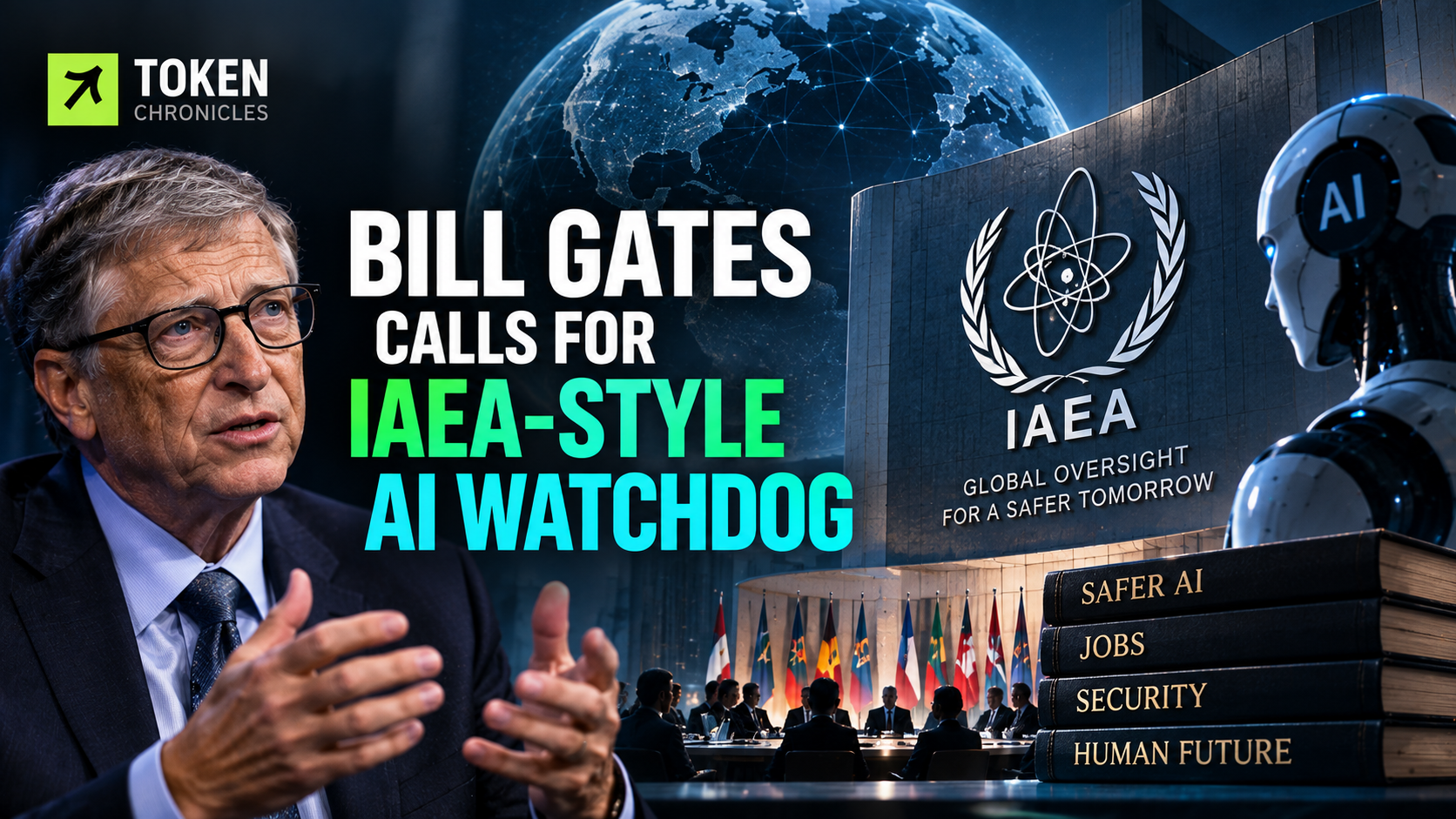
Microsoft co-founder Bill Gates is warning that artificial intelligence is advancing faster than governments and regulators can adapt. He argues that increasingly capable AI systems could disrupt employment, create new biological-security risks and affect human behavior, and is calling for stronger international oversight alongside new economic and legal safeguards.
- Gates warned that rapid AI deployment could create significant employment and security challenges.
- He supports an international watchdog modeled on the International Atomic Energy Agency (IAEA) for advanced AI.
- Gates proposed a compute-based “token tax” that could help finance worker retraining.
- He also suggested protecting certain human-focused professions from complete automation.
- His concerns include workforce disruption, AI-assisted biological threats and excessive reliance on AI companions.
Gates Warns AI Is Moving Faster Than Regulation
In an Aug. 27, 2026, interview with journalist Karen Weise, Gates argued that the pace at which companies are deploying AI has become one of the technology’s biggest challenges.
His concern extends beyond whether AI models become more capable. Gates believes the speed at which those systems are being integrated into workplaces, software and everyday services could leave governments struggling to establish appropriate safeguards.
He also pointed to a potential disconnect between the public optimism surrounding AI and the private concerns held by some technology executives. According to Gates, companies have strong financial incentives to continue investing heavily in computing infrastructure, data centers and increasingly powerful models, even when the social consequences remain uncertain.
Employment Could Face a Major Transformation
One of Gates’ primary concerns is the impact of automation on employment.
Unlike earlier technological shifts that took years or decades to reshape workplaces, modern AI tools can be introduced directly into existing computers, smartphones and cloud-based systems.
That could accelerate the replacement of certain tasks and occupations, particularly in white-collar industries.
Gates is especially concerned about entry-level and mid-career positions. These roles traditionally provide workers with experience that allows them to progress into more senior positions.
If AI eliminates too many of those opportunities, companies could eventually face a shortage of experienced professionals who traditionally developed their skills through those early-career positions.
The potential disruption also challenges the assumption that technology will automatically create enough new jobs to replace those it eliminates.
AI Could Create New Biosecurity Risks
Gates also highlighted biological security as another area requiring greater attention.
More advanced AI systems could potentially assist researchers with complex biological problems, but the same capabilities could theoretically be misused by individuals seeking to develop harmful biological agents.
Gates believes this possibility warrants international oversight before AI capabilities become significantly more powerful.
His concern is not that AI development will inevitably lead to biological attacks, but that increasingly capable systems could lower some of the technical barriers facing malicious actors.
AI Companions Raise Social Concerns
Another issue Gates identified is the growing use of AI as an always-available companion or personal assistant.
He warned that increasingly human-like digital interactions could have unintended effects on social behavior, particularly if people begin substituting AI relationships for human connections.
The concern extends beyond loneliness. Gates suggested that excessive dependence on AI systems could also affect independent thinking and the way people process information.
He views this as a gradual societal shift rather than a futuristic scenario that can simply be ignored.
Gates Wants an IAEA-Style AI Watchdog
Rather than leaving AI oversight entirely to individual technology companies, Gates has advocated for an international organization modeled partly on the International Atomic Energy Agency.
Such an institution could help governments assess highly capable AI systems and identify technologies that could present exceptional security risks before they are deployed on a large scale.
The concept reflects Gates’ broader argument that some AI capabilities may have consequences that extend beyond individual companies or national borders.
An international framework could potentially create common standards for evaluating powerful systems, particularly where their capabilities could be misused.
A Token Tax Could Help Fund the Transition
Gates has also proposed an economic response to AI-driven automation.
His idea of a compute-based “token tax” would place an additional cost on the computational resources used to automate human work. The revenue could potentially be directed toward programs that help workers retrain and transition into new occupations.
The proposal is intended to address a key imbalance: companies may capture much of the economic benefit from automation while workers and governments bear some of the adjustment costs.
A tax linked to AI computation could therefore serve both as a source of funding for workforce programs and as a mechanism for slowing extremely rapid substitution of human labor.
Some Work Could Remain Reserved for Humans
Gates has additionally suggested that certain professions should retain a stronger human role even as AI capabilities improve.
Fields involving caregiving, palliative care and sensitive psychological support are examples where human interaction, empathy and trust remain particularly important.
Rather than attempting to prevent AI from entering these areas entirely, policymakers could establish boundaries defining which responsibilities should remain under human control.
The approach reflects Gates’ view that technological efficiency should not always be the only measure used to determine whether a task should be automated.
From AI Enthusiasm to Accountability
Gates has described his own changing perspective on AI as evidence of how quickly the technology is progressing.
After being impressed by an early ChatGPT demonstration in 2022, he says he has since watched newer systems perform increasingly sophisticated tasks, including complex coding work.
That progression has shifted his focus from simply asking what AI can accomplish to considering who is responsible when powerful AI systems create harm or are misused.
For Gates, the central challenge is now the widening gap between AI capability and institutional preparedness.
His proposed combination of international oversight, economic incentives for responsible automation and protected areas of human work reflects an attempt to close that gap before increasingly capable AI becomes too deeply embedded in society to regulate effectively.