

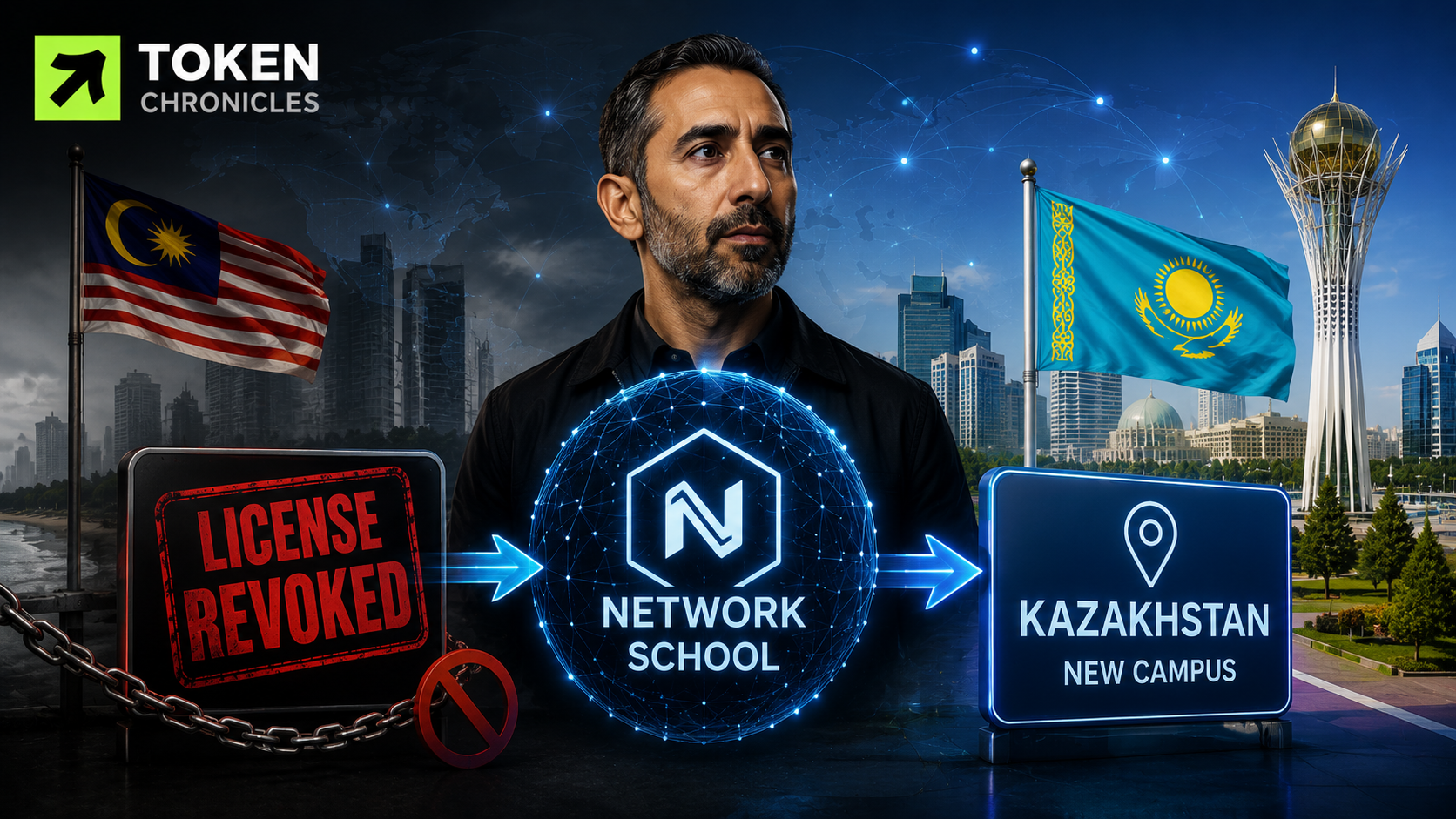
Balaji Srinivasan’s Network School is exploring Kazakhstan as a potential new base, signing an agreement to establish a campus in the country as its existing operation in Malaysia faces mounting regulatory challenges.
The development could mark a significant geographic shift for Srinivasan’s experiment in building globally distributed communities of technologists, entrepreneurs, investors, and digital nomads. It also comes as Kazakhstan seeks to position itself as an emerging destination for technology, digital assets, and internationally mobile talent.
Network School signs Kazakhstan agreement
A memorandum of understanding was signed between Srinivasan and Zhaslan Madiyev, Kazakhstan’s Minister of Digital Development, Innovation and Aerospace Industry, outlining plans to establish the first Network School campus in Kazakhstan.
The agreement does not necessarily mean a full campus is immediately operational, but it establishes a framework for further cooperation and gives Network School a potential alternative base as uncertainty surrounds its Forest City operation in Johor, Malaysia.
Srinivasan said the proposed campus would seek to attract globally mobile technology talent through policies such as expedited visas, easier redomiciliation, and active recruitment.
“Our new campus will become a haven for global techno-optimism,” Srinivasan said, outlining a vision for a more streamlined environment for entrepreneurs and technology professionals.
Kazakhstan pushes to become a technology and crypto hub
Kazakhstan’s interest in Network School fits into the country’s broader ambitions around technology and digital assets.
The country has been working to attract international technology companies, entrepreneurs, and crypto businesses while developing regulatory frameworks for the digital economy.
Kazakhstan has also outlined plans for a technology-focused development in Alatau, including ambitions around a so-called “crypto city” where digital assets could play a larger role in payments and economic activity.
For Network School, such government-level support could provide an opportunity to negotiate clearer operating conditions before committing significant capital to a new location.
That could be particularly important following its experience in Malaysia.
Malaysia campus faces business license revocation
The Kazakhstan agreement comes as Network School’s Forest City operation faces regulatory action from Malaysian authorities.
The Iskandar Puteri City Council reportedly revoked the business license of NSO Malaysia Sdn Bhd, the entity operating Network School in the country, citing alleged breaches involving licensing conditions and the permitted use of premises.
The regulatory action reportedly required the affected operation to cease activities.
The situation escalated when the Malaysia Digital Economy Corporation said it was beginning steps to revoke NSO Malaysia’s Malaysia Digital status.
Malaysia Digital status provides qualifying technology companies with various incentives and operational advantages, potentially including tax benefits, ownership flexibility, and support for employing domestic and international workers.
Losing that status could therefore have broader implications for Network School’s long-term operations in Malaysia.
Immigration questions add to regulatory pressure
The licensing dispute is not the only issue facing the organization.
Johor Chief Minister Onn Hafiz Ghazi has called for federal authorities to continue examining whether Network School complied with Malaysia’s immigration requirements.
Johor’s proximity to Singapore makes immigration enforcement particularly sensitive for authorities, especially when organizations host internationally mobile communities.
The scrutiny follows earlier controversy surrounding the Network School and the status of some foreign participants at its Forest City community.
Srinivasan has disputed the severity of the latest regulatory issues.
He said reports suggesting that Network School was completely shutting down were inaccurate and characterized the notices as remediable compliance matters.
According to Srinivasan, one issue involved signage, while another concerned a coworking space created by combining adjacent units where licensing coverage allegedly differed between the two premises.
He said the organization had been given time to address the issues and maintained that members were otherwise unaffected.
Kazakhstan move reflects the Network State strategy
The dispute has also renewed discussion around Srinivasan’s broader concept of the “network state.”
The idea proposes that digitally connected communities could organize around shared interests, accumulate economic resources and talent, establish physical communities in multiple locations, and eventually negotiate collectively with governments.
Dragonfly Capital managing partner Haseeb Qureshi argued that the Malaysia controversy may inadvertently demonstrate part of that thesis.
If a globally organized community can move talent and capital between jurisdictions, governments may effectively compete to offer more attractive regulatory, immigration, and economic conditions.
Under that model, a community facing difficulties in one jurisdiction does not necessarily disappear. Instead, it can negotiate with another government and potentially recreate its ecosystem elsewhere.
The Kazakhstan agreement could become an early real-world test of that strategy.
For Network School, however, the immediate challenge will be converting the memorandum into a functioning campus while resolving or navigating its regulatory difficulties in Malaysia.
If Kazakhstan ultimately provides favorable immigration rules, regulatory certainty, and operating conditions, the move could demonstrate how globally mobile technology communities increasingly negotiate directly with jurisdictions rather than committing permanently to a single geographic base.