

Artificial intelligence could be moving from a crypto research assistant to an autonomous portfolio manager, with a new survey suggesting that a large majority of US crypto traders are open to letting AI make investment decisions on their behalf.
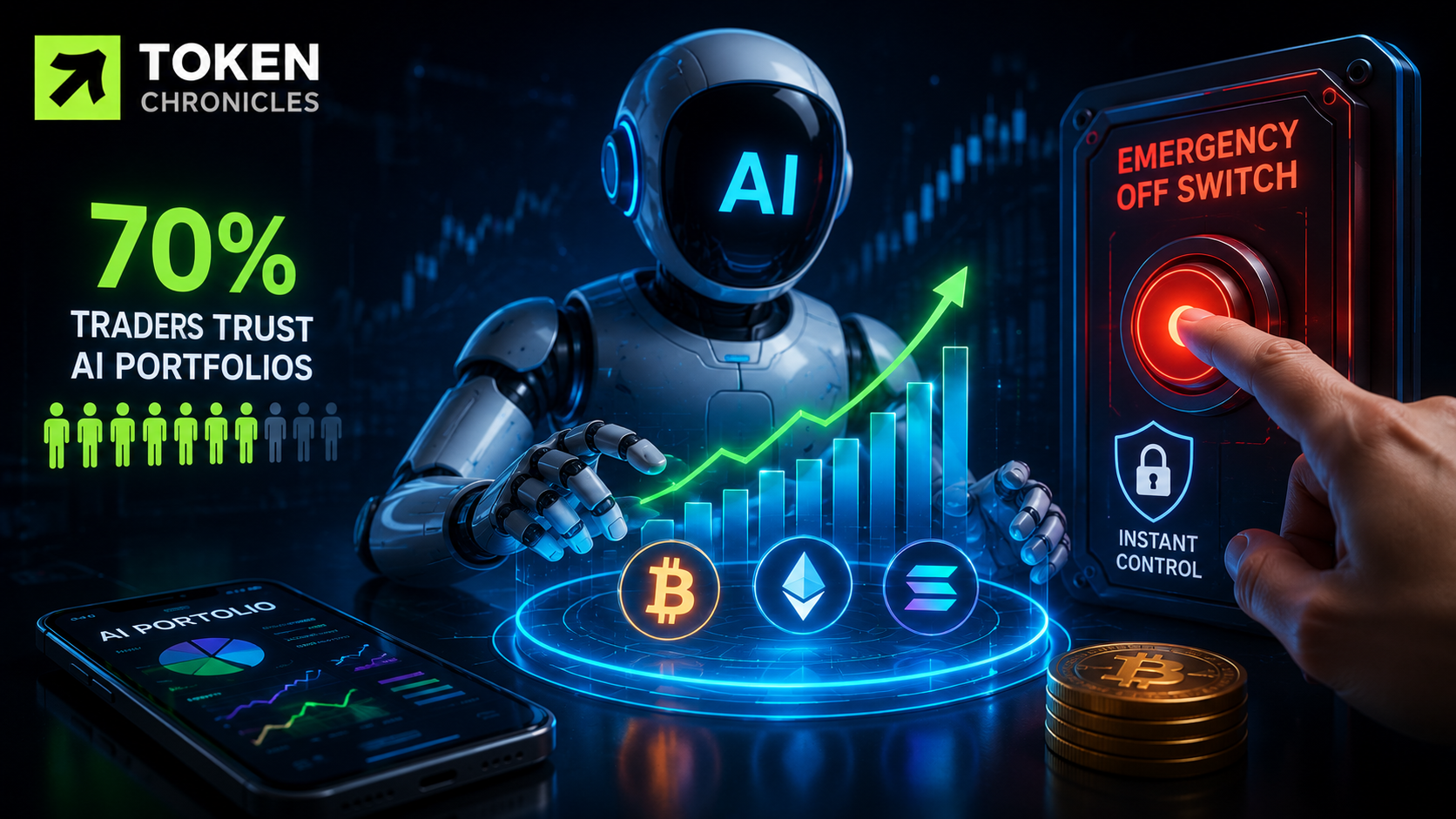
A survey of 1,400 US crypto traders found that roughly 70% of respondents would be comfortable allowing AI to manage their portfolios either autonomously or within predefined risk limits. However, traders overwhelmingly want one critical safeguard: the ability to immediately stop the AI and revoke its permissions.
The findings highlight an emerging tension in AI-powered finance. Investors appear increasingly willing to delegate decision-making to autonomous systems, but they still want ultimate control when markets behave unexpectedly.
Traders turning comfortable with Autonomous AI
According to survey results published by OKX, around seven in ten respondents said they would consider allowing an AI system to manage their crypto portfolio without requiring human approval for every transaction.
That group includes traders willing to give AI complete autonomy as well as those who would allow automated trading within predefined parameters, such as portfolio allocation limits, maximum losses, approved assets, or risk thresholds.
This represents a significant evolution from how AI is currently used by many investors.
Today, AI tools are primarily used to analyze markets, summarize information, identify trading opportunities, interpret data, and support investment research. Agentic AI could go considerably further by executing decisions itself.
An autonomous trading agent could potentially monitor markets continuously, rebalance portfolios, execute trades, respond to volatility, and manage risk without waiting for manual instructions.
Younger traders show greater willingness to give AI full control
Generational differences were particularly noticeable.
According to the survey, 38% of Gen Z respondents and 37% of millennials said they would be willing to give AI complete, unsupervised control over portfolio decisions.
Among baby boomers, that figure was just 11%.
The difference suggests younger investors may be more comfortable treating AI as an active financial operator rather than simply an analytical tool.
AI-assisted investment research is already becoming common among respondents.
About 51% said they use AI tools for research or trading several times per week, while 77% reported using a general-purpose chatbot to research a crypto investment during the previous three months.
As these tools become integrated directly into exchanges, wallets, and trading platforms, the boundary between AI providing advice and AI taking action could increasingly disappear.
Investors want an instant kill Switch
Despite growing enthusiasm for automation, traders were clear about one requirement: they want to be able to regain control immediately.
When respondents were asked what would increase their trust in an AI agent capable of making crypto transactions, real-time notifications and instant permission revocation emerged as the strongest preference.
This suggests that users may not necessarily view autonomy and control as opposites.
Instead, investors may be comfortable giving AI substantial independence as long as they retain the ability to intervene instantly.
Such controls could become particularly important in crypto markets, which operate continuously and can experience extreme volatility within minutes.
A practical AI trading system might therefore need safeguards such as spending limits, approved-token lists, maximum position sizes, withdrawal restrictions, real-time alerts and a one-click emergency shutdown mechanism.
AI is another competitor for Crypto Exchanges
Advanced AI functionality could also influence where traders choose to hold and trade their assets.
According to the survey, 79% of respondents said they would consider switching exchanges to access better AI-powered tools.
That creates a potentially significant competitive opportunity for crypto platforms.
Future exchanges may compete not only on trading fees, liquidity, token listings and user experience, but also on the intelligence and autonomy of their embedded AI systems.
Users could eventually deploy personalized agents capable of executing portfolio strategies around the clock.
However, the platforms offering the most autonomous systems may also face greater responsibility for ensuring those agents behave predictably and securely.
Regulators warn AI trading creates new risks
As autonomous trading technology develops, regulators are increasingly examining how existing financial rules apply when AI systems make investment decisions.
US lawmakers have sought greater clarity from the Securities and Exchange Commission over how securities regulations should apply to agentic AI used for trading and investment activities.
Regulators are particularly concerned about accountability.
If an autonomous agent executes an unsuitable trade, acts on fabricated information, exceeds its authority, or causes significant investor losses, determining responsibility could become complicated.
Is the user responsible?
The AI developer?
The exchange?
The company deploying the agent?
These questions could become increasingly important as AI moves from recommending trades to actually executing them.
Fraud and AI hallucinations add another layer of risk
Financial regulators have also warned that criminals are exploiting enthusiasm around artificial intelligence to promote fraudulent trading platforms and investment schemes.
Scammers can market supposedly advanced “AI trading bots” that promise unusually high returns with limited risk, even when the underlying systems have little genuine AI capability.
Another concern is the reliability of AI-generated financial information.
Large language models can generate incorrect or fabricated information, meaning an autonomous system acting on inaccurate data could potentially make poor investment decisions at machine speed.
Regulators therefore continue to encourage investors to verify important financial information against reliable primary sources rather than relying exclusively on chatbot-generated analysis.
Autonomous trading could create broader market risks
The risks may eventually extend beyond individual investors.
If millions of AI trading agents use similar models, datasets, and strategies, they could respond to market events in similar ways.
During periods of extreme volatility, large numbers of autonomous systems could potentially buy or sell simultaneously, amplifying price movements and liquidity shocks.
Bank of England Deputy Governor Sarah Breeden has previously suggested that increasingly autonomous financial systems may eventually require safeguards resembling circuit breakers or emergency “kill switches.”
Interestingly, that concern closely mirrors what traders themselves appear to want.
The future of AI-powered investing may therefore depend on balancing two seemingly competing objectives: giving machines enough autonomy to act quickly and intelligently while ensuring humans can immediately regain control when something goes wrong.
For crypto markets, where trading never closes and volatility can emerge without warning, that emergency off switch could become one of the most important features of the autonomous investing era.