

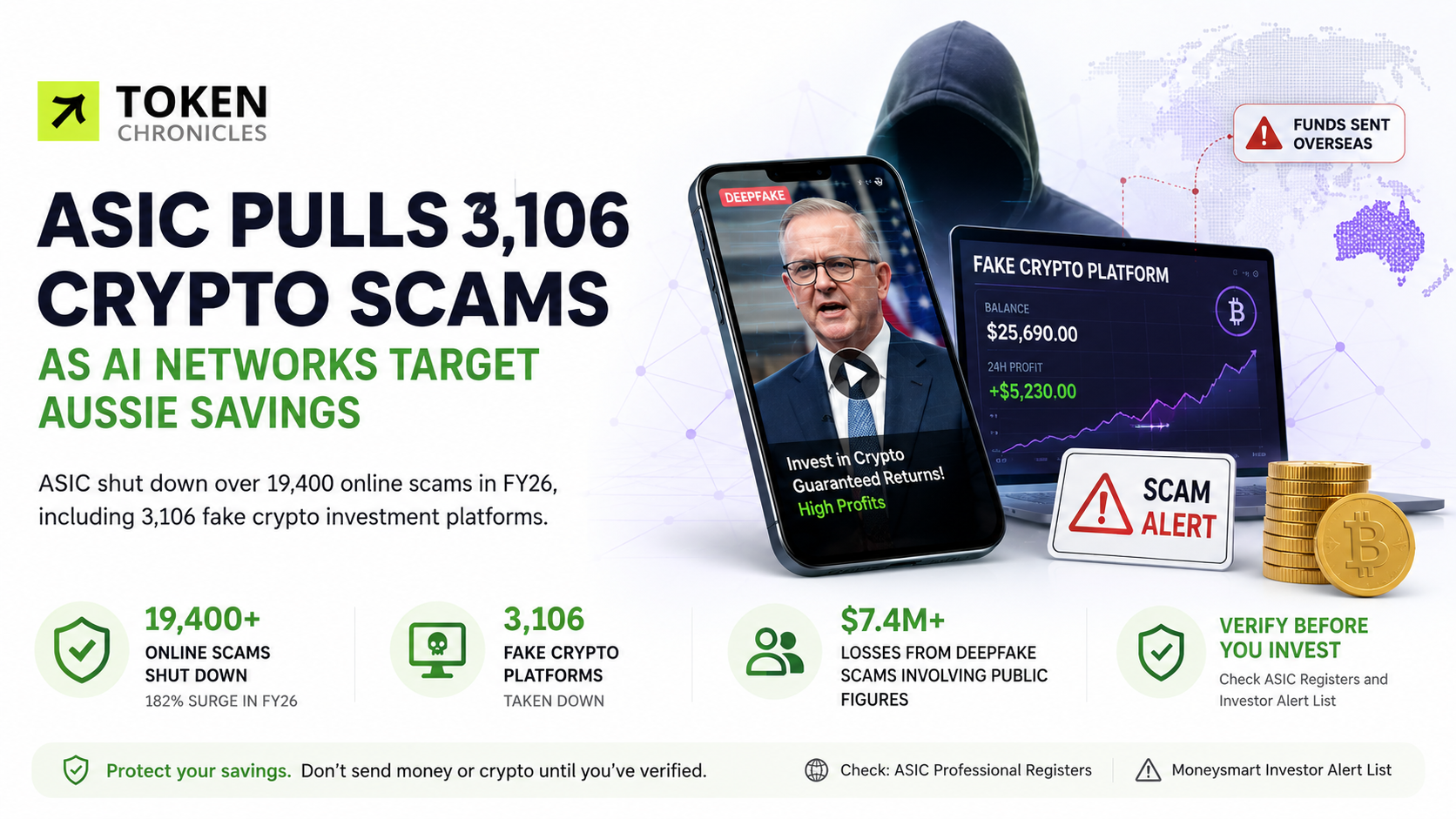
Australia’s financial regulator has stepped up its crackdown on online investment fraud after shutting down more than 19,400 scam websites, platforms and other malicious online operations during FY2026.
Among them were 3,106 cryptocurrency investment scams, as fraud networks increasingly use generative AI, deepfake videos and fabricated online identities to make fraudulent investment opportunities appear legitimate.
The Australian Securities and Investments Commission (ASIC) said the scale and sophistication of these scams are increasing, making it harder for consumers to distinguish legitimate investment opportunities from carefully engineered fraud.
AI Is Making Crypto Scams More Convincing
According to ASIC, investment scammers are moving beyond simple fake websites and are now creating interconnected digital ecosystems designed to build credibility and trust.
Potential victims may initially encounter a cryptocurrency investment advertisement through social media. After clicking the advertisement, they can be directed to a professionally designed investment platform featuring fake trading dashboards, fabricated news coverage, testimonials and positive online reviews.
Some schemes use AI-generated videos and deepfakes of politicians, celebrities and financial commentators to falsely promote investment platforms or automated crypto-trading systems.
The scammers may also create fake media websites and articles that appear to independently verify the investment opportunity. AI-generated comments and reviews can then provide additional artificial “social proof.”
In some cases, victims are initially shown small profits on fake dashboards. Once confidence has been established, they are encouraged to deposit significantly larger amounts.
When the victim attempts to withdraw the funds, the platform may demand additional payments or simply become inaccessible. The money or cryptocurrency has often already been transferred to overseas criminal networks.
Public Figures Are Being Used to Build Trust
The National Anti-Scam Centre reported that several prominent Australians were among the most frequently impersonated individuals in investment scams during FY2026.
Those targeted included Prime Minister Anthony Albanese, financial commentators Tom Piotrowski and Alan Kohler, among other public figures.
Reported losses associated with impersonation scams involving these figures exceeded $7.4 million.
The use of recognizable public figures is particularly effective because scammers can exploit existing public trust. AI-generated video, audio and imagery can make fraudulent endorsements appear increasingly authentic.
ASIC Chair Sarah Court warned that advances in generative AI are making investment scams more difficult for ordinary consumers to identify.
A professional-looking website, familiar branding or convincing video endorsement should therefore not be treated as evidence that an investment platform is legitimate.
Fake Licenses Add Another Layer of Deception
Scammers are also increasingly using legitimate Australian financial credentials to make fraudulent platforms appear credible.
ASIC said criminals may fabricate or misuse Australian Financial Services Licence information and present it alongside fake company details, creating the impression that an investment platform is regulated.
This can be particularly effective because many investors assume that the presence of a license number automatically confirms legitimacy.
ASIC recommends checking the information independently rather than relying on details provided by the investment platform itself.
How Investors Can Protect Their Money
ASIC and Scamwatch are urging Australians to independently verify any investment opportunity before sending money or cryptocurrency.
Investors should:
- Check the company through ASIC’s official Professional Registers.
- Confirm that the entity is actually licensed to provide the financial services it is offering.
- Verify that the company’s contact information matches the official regulatory records.
- Search ASIC’s Moneysmart Investor Alert List for warnings involving the company, website or domain.
- Avoid sending cryptocurrency or money simply because an online personality appears to endorse the opportunity.
- Treat unusually high or guaranteed returns as a major warning sign.
- Be skeptical of testimonials, reviews and trading profits displayed only on the platform itself.
- Avoid sharing personal information or financial credentials with unverified investment services.
A search engine result, social media advertisement or AI-generated endorsement should never be considered sufficient proof that an investment platform is regulated.
ASIC Has Removed More Than 33,000 Malicious Links
The latest crackdown forms part of a broader effort by Australian authorities to remove fraudulent investment infrastructure from the internet.
ASIC said it has taken down more than 33,400 malicious links, fake investment platforms and social media advertisements over the past three years.
However, regulators acknowledge that many scam operations are based overseas and can quickly recreate websites, domains and social media accounts after being removed.
That makes prevention particularly important.
The growing use of generative AI means scammers can now produce convincing videos, websites, written content and fake customer interactions at a scale that was previously difficult and expensive to achieve.
The Bigger Threat for Crypto Investors
The latest ASIC figures highlight a broader challenge facing the cryptocurrency industry.
Blockchain transactions can move money across borders quickly, while fraudulent platforms can be established and replicated at relatively low cost. Combined with AI-generated content, these characteristics create an environment where sophisticated scam networks can operate at enormous scale.
For investors, the lesson is straightforward: technology can make a scam look legitimate without making it legitimate.
A convincing deepfake, a professional website, a fabricated license or a fake trading balance can all be manufactured.
Independent verification through official regulatory channels remains one of the strongest defenses.
As AI continues to improve, the ability to distinguish genuine investment opportunities from highly convincing digital deception is likely to become an increasingly important part of crypto investor protection.