
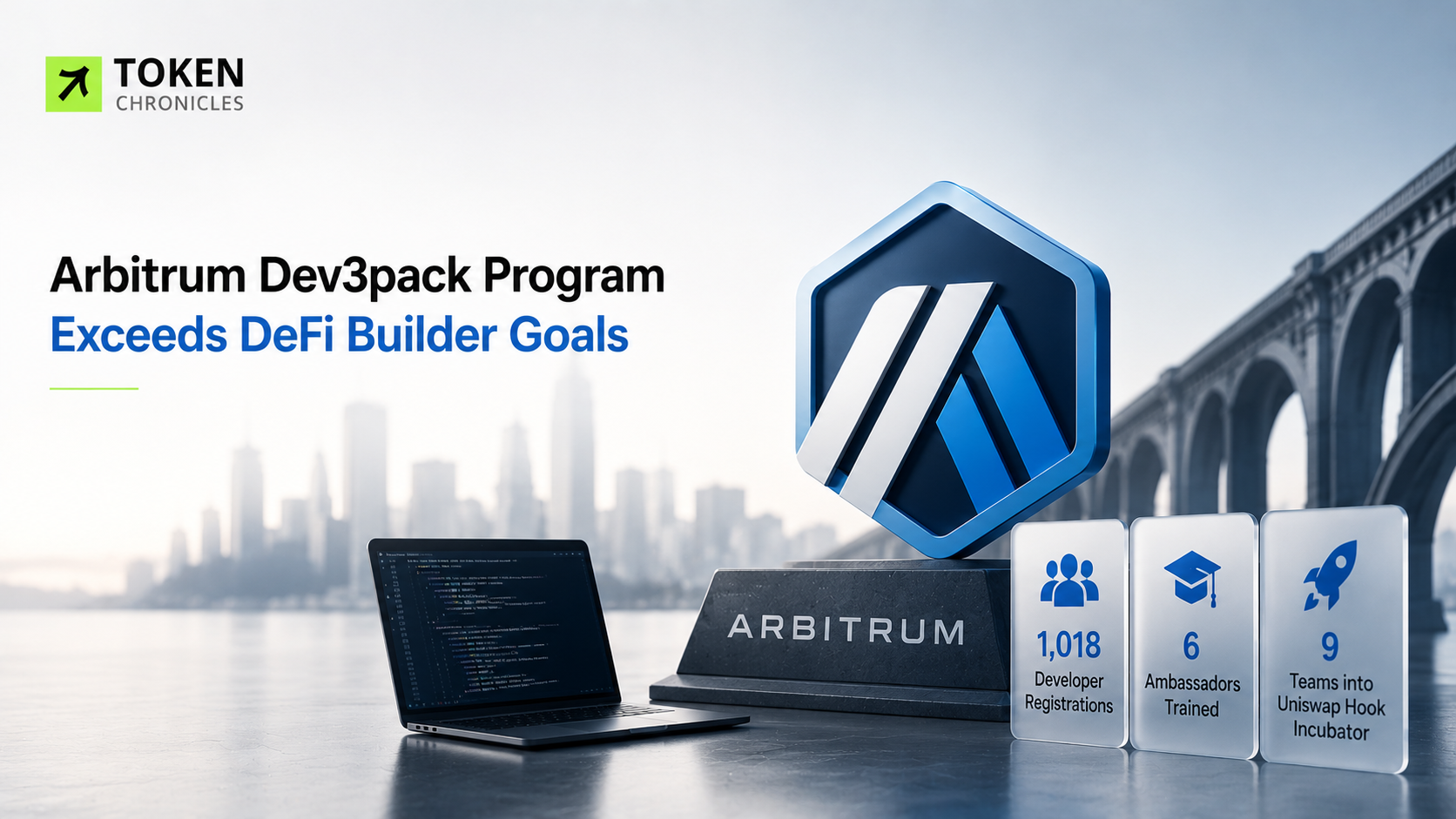
Arbitrum’s grant-backed Dev3pack DeFi Builder Club has published its final performance report, showing that the developer education initiative exceeded several of its key objectives and providing the Arbitrum DAO with measurable data to evaluate the effectiveness of ecosystem grant funding.
According to the report shared on the Arbitrum governance forum, the programme recorded 1,018 developer registrations, trained six community ambassadors, and helped nine developer teams progress into the Uniswap Hook Incubator, demonstrating tangible outcomes from the DAO-funded initiative.
While the figures represent the results of a single educational programme rather than the overall growth of Arbitrum’s developer ecosystem, the report offers valuable insight into how grant-funded initiatives can contribute to long-term ecosystem development.
Developer Education Delivers Measurable Results
The Dev3pack programme was designed to introduce developers to decentralised finance (DeFi) development on Arbitrum through workshops, bootcamps and technical education.
Over the course of the initiative, more than 1,000 developers registered for the programme, while selected participants received additional training to become community ambassadors capable of supporting future educational efforts.
Perhaps the most significant outcome was the progression of nine developer teams into the Uniswap Hook Incubator, where they can continue building more advanced DeFi applications using Uniswap’s latest infrastructure.
Rather than measuring success solely through attendance numbers, the programme demonstrated that a portion of participants advanced towards building real blockchain products.
Grant Reports Improve DAO Accountability
For decentralised autonomous organisations (DAOs), measuring the impact of treasury spending remains one of governance’s biggest challenges.
DAOs regularly allocate millions of dollars to support developer education, infrastructure projects, public goods, research and ecosystem incentives. However, evaluating whether those grants deliver meaningful results has often proven difficult.
Some funded projects fail to meet expectations, while others provide only limited transparency regarding their outcomes.
Final reports such as Dev3pack’s create an important accountability mechanism by allowing governance participants to compare promised objectives with actual results.
Rather than relying on proposals alone, delegates can assess concrete performance indicators before deciding whether similar initiatives deserve future funding.
Building Developers Is a Long-Term Investment
Although liquidity incentives often receive the most attention in blockchain ecosystems, developer growth remains one of the strongest indicators of long-term network health.
Financial incentives can attract capital temporarily, but sustainable ecosystems require builders who continuously develop new decentralised applications, infrastructure and user experiences.
Programmes like Dev3pack aim to strengthen that foundation by helping new developers acquire the technical skills needed to build on Arbitrum.
While educational initiatives rarely generate immediate increases in total value locked (TVL) or token prices, they can contribute to the long-term pipeline of projects launching on the network.
Competition for Developers Is Intensifying
Arbitrum operates in an increasingly competitive Layer-2 landscape.
Major blockchain ecosystems including Base, Optimism, Solana, Polygon, Avalanche and BNB Chain are all investing heavily in attracting developers through grants, incubators, hackathons and technical support programmes.
As competition for developer talent grows, blockchain networks can no longer rely solely on financial incentives.
Developer education, mentorship and incubation programmes are becoming increasingly important tools for building sustainable ecosystems capable of supporting long-term innovation.
Progress Into the Uniswap Hook Incubator Adds Value
One of the report’s most notable achievements was the successful transition of nine teams into the Uniswap Hook Incubator.
The incubator focuses on projects building with Uniswap v4 Hooks, a major upgrade that enables developers to customise liquidity pools with programmable features such as dynamic fee structures, automated execution logic and application-specific trading functionality.
Advancing participants into a specialised incubation programme suggests that the initiative extended beyond introductory education and helped developers continue towards building production-ready DeFi applications.
Although not every participating team will ultimately launch a successful protocol, creating a structured pathway from education to product development represents a meaningful outcome for ecosystem growth.
One Programme Does Not Define the Entire Ecosystem
Despite the positive results, the report should be viewed within its proper context.
The achievements reflect the performance of a single grant-funded educational initiative rather than the overall state of Arbitrum’s developer ecosystem.
They do not necessarily indicate that every ecosystem grant produces similar outcomes or that developer activity across the entire network has accelerated at the same pace.
Instead, the report provides governance participants with another useful data point when evaluating future treasury spending.
Transparent Reporting Strengthens DAO Governance
As blockchain ecosystems continue allocating significant resources to developer growth, transparency and measurable performance will become increasingly important.
Clear reporting allows DAOs to identify successful programmes, improve future funding decisions and strengthen accountability across ecosystem grants.
Rather than assuming every grant delivers value—or dismissing grant programmes altogether governance becomes more effective when decisions are based on measurable outcomes.
Dev3pack’s final report demonstrates that structured developer education can produce tangible results, offering Arbitrum delegates a clearer framework for assessing future ecosystem investments.
While builder programmes may not generate the same headlines as major protocol launches, they remain an essential part of developing a competitive Layer-2 ecosystem capable of sustaining long-term innovation in decentralised finance.