

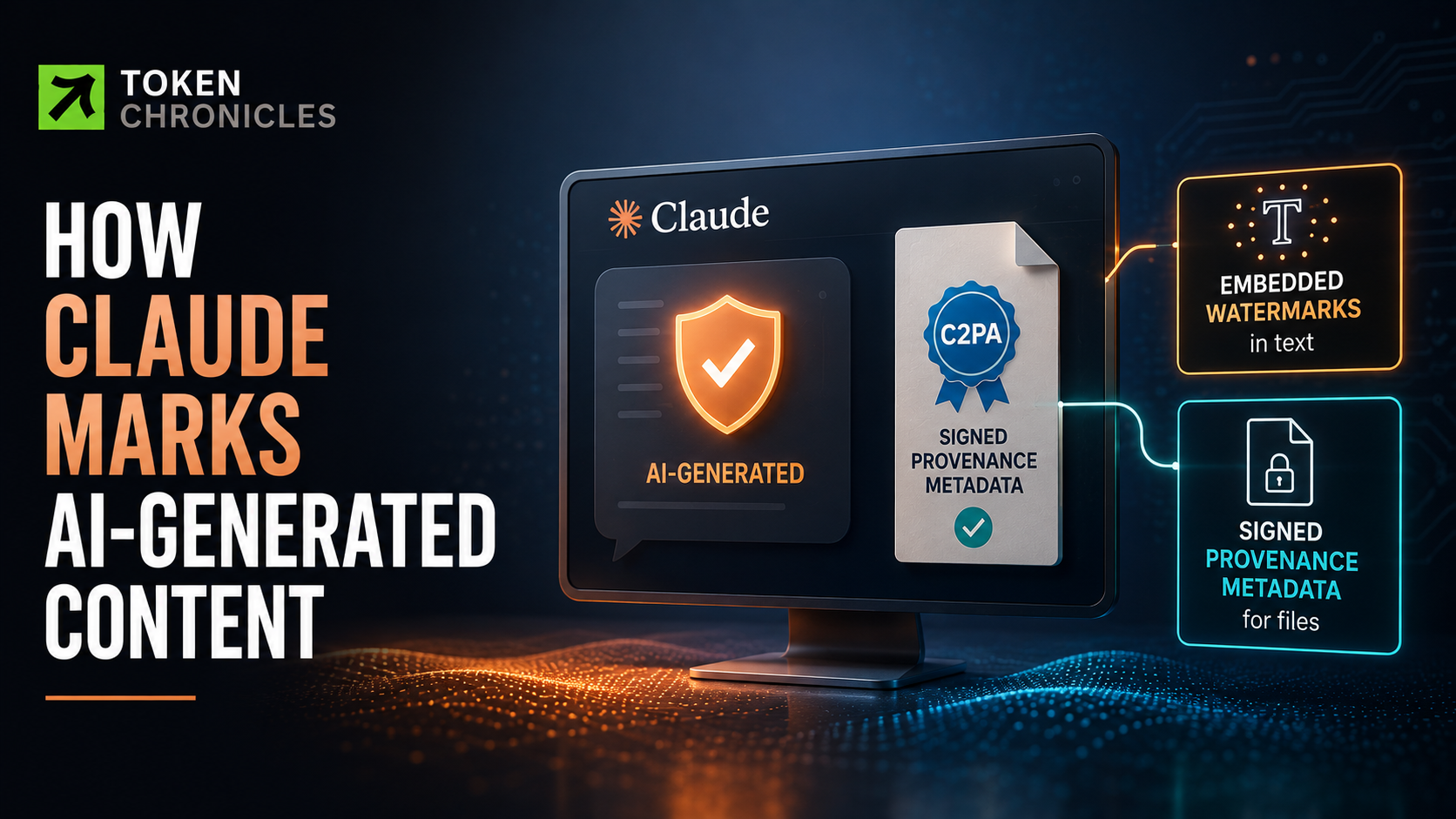
Anthropic has signed the EU AI Act’s Article 50(2) Code of Practice on Transparency of AI-Generated Content and is preparing to introduce machine-readable markers across Claude-generated content.
The company says the system will combine embedded text watermarks with digitally signed provenance metadata for supported files, giving users and third parties additional signals about whether content has been generated or processed by Claude.
The initiative is designed to improve transparency around AI-generated material while helping Anthropic and its users meet emerging regulatory requirements in the European Union.
New Claude Models to Include AI Marking From Launch
Anthropic says Claude models launched in the EU on or after August 2, 2026 will support machine-readable marking from the beginning.
Generated text will contain embedded watermarks, while supported files can include digitally signed provenance information.
The markings are expected to apply across Anthropic’s major Claude products, including:
- Claude
- Claude Platform and API
- Claude Code
- Claude Cowork
- Claude Tag
Anthropic also says the marking system will apply globally wherever supported Claude models are available, rather than being restricted exclusively to European users.
Older Claude models released before August 2, 2026 are covered by a transition period under the EU rules. Anthropic says it is working to add comparable marking capabilities to those models as well.
Claude Will Use Two Types of Content Markers
Anthropic’s approach relies on two complementary technologies.
1. Invisible Watermarks for Generated Text
Supported Claude models will embed an imperceptible watermark directly into generated text.
The watermark will not be visible to users and is designed not to affect the meaning, readability or quality of the content.
Because the marker is embedded at the model level, Anthropic says it should remain associated with Claude-generated text regardless of which Claude product is used to generate it.
The watermark may also survive basic copying and pasting and some forms of editing, although extensive modifications could make detection more difficult.
2. Signed Provenance Metadata for Files
For supported file formats such as PNG, JPG and SVG, Claude will attach digitally signed provenance metadata.
The metadata will use the Coalition for Content Provenance and Authenticity (C2PA) standard, an open framework increasingly used to record the origin and history of digital content.
A valid provenance record can indicate that a file was processed by Claude and can help determine whether the associated metadata has been altered.
The availability of signed metadata may vary depending on the platform and file-processing capabilities involved.
Cloud Platforms May Support Different Marking Features
Anthropic says embedded text watermarks will also apply when supported Claude models are accessed through major cloud platforms, including AWS, Google Cloud and Microsoft Foundry.
However, signed provenance metadata may not be available in every environment.
The difference is largely dependent on the capabilities offered by individual platforms and the way they handle generated files.
Anthropic Plans Detection Tools
Marking content is only one part of the system.
Anthropic is also working on mechanisms that will allow users, developers and other third parties to detect Claude’s watermarks and provenance metadata.
A detection system could examine a piece of text or a file and determine whether it contains a supported Claude marker.
Anthropic says additional technical information about these detection mechanisms will be released in future documentation.
A Claude Mark Is Not Definitive Proof of Original Authorship
Anthropic emphasizes that content marking has important limitations.
Detecting a Claude marker indicates that content may have been processed by Claude, but it does not necessarily prove that Claude created the underlying material.
For example, a user could provide an original document to Claude for:
- Editing
- Translation
- Summarization
- Formatting
- Rewriting
The resulting content could contain a Claude marker even though the original ideas and information came entirely from the user or another source.
Content can also be modified after Claude processes it, potentially changing its provenance or combining it with material from other sources.
As a result, a detected mark should be treated as a provenance signal rather than definitive proof of authorship.
No Marker Does Not Mean Content Wasn’t Created by AI
The reverse is also important.
If a Claude marker cannot be detected, that does not necessarily mean the content was not generated or processed using AI.
Several factors can remove or weaken a marker.
These include:
- Older Claude models that did not support marking
- Heavy editing or paraphrasing
- Translation into another language
- Very short pieces of text
- Combining AI-generated material with human writing
- File conversions
- Screenshots
- Re-saving files
- Platforms or formats that do not support a particular marking method
This means AI-content detection will remain probabilistic rather than absolute.
What the New System Means for Developers
Companies building products with Claude will still need to evaluate their own obligations under Article 50 of the EU AI Act.
Anthropic says its marking infrastructure is intended to help developers meet their own transparency requirements, but businesses remain responsible for determining which rules apply to their specific products and services.
The company plans to publish additional technical documentation covering how its marking and detection systems work.
A New Layer of AI Transparency
Anthropic’s approach reflects a broader industry effort to establish reliable ways of identifying AI-generated content without relying entirely on conventional AI detectors.
Rather than simply asking whether a piece of content looks AI-generated, machine-readable provenance systems attempt to create a persistent signal tied directly to the generation or processing process.
The approach is not foolproof. Editing, translation, screenshots, format conversions and other transformations can weaken or remove these signals.
But as AI-generated text, images and files become increasingly common, provenance technology could become an important layer of digital transparency.
For Claude, Anthropic’s goal is to make AI-generated content machine-identifiable from the point of creation while giving users and developers tools to understand where content came from and how it was processed.