

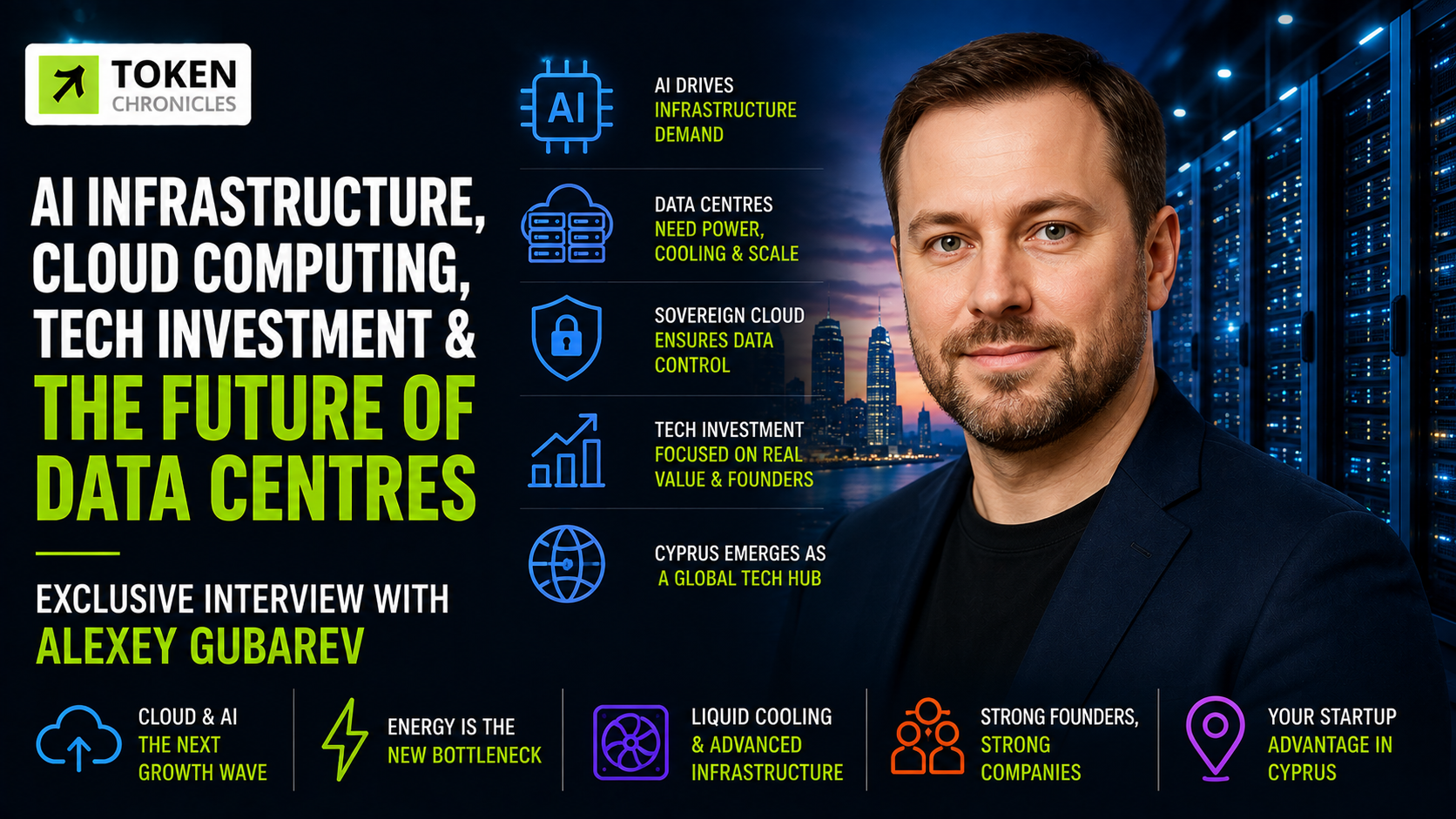
Technology entrepreneur and investor Alexey Gubarev has spent more than two decades building companies across cloud infrastructure, data centers, software and consumer technology. His entrepreneurial career includes founding Servers.com, a global infrastructure business that expanded from a small server operation into an international data-center platform before being acquired by CloudOne Digital in 2023.
Gubarev is also a co-founder of Palta, a consumer technology company whose portfolio includes businesses in health, wellness and AI-powered applications. Alongside his investment activities, he is involved with TechIsland, a nonprofit initiative focused on strengthening Cyprus as a technology ecosystem.
In a wide-ranging discussion, Gubarev reflects on the lessons of scaling infrastructure businesses internationally, the implications of AI for computing and energy demand, the emergence of sovereign cloud infrastructure, startup financing and Europe’s competitive position in technology.
He also discusses what investors should look for in founders, how AI could reshape startup economics and why regions outside traditional technology centers may become increasingly important.
From a 20-Server Startup to Global Infrastructure
Gubarev’s entry into technology began while he was studying at university, when he launched an internet business focused on online advertising.
In 2005, he founded Servers.com with only around 20 servers. The business was built around a relatively simple observation: traditional hosting providers often forced customers into inflexible packages that either provided more capacity than they needed or became insufficient as companies grew.
Servers.com took a different approach by emphasizing flexible bare-metal infrastructure that could expand alongside customers.
Geography was another major opportunity.
International companies needed infrastructure positioned close to their users, while data-residency and regulatory requirements were becoming increasingly important. Rather than concentrating infrastructure in a small number of locations, the company expanded its data-center footprint across multiple regions.
After approximately 18 years of development, CloudOne Digital acquired Servers.com in 2023 in a transaction valued at roughly $200 million.
For Gubarev, the experience demonstrated that international infrastructure businesses require both global consistency and local expertise.
A centralized engineering organization can maintain product quality and security, while regional teams understand local customers, regulations, payment systems and business practices.
Localization, he argues, therefore involves considerably more than translating a website. Successful expansion requires adapting operations to the realities of each market.
An Acquisition Should Create the Next Opportunity
Looking back at the Servers.com transaction, Gubarev says founders should think carefully about what an acquisition enables rather than viewing a sale simply as an exit.
His philosophy is that entrepreneurs should consider selling when a strategic buyer can provide resources, distribution or capabilities that allow the business to reach a scale that would be difficult to achieve independently.
The key question is therefore not simply how much money a founder can receive.
Instead, entrepreneurs should ask whether the transaction creates a stronger future for the company and its stakeholders.
AI Is Redefining the Economics of Data Centers
Artificial intelligence is changing the infrastructure industry at a much deeper level than previous waves of cloud adoption.
Traditional cloud workloads were heavily dependent on general-purpose CPUs. AI training and inference, by comparison, require enormous amounts of specialized GPU computing.
That shift is forcing infrastructure providers to rethink almost every part of their operations.
Data centers must accommodate:
- Much higher computing density
- Larger power requirements
- Advanced cooling systems
- High-speed networking
- Specialized AI accelerators
- Greater availability and reliability requirements
Gubarev believes the industry is moving toward an environment where infrastructure designed primarily for conventional computing will increasingly need to be redesigned around AI workloads.
But hardware availability may not remain the biggest constraint.
Power Could Become AI’s Biggest Bottleneck
As AI infrastructure expands, access to electricity is becoming a strategic issue.
A data center cannot operate without sufficient power, regardless of how many servers or GPUs are available.
In some markets, securing grid capacity can take longer than constructing the physical facility itself. That changes the economics of data-center development.
Electricity availability, energy pricing and grid connectivity are becoming important determinants of where new AI infrastructure can be built.
This creates a new competitive advantage for locations that can provide reliable, affordable and scalable energy.
It also explains why technology companies are increasingly exploring direct relationships with energy providers and alternative power-generation models.
Liquid Cooling and Dedicated Energy Infrastructure
Gubarev expects liquid cooling to become increasingly common as semiconductor density continues to rise.
Conventional air-based cooling becomes less practical as increasingly powerful processors generate greater amounts of heat within smaller physical spaces.
The next generation of AI infrastructure could therefore depend heavily on advanced liquid-cooling architectures.
Energy infrastructure is likely to evolve as well.
Instead of relying entirely on conventional electricity grids, large data-center operators may increasingly pursue dedicated or onsite generation, including renewable energy and other high-capacity power sources.
The result could be a closer relationship between the technology and energy industries than has existed in previous computing cycles.
Sovereign Cloud Is Becoming a Strategic Requirement
Another major trend Gubarev sees accelerating is sovereign computing.
Data residency was once primarily viewed as a regulatory requirement. Increasingly, governments and businesses see control over computing infrastructure as a strategic issue.
Governments may not want critical systems or sensitive information to depend entirely on infrastructure controlled by foreign technology companies.
Businesses face similar pressures as regulators demand greater visibility into where data is stored, processed and transferred.
Sovereign cloud infrastructure can address these concerns by providing computing resources within specific jurisdictions and under locally relevant legal and regulatory frameworks.
Gubarev expects this trend to expand across Europe, the Middle East and Asia as governments place greater emphasis on digital sovereignty.
Europe Has Capital – But Needs Speed
Gubarev believes Europe has many of the ingredients required to compete in AI and digital infrastructure, including capital, engineering talent and substantial industrial capabilities.
The problem, in his view, is execution speed.
Large infrastructure projects can encounter lengthy permitting processes, complicated regulations and slow connections to electricity networks.
Europe’s fragmented regulatory environment can also make expansion more difficult compared with markets where companies can operate under a more unified framework.
For Europe to become more competitive, he argues that policymakers should make it easier and faster to approve infrastructure, connect projects to power grids and deploy capital.
The challenge is therefore not simply raising more money. It is converting available capital into infrastructure and businesses quickly enough to compete internationally.
What Gubarev Looks for Before Investing
Having operated companies himself, Gubarev approaches venture investing differently from someone who has only evaluated businesses from the outside.
One of the most important lessons he emphasizes is founder diligence.
A compelling pitch and strong communication skills are not sufficient. Investors need to understand a founder’s history, reputation, decision-making and track record.
Trust becomes particularly important because startups operate under significant uncertainty. A founder who lacks integrity can create risks that financial models cannot capture.
Beyond the individual founder, Gubarev looks for evidence that the technology solves a genuine problem rather than simply benefiting from a temporary market narrative.
Real Problems Matter More Than Hype
For Gubarev, one of the clearest distinctions between durable technology companies and speculative trends is whether customers already recognize the underlying problem.
A technology becomes more compelling when it addresses an existing pain point for which businesses or consumers are already spending money.
By contrast, investments based primarily on assumptions about how people might behave years into the future carry considerably more uncertainty.
Timing matters too.
Even an excellent product can fail if its market is not yet prepared to adopt it.
The investor’s task is therefore to assess both technology quality and market readiness.
Founder Resilience Is a Major Investment Signal
Gubarev also places significant emphasis on resilience.
Technology companies rarely follow the plans outlined in their original business models. Supply constraints, regulatory problems, hiring challenges, competitive pressure and changes in customer behavior can all force startups to adapt.
As a result, he evaluates how teams behave when circumstances deteriorate.
A resilient founder can identify problems early, change direction when necessary and continue operating through difficult periods.
This means startup risk cannot be fully captured by metrics such as market size or projected revenue.
The quality of the team confronting inevitable obstacles can be just as important.
AI Could Make Startups Much Leaner
Artificial intelligence is also changing how technology companies are built.
AI-assisted programming is already allowing developers to produce software more quickly, while AI tools are increasingly being used for customer support, design, research, analytics and other functions.
That could fundamentally alter startup staffing models.
A company that once needed large teams for routine operational work may increasingly be able to perform those functions with a smaller workforce supported by AI systems.
For early-stage businesses, this could lower the cost of reaching product-market fit and allow small teams to compete with companies that previously required significantly larger organizations.
The advantage may increasingly go to startups that integrate AI into their operations from the beginning rather than adding it later.
Don’t Optimize for the Highest Possible Valuation
Gubarev also cautions founders against treating a high valuation as the ultimate measure of fundraising success.
A startup that raises capital at an ambitious valuation must eventually grow into that valuation.
If it fails to deliver, the next fundraising round can become considerably more difficult.
For founders, the better question may be how much capital is genuinely required to reach the next meaningful milestone.
Raising less money can preserve more ownership and give companies greater flexibility.
Investors, meanwhile, increasingly want to understand how and when a company can become economically sustainable rather than simply hearing a story about indefinite growth.
Consumer Technology Requires Both Science and Business Discipline
Gubarev’s experience with Palta has also shaped his perspective on consumer health and wellness products.
Technology in health-related markets cannot depend solely on attractive design or aggressive user acquisition.
Scientific credibility is critical.
Products need to combine sound underlying methodology with sustainable economics if they are going to serve large populations over the long term.
This balance becomes even more important as AI begins playing a larger role in consumer health applications.
Scaling to Millions of Users Requires More Than Translation
Moving from early adopters to a global audience presents a different challenge from building the original product.
Mainstream users generally do not want to understand the underlying technology. They expect products to work reliably, intuitively and consistently.
International expansion also requires genuine localization.
Different countries have different cultural expectations, regulations, payment methods and customer behaviors.
Simply translating an application into another language is therefore insufficient.
Companies that achieve global scale typically adapt the experience itself to the markets they enter.
Cyprus Is Emerging as a Technology Base
Gubarev is also closely involved with efforts to develop Cyprus as a technology destination.
He sees the country as increasingly attractive because of its business environment, taxation policies, lifestyle and growing technology community.
The island can offer an alternative to larger European technology centers for entrepreneurs and international companies seeking access to the European market.
However, continued growth also creates challenges.
Rapid migration of technology workers has placed pressure on:
- Housing
- Schools
- Transportation
- Public services
- Local infrastructure
Cyprus also has a relatively limited domestic supply of early-stage venture capital, meaning many startups still need to approach international investors.
Government digitization is another area where improvements could make the country more attractive to entrepreneurs and skilled professionals.
Efficient digital processes for company formation, residency and other administrative services can significantly affect the experience of international businesses.
The Next Opportunity May Be Outside Traditional Tech Hubs
One area Gubarev believes investors may be overlooking is regional and sovereign cloud infrastructure outside the established technology centers.
Much of the attention surrounding AI infrastructure is concentrated on major markets where hyperscale data centers are being built.
But other regions could become important as demand for computing grows.
The Eastern Mediterranean and parts of Central Asia, for example, could benefit from comparatively lower infrastructure costs, improving regulatory environments and increasing demand for digital services.
These markets may not immediately compete with the largest AI hubs in absolute scale.
However, their combination of geographic position, energy availability, infrastructure costs and emerging technology ecosystems could create attractive opportunities.
Success Is About Building Something That Lasts
After years of entrepreneurship and investing, Gubarev’s definition of success has shifted away from simply creating valuable companies.
He increasingly views success through the durability of what has been built.
A successful company, technology platform or community initiative should continue generating value even after its founder is no longer involved in every daily decision.
That philosophy connects his experiences across infrastructure, consumer technology, investment and ecosystem development.
The broader lesson is that technology cycles may change rapidly, but durable businesses are usually built around a few enduring principles: solving real problems, understanding customers, managing capital carefully, adapting to changing conditions and building infrastructure capable of supporting long-term growth.
As AI accelerates demand for computing, energy and digital infrastructure, those principles may become even more important.
The next phase of the technology economy may not be defined solely by better AI models. It could be defined by who controls the computing, energy, data and infrastructure required to make those models useful at global scale.