

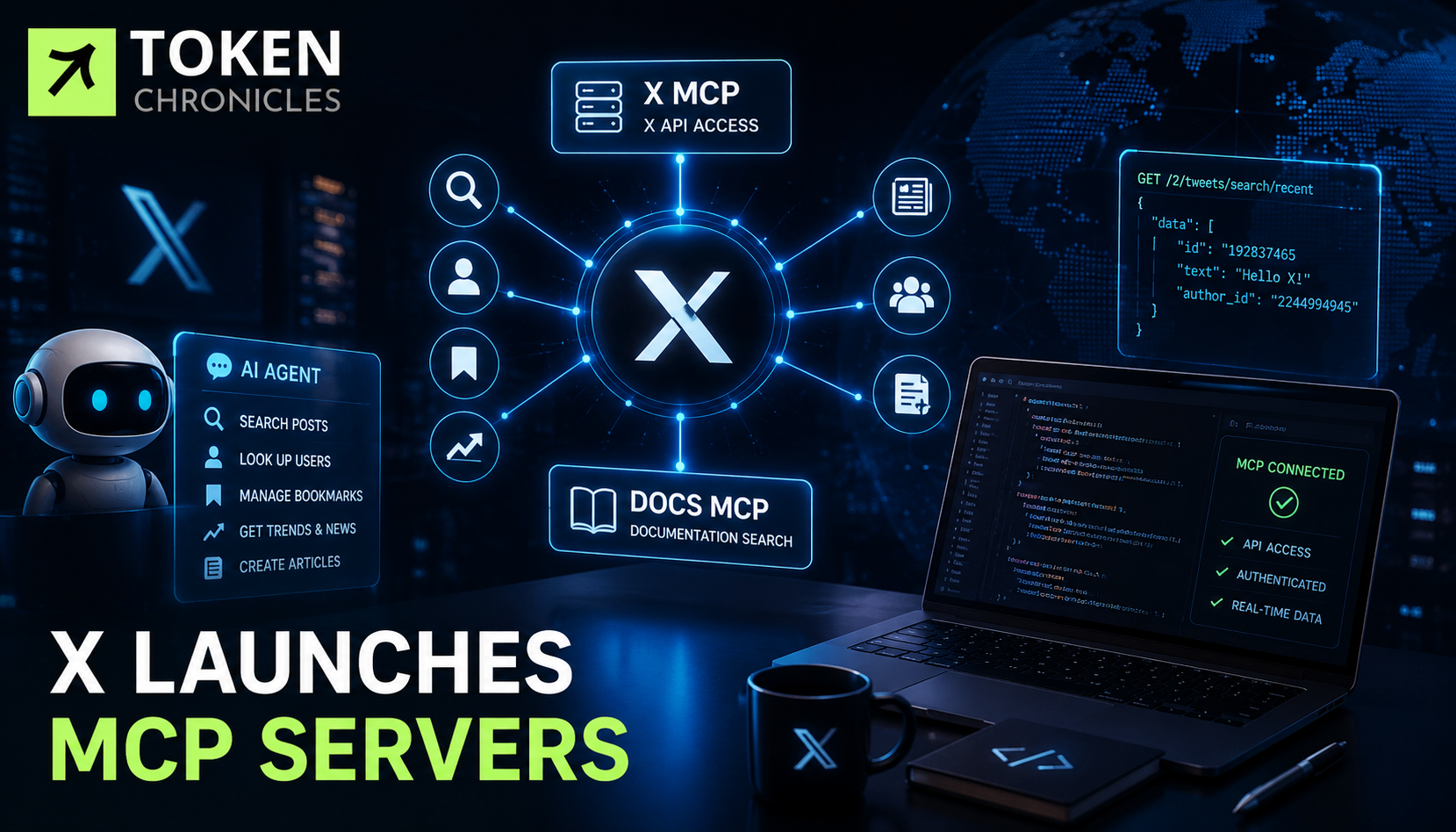
X has introduced hosted Model Context Protocol (MCP) servers, enabling AI assistants such as Grok, Cursor, Claude Desktop, VS Code, and other MCP-compatible tools to interact directly with the X platform and its developer ecosystem. The launch marks a major step toward making X an AI-native platform, allowing developers to build intelligent applications that can both access live social data and understand X’s APIs without leaving their development environment.
The announcement also includes a machine-readable OpenAPI specification for X API v2, making it easier to build, automate, and integrate applications with the platform.
AI Agents Can Now Connect Directly to X
The new MCP infrastructure allows AI assistants to perform authenticated actions using the X API through a standardized protocol.
Instead of manually searching documentation or writing API requests, developers can allow AI tools to directly interact with X using their own account permissions.
Supported capabilities include:
- Searching historical and live posts
- Looking up user profiles and timelines
- Accessing trending topics and news
- Managing bookmarks
- Creating and publishing X Articles
- Reading mentions and user activity
- Searching across the full X archive
By exposing these capabilities through MCP, X is positioning itself as one of the first major social platforms built for autonomous AI workflows.
Two MCP Servers Power the Ecosystem
X has released two dedicated hosted MCP servers.
X MCP
The primary server connects AI applications directly to the X API.
It enables authenticated access to live platform data while allowing AI assistants to perform actions on behalf of users through secure OAuth authentication.
This transforms AI assistants from passive chatbots into active operators capable of interacting with X in real time.
Docs MCP
Alongside the API server, X has launched a dedicated documentation MCP server.
Rather than manually searching developer documentation, AI assistants can instantly retrieve API references, endpoint details, authentication guides, and implementation examples directly from X’s official documentation.
This significantly shortens development time while reducing implementation errors.
Simplified Authentication for Developers
To simplify access, X provides two authentication options.
The first uses an App-only Bearer Token, allowing developers to access read-only API endpoints without requiring user authentication.
The second option uses the xurl MCP bridge, which manages OAuth 2.0 authentication, automatically refreshes access tokens, and enables AI assistants to perform authenticated actions such as publishing Articles or managing bookmarks.
The bridge supports one-time browser authentication and automatically maintains secure user sessions afterward.
Broad Support Across Popular AI Development Tools
The MCP servers are designed to work with most modern AI coding environments.
Official configuration examples are available for:
- Grok Build
- Cursor
- Claude Desktop
- Visual Studio Code
- Other MCP-compatible AI clients
Developers can connect AI assistants using only a few configuration lines, allowing them to search documentation and execute API requests directly from their editor.
Documentation and API Discovery Become AI-Native
X has also introduced a centralized documentation index that allows AI models to discover the entire developer documentation before retrieving individual pages.
Combined with the Docs MCP server, AI assistants can:
- Search documentation instantly
- Retrieve complete API pages
- Access code examples
- Understand authentication flows
- Reference endpoint specifications while generating code
This reduces the need for developers to switch between documentation websites and coding environments.
OpenAPI Specification Released
To further improve developer workflows, X has published the complete OpenAPI specification for its API v2.
The specification can be imported into tools such as Postman, used to generate client SDKs automatically, validate request schemas, or power custom AI development agents.
Machine-readable API definitions are becoming increasingly important as AI coding assistants take on a larger role in software development.
Why It Matters
The launch of X’s MCP servers reflects a broader shift toward AI-native software development.
Rather than treating AI as a coding assistant that merely generates code, platforms are beginning to expose their APIs directly to intelligent agents capable of understanding documentation, executing authenticated actions, and automating complex workflows.
For developers, this means faster integration, reduced development friction, and more powerful automation. For X, it strengthens the platform’s position as a hub where AI agents can both consume information and actively interact with one of the world’s largest real-time social networks.
As Model Context Protocol adoption grows across the AI ecosystem, X’s early investment in hosted MCP infrastructure could become an important foundation for the next generation of AI-powered applications.