

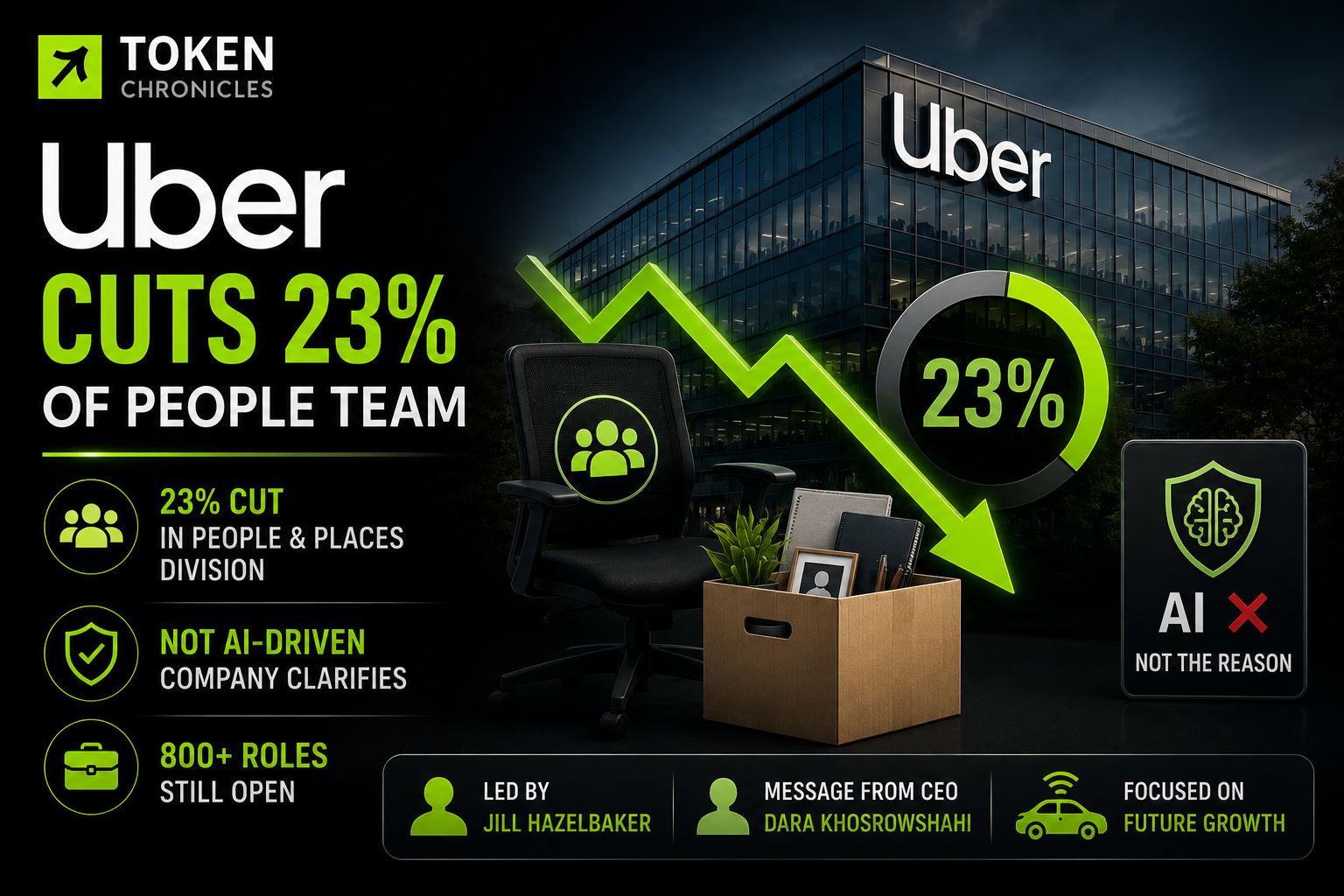
Uber is reducing approximately 23% of its People and Places division, impacting teams responsible for human resources, recruitment, workplace operations, and employee experience. While the move affects several senior positions, company leadership has emphasized that the restructuring is not driven by artificial intelligence replacing workers, distancing itself from a trend increasingly seen across the technology sector.
Strategic Reorganization, Not an AI-Driven Reduction
The workforce reduction affects less than 1% of Uber’s global employee base of roughly 34,000 people. However, the layoffs are concentrated within the company’s internal operations and people-management functions, making them significant for the teams involved.
The restructuring comes shortly after Jill Hazelbaker was promoted to the expanded role of President and Chief Corporate Affairs Officer. A long-time Uber executive, Hazelbaker now oversees communications, public policy, marketing, and the company’s People and Places organization.
According to company leadership, the goal is to simplify operations and improve efficiency rather than reduce headcount through automation.
Uber Says Internal Complexity Prompted the Move
In a message to employees, Hazelbaker explained that Uber’s rapid growth over the years has created organizational complexity that is becoming increasingly difficult to manage.
She noted that some teams have developed overlapping responsibilities, unclear ownership structures, and fragmented workflows that have distanced support functions from the business units they serve.
The restructuring is intended to create a more streamlined organization with clearer accountability, faster decision-making, and stronger alignment between support teams and core business operations.
Uber believes a leaner structure will help improve execution while allowing the company to remain agile as it expands into new areas of mobility, delivery, and autonomous transportation.
CEO Dara Khosrowshahi Defends the Decision
Uber CEO Dara Khosrowshahi supported the move, describing it as a necessary step to strengthen the effectiveness of the People organization.
According to Khosrowshahi, the changes are designed to unlock greater potential within the company and ensure internal teams are structured to support Uber’s next phase of growth.
Management maintains that the decision is part of a broader operational optimization strategy rather than a response to short-term economic pressures.
Breaking Away From the Industry’s AI Layoff Trend
The announcement stands out because many technology companies have recently linked workforce reductions to increasing AI adoption and automation.
Throughout 2026, numerous firms have cited AI-powered productivity gains as justification for reducing headcount, particularly in administrative, support, and operational roles.
Uber, however, has taken a different approach.
Company representatives explicitly stated that the layoffs were not caused by artificial intelligence replacing employees, even as the company continues to expand its internal use of AI-powered tools.
The clarification appears aimed at avoiding the growing perception that every corporate restructuring is being driven by automation.
Hiring Continues in Key Growth Areas
Despite the workforce reduction, Uber is not freezing recruitment.
The company currently has more than 800 open positions globally, with hiring continuing across several strategic initiatives.
A significant portion of those roles are tied to Uber’s long-term mobility ambitions, including:
- Autonomous vehicle operations
- Robotaxi commercialization
- Artificial intelligence development
- Platform infrastructure
- Engineering and product innovation
While Uber recently indicated it would slow overall hiring and rely more heavily on internal AI tools to improve productivity, it remains actively focused on expanding teams that support future growth opportunities.
Independent Drivers Remain Unaffected
Uber also clarified that the restructuring does not affect its network of approximately 10 million drivers worldwide, who operate as independent contractors rather than employees.
The layoffs are limited to corporate functions and internal support teams.
Balancing Efficiency and Growth
The move reflects a broader trend across the technology industry where companies are seeking greater operational efficiency while continuing to invest in strategic growth areas.
Rather than pursuing aggressive expansion across all departments, firms are increasingly concentrating resources on high-priority initiatives while streamlining back-office operations.
For Uber, that means reducing organizational complexity, improving accountability, and reallocating resources toward emerging opportunities such as autonomous transportation and AI-enabled mobility services.
While the layoffs represent a difficult transition for affected employees, company leadership argues that the restructuring is intended to build a more focused and scalable organization capable of supporting Uber’s long-term vision in an increasingly competitive transportation and technology landscape.