

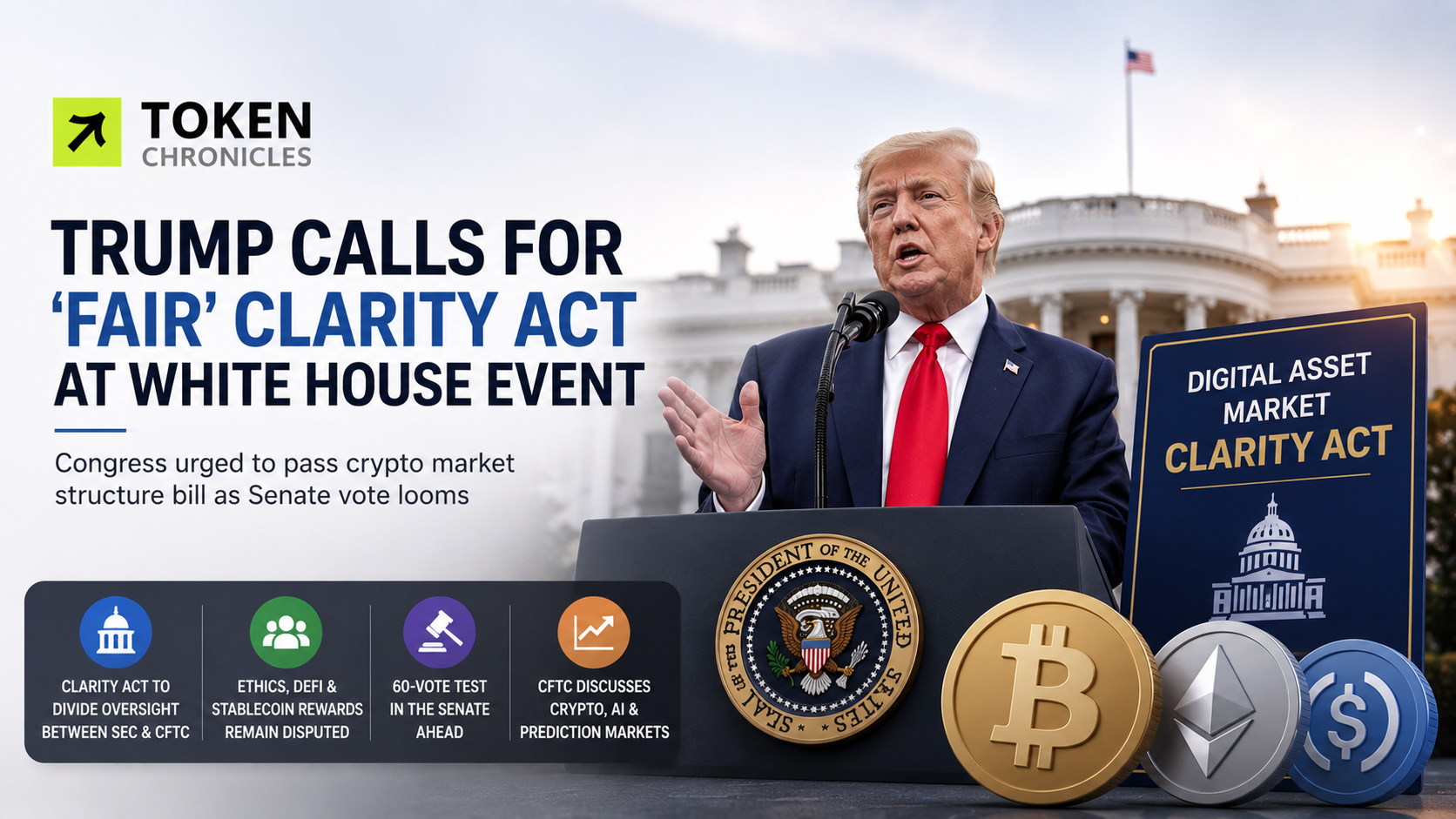
President Donald Trump is pressing Congress to advance the Digital Asset Market CLARITY Act, arguing that the United States needs a durable federal framework for cryptocurrency rather than relying primarily on regulatory action from individual agencies.
Speaking at a White House meeting with cryptocurrency and financial-industry executives on Aug. 19, Trump called for a “fair version” of the legislation and urged lawmakers to take the next step toward establishing permanent rules for the digital-asset industry. (Reuters)
The comments come as the legislation remains stalled in the Senate and faces a potentially decisive procedural test when lawmakers return from their August recess.
Trump Wants Crypto Policy Locked Into Law
Trump framed the CLARITY Act as a way to make his administration’s broader crypto policy more durable.
The president argued that legislation would help keep the U.S. ahead of China and encourage another wave of investment and innovation in digital assets.
The distinction between regulation and legislation is important. Rules issued by agencies such as the Securities and Exchange Commission (SEC) and Commodity Futures Trading Commission (CFTC) can be changed by future administrations or regulators. Congressional legislation, by contrast, would establish a statutory framework that would require Congress to amend or repeal.
Coinbase CEO Brian Armstrong made a similar argument at the White House event, saying legislation would help preserve the regulatory changes made under the current administration.
What the CLARITY Act Would Change
The CLARITY Act is designed to establish clearer legal categories for digital assets and determine which federal regulator should oversee different parts of the crypto market.
A central component would be a clearer division of responsibilities between the SEC and CFTC.
The legislation would also establish regulatory pathways for crypto exchanges, brokers and custodians while introducing requirements covering areas such as customer-asset segregation, disclosures and market protections.
The House of Representatives passed its version of the legislation in July 2025 by a 294–134 vote. The bill subsequently advanced through the Senate Banking Committee but did not receive a Senate floor vote before lawmakers left for their August recess.
Senate Majority Leader John Thune filed a cloture motion before the recess, setting up a procedural vote when the Senate returns. The legislation would need 60 votes to overcome a filibuster and advance.
Senate Negotiations Remain Divided
Despite Trump’s support, several major disagreements remain between lawmakers.
One of the most politically sensitive issues involves ethics restrictions for government officials and their families who have financial interests in crypto.
Democratic lawmakers have pushed for stronger restrictions on digital-asset holdings and business relationships involving senior officials across the executive, legislative and judicial branches.
The issue has particular significance because of Trump’s family’s extensive involvement in cryptocurrency ventures.
Other unresolved questions involve the treatment of decentralized finance and stablecoin rewards.
The stablecoin debate is especially significant for crypto companies that generate revenue from activities surrounding dollar-pegged tokens. Coinbase, for example, has commercial interests connected to USDC-related activity.
Republicans control 53 Senate seats, meaning the legislation requires Democratic support to reach the 60-vote threshold.
With the Senate returning in September and the November elections approaching, lawmakers have a relatively narrow window to reach a bipartisan agreement.
SEC Rules Can Help, but Cannot Replace Congress
The White House meeting also highlighted the limits of regulatory action by federal agencies.
SEC Chairman Paul Atkins pointed to the agency’s recently proposed Regulation Crypto Assets framework, which would create new exemptions for certain crypto investment-contract offerings and establish a potential pathway for some tokens to eventually move outside the investment-contract framework.
The proposal includes potential fundraising exemptions allowing qualifying projects to raise up to $5 million over four years under one exemption and as much as $75 million over a 12-month period under another.
However, the SEC cannot independently rewrite the statutory division of authority between the SEC and CFTC.
Atkins therefore presented the SEC’s regulatory work as complementary to, rather than a substitute for, congressional legislation.
The broader problem is durability. Agency rules can provide immediate regulatory clarity, but Congress is required to establish the underlying statutory framework that determines the agencies’ powers.
CFTC Turns Attention to Crypto, AI and Prediction Markets
The regulatory push is also moving forward at the CFTC.
The agency’s Innovation Advisory Committee held its first meeting on Aug. 20, with crypto assets, artificial intelligence and prediction markets among the subjects on the agenda. (Finance Feeds)
The committee includes executives and senior representatives from major crypto and financial companies, alongside participants from prediction-market and AI industries.
The committee is advisory rather than legislative and cannot independently adopt regulations or conduct enforcement actions. Its discussions nevertheless provide insight into how the CFTC is approaching emerging technologies.
The meeting comes at an important moment for the agency as regulators attempt to advance crypto policy while Congress works on a broader market-structure framework.
A Race Between Regulation and Legislation
The developments highlight a growing tension in U.S. crypto policy.
The SEC, CFTC and Treasury are moving ahead with regulatory initiatives that can provide businesses with greater clarity under their existing authority.
But industry participants continue to argue that agency action alone is not enough.
A future administration could reverse regulatory policies, while statutory legislation would provide considerably greater certainty for companies making long-term investments in the U.S.
That is why the CLARITY Act remains central to the crypto industry’s Washington strategy.
September Could Be the Decisive Month
The Senate’s return will determine whether the CLARITY Act can move beyond negotiations and toward a final vote.
The legislation currently faces a difficult path. Lawmakers must resolve disputes over ethics provisions, DeFi, stablecoin rewards and other issues while finding enough bipartisan support to clear the 60-vote procedural hurdle.
Trump’s intervention adds political pressure, but it does not resolve those underlying disagreements.
For the crypto industry, the stakes extend well beyond a single bill. The legislation could determine how digital assets are classified, which regulator oversees them, how crypto businesses obtain licenses and how much authority the SEC and CFTC have over the market.
If Congress reaches a compromise, the CLARITY Act could provide the long-term regulatory foundation the industry has sought for years.
If negotiations fail, U.S. crypto policy is likely to remain dependent on agency rulemaking and enforcement decisions, leaving businesses with less certainty about how the regulatory landscape will evolve under future administrations. (Reuters)