

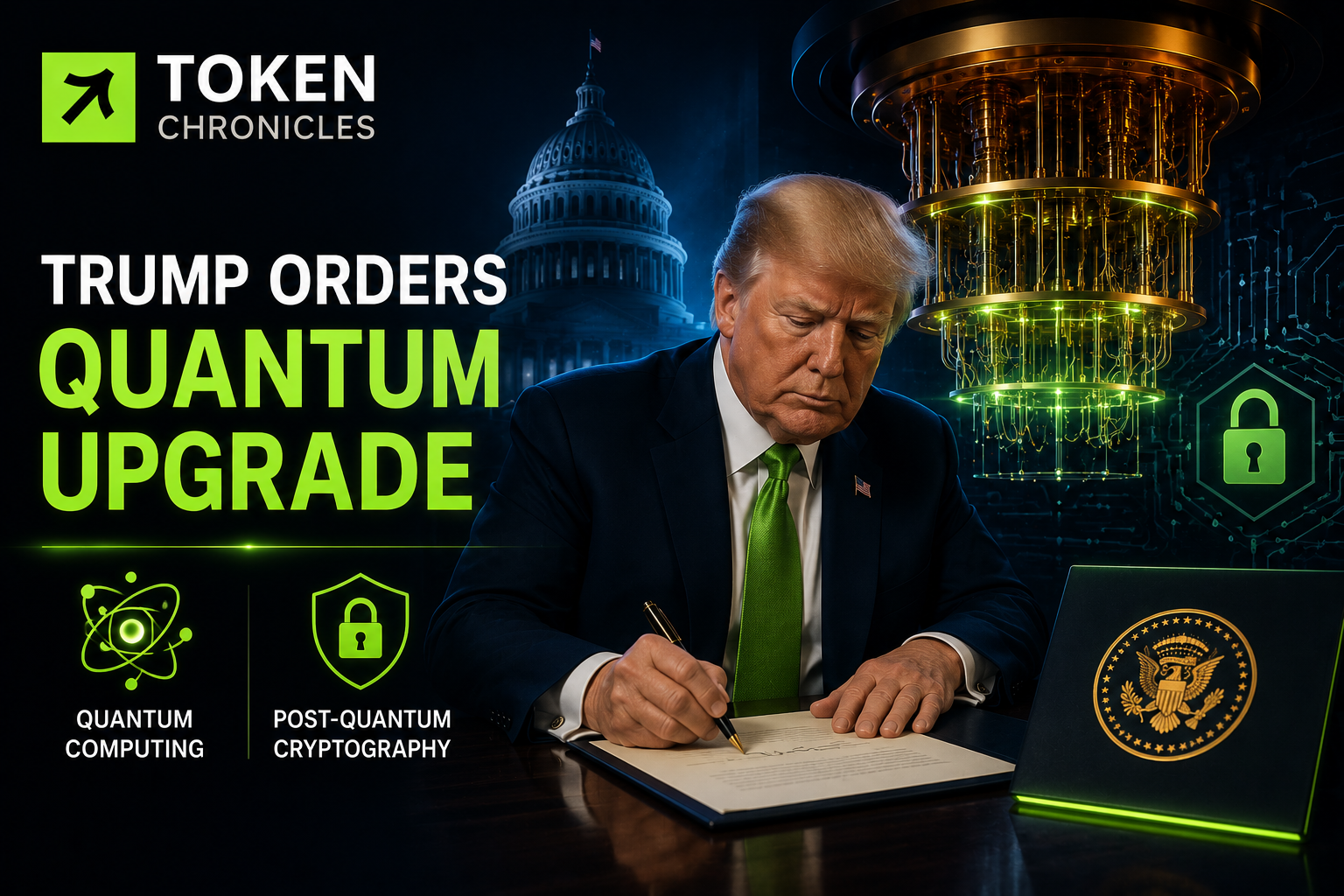
The United States is accelerating its push into the next era of computing after President Donald Trump signed two new executive orders aimed at expanding the country’s quantum technology capabilities and strengthening defenses against future cyber threats.
The initiatives focus on two critical areas: building advanced quantum computers and preparing the nation’s digital infrastructure for an age when current encryption methods may no longer be secure.
A New Push for Quantum Leadership
The White House described the move as a coordinated national strategy designed to speed up research, commercialization, and real-world adoption of quantum technologies.
President Trump said the United States intends to invest aggressively in quantum innovation to maintain its technological advantage.
“We’re going to be investing in American quantum leadership like never before to stay ahead of the pack,” Trump said while announcing the measures.
Federal agencies have been instructed to update the country’s National Quantum Strategy within the next six months, with a stronger focus on industry partnerships, private sector innovation, and commercial deployment.
Launch of a National Quantum Computing Initiative
One of the executive orders establishes a new initiative called Quantum Computer for Application Development and Discovery Science (QC-ADDS).
The program aims to develop large-scale quantum computers capable of solving scientific and industrial problems that are beyond the reach of today’s most powerful supercomputers.
Officials believe such systems could transform industries including:
- Artificial Intelligence
- Drug discovery
- Materials science
- Financial modeling
- Climate research
- National defense
The government also plans to assess how increasingly powerful quantum computers could impact existing digital systems and industries.
Preparing for the Quantum Cybersecurity Era
The second executive order focuses on cybersecurity and the growing risk that future quantum computers may be able to break many of today’s encryption standards.
Most online banking systems, government networks, cryptocurrencies, and digital communications currently rely on cryptographic methods that could eventually become vulnerable to sufficiently advanced quantum machines.
To address this risk, the White House has ordered an accelerated transition toward post-quantum cryptography—a new generation of encryption algorithms designed to resist attacks from quantum computers.
Government agencies, cybersecurity authorities, and federal institutions will now coordinate efforts to upgrade sensitive systems before large-scale quantum computers become a reality.
Growing Competition With China
The announcement comes amid intensifying global competition in quantum technology.
China has significantly increased investment in the field under its latest Five-Year Plan, with ambitions that include:
- Scalable quantum computers
- Quantum communication satellites
- Space-to-ground quantum networks
- Advanced encryption technologies
US policymakers increasingly view quantum technology as a strategic industry that could influence economic leadership, cybersecurity, and military capabilities for decades to come.
What It Means for Crypto
The executive orders are also relevant for the cryptocurrency industry.
Quantum computers, if they become powerful enough, could theoretically threaten the cryptographic systems used by major blockchain networks.
Several crypto ecosystems have already begun preparing:
- Ethereum is exploring post-quantum security upgrades.
- Solana developers are researching quantum-resistant cryptography.
- The Bitcoin community remains divided on how and when to migrate older wallets to quantum-safe systems.
While experts believe practical quantum attacks are still years away, the technology is increasingly becoming an important topic for blockchain developers and investors alike.
The new executive orders signal that quantum computing is no longer viewed as a distant scientific experiment. Instead, governments are treating it as a strategic technology race—one that could redefine computing power, cybersecurity, artificial intelligence, and the future of digital assets.As nations invest billions into quantum research, the race to build secure, quantum-resistant infrastructure may become one of the defining technology battles of the coming decade.