

A high-profile UFC event hosted on the White House South Lawn has thrust President Donald Trump’s crypto venture, World Liberty Financial (WLFI), back into the spotlight. While the spectacle centered around record-breaking fighter bonuses paid in the company’s USD1 stablecoin, lawmakers are increasingly focused on a different question: who ultimately benefits from the rapid rise of a stablecoin tied to a sitting U.S. president and partially owned by foreign investors?
The event highlighted the growing intersection of politics, sports, cryptocurrency, and international finance, as USD1 continues its rapid ascent among the world’s largest stablecoins.
White House Hosts Historic UFC Event
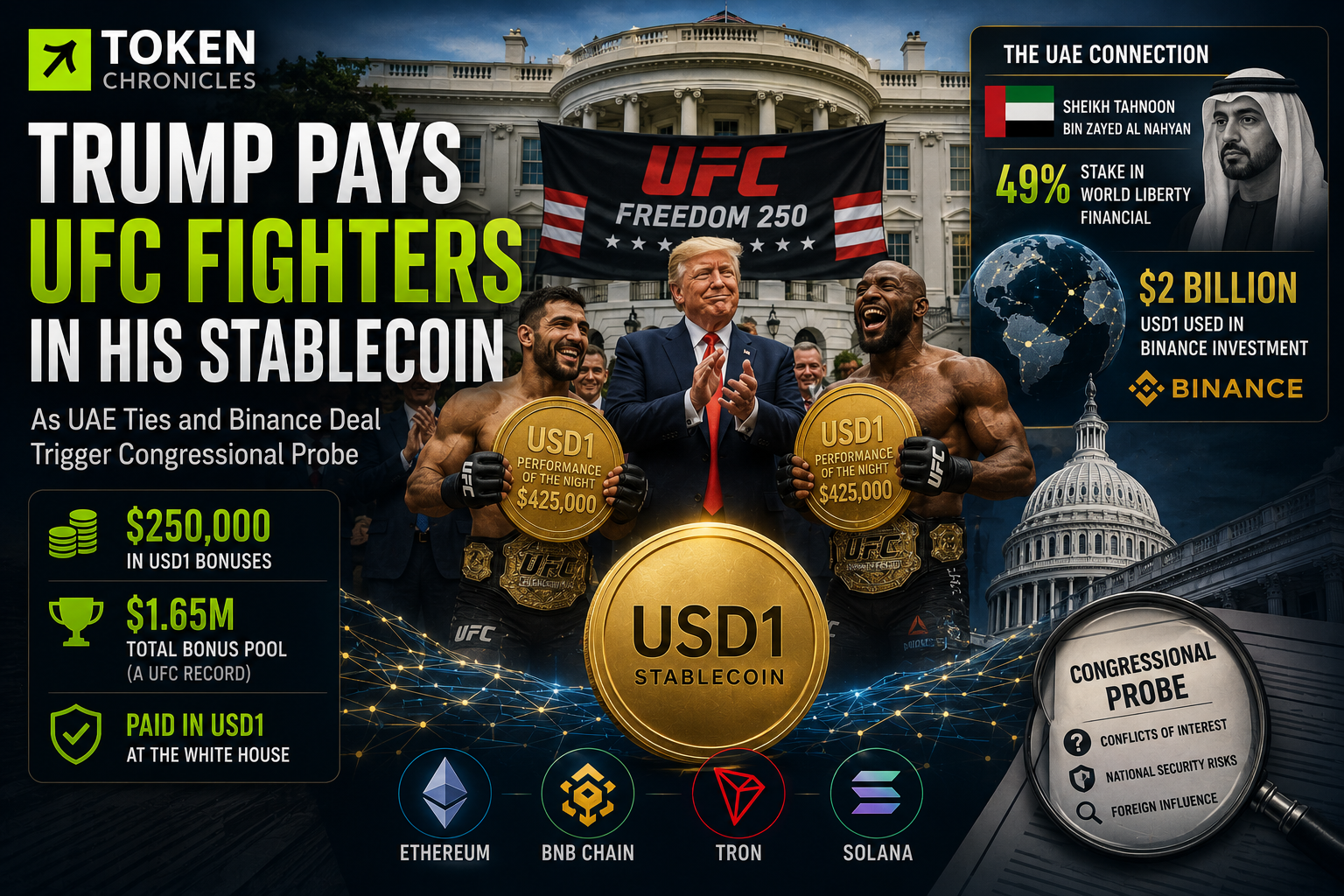
On June 14, World Liberty Financial served as the presenting sponsor of UFC Freedom 250, a landmark event staged on the South Lawn of the White House.
As part of the sponsorship agreement, WLFI contributed $250,000 in USD1 stablecoin bonuses to the event’s “Performance of the Night” award pool. The contribution boosted individual performance bonuses to $425,000 per winning fighter.
Meanwhile, Crypto.com sponsored the “Fight of the Night” awards, increasing those payouts to $400,000 each.
Combined, the event distributed approximately $1.65 million in fighter bonuses, making it one of the most lucrative bonus structures in UFC history.
In a symbolic moment for both the crypto industry and sports marketing, winning fighters received their rewards in USD1 stablecoins directly at the White House, marking one of the highest-profile cryptocurrency payment events ever associated with a U.S. government venue.
The Rapid Rise of USD1
World Liberty Financial was co-founded by Donald Trump in 2024 as part of a broader push into digital assets and blockchain-based financial services.
Its flagship product, USD1, is a U.S. dollar-backed stablecoin supported by reserves consisting of Treasury securities, cash, and cash-equivalent assets.
Since launching in March 2025, USD1 has experienced remarkable growth.
USD1 Stablecoin Snapshot
- Launch Date: March 2025
- Current Market Capitalization: Over $5 Billion
- Supported Networks:
- Ethereum
- BNB Chain
- Tron
- Solana
- Reserve Assets:
- U.S. Treasuries
- Cash Holdings
- Cash Equivalents
The stablecoin has rapidly expanded across multiple blockchain ecosystems and is increasingly being used for payments, settlements, and institutional transactions.
Its growth has positioned WLFI as a notable player in the global stablecoin market alongside established issuers such as Tether and Circle.
Congressional Concerns Intensify
The White House event arrives amid growing scrutiny from members of Congress regarding WLFI’s ownership structure and international connections.
At the center of the controversy is a reported investment by a UAE-linked entity connected to Sheikh Tahnoon bin Zayed Al Nahyan, the United Arab Emirates’ National Security Adviser and brother of the UAE president.
According to reports, the investment vehicle acquired a 49% stake in World Liberty Financial through a deal reportedly valued at approximately $500 million.
The transaction immediately raised questions among lawmakers about foreign influence, transparency, and potential conflicts of interest.
Several congressional committees have since launched inquiries into the arrangement, seeking greater clarity regarding the relationship between WLFI, its foreign investors, and the broader implications for U.S. financial policy.
The Binance Connection
Congressional attention intensified further following revelations that another Tahnoon-linked investment vehicle reportedly utilized USD1 to settle a $2 billion investment transaction involving Binance earlier this year.
The deal represented one of the largest known transactions involving the stablecoin and significantly elevated its profile within global crypto markets.
For lawmakers, however, the transaction introduced new concerns.
Questions being raised include:
- Why was USD1 selected as the settlement mechanism?
- What oversight exists for such transactions?
- Does foreign ownership create potential influence over a major stablecoin issuer?
- Could political connections provide commercial advantages unavailable to competitors?
The growing adoption of USD1 has transformed these concerns from theoretical discussions into issues with real economic and geopolitical implications.
Politics, Crypto, and National Security Collide
The controversy surrounding World Liberty Financial reflects a broader debate taking shape in Washington as digital assets become increasingly intertwined with traditional finance and global politics.
Supporters argue that USD1 represents innovation, financial modernization, and growing international demand for dollar-backed digital assets.
Critics counter that the involvement of foreign state-linked investors, combined with Trump’s direct association with the company, creates unprecedented governance and conflict-of-interest questions.
The situation is particularly unique because it combines several highly sensitive areas:
- Presidential business interests
- Stablecoin regulation
- Foreign investment
- National security considerations
- Global crypto infrastructure
As stablecoins continue gaining importance within global financial markets, lawmakers appear increasingly determined to establish clear rules governing ownership, transparency, and oversight.
The Bigger Picture
What appeared on the surface to be a celebratory UFC sponsorship has evolved into a much larger conversation about power, influence, and the future of digital finance.
The White House event demonstrated how quickly crypto assets can move from niche financial products into mainstream cultural and political arenas. At the same time, it highlighted the growing scrutiny facing projects that operate at the intersection of government, international capital, and emerging financial technology.
For now, USD1 continues expanding its footprint across the crypto ecosystem, supported by a market capitalization exceeding $5 billion and growing institutional adoption.
But as Congress examines the ownership structure behind World Liberty Financial, the focus is shifting beyond the fighters who received stablecoin bonuses.
The central question lawmakers now appear determined to answer is simple: as USD1 grows into a major financial asset, who ultimately benefits from its success?


