
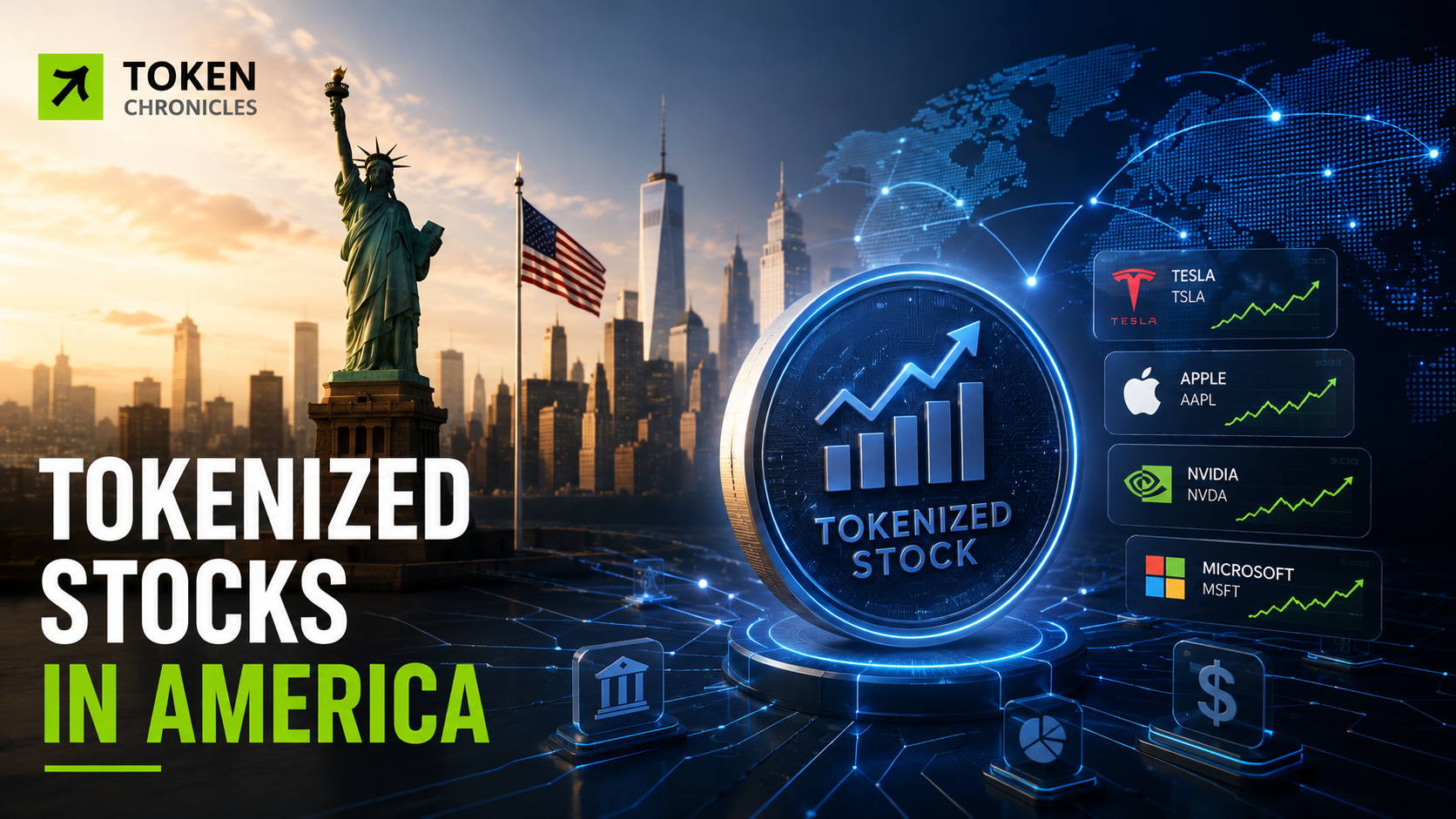
The global tokenization movement is moving from experimentation toward mainstream adoption. What once looked like a niche application of blockchain technology is increasingly becoming a broader effort to modernize how financial assets are issued, traded, settled and owned.
Last year, I described tokenization as a freight train that could eventually reshape the entire financial system. Since then, that momentum has accelerated.
Outside the United States, Robinhood has been among the companies pushing tokenized assets into practical use. At its London event, The World Is Flat, the company launched the mainnet of Robinhood Chain, a blockchain designed specifically around real-world assets.
The network has since surpassed 100 million transactions, while Stock Tokens have emerged as a core application. These tokens provide users in more than 120 countries with economic exposure to more than 190 U.S. stocks, backed 1:1 by the underlying securities.
Yet there remains a significant gap:
Robinhood Stock Tokens are not currently available to U.S. investors.
That raises an important question: if Americans already have relatively inexpensive and accessible ways to invest in U.S. equities, why should stocks be tokenized at all?
The answer is that tokenization isn’t simply about putting an existing asset on a blockchain.
It is about rebuilding the infrastructure underneath ownership.
Tokenization Is More Than Putting Stocks on a Blockchain
The debate around tokenized equities in the United States has largely divided into two camps.
Optimists ask when tokenized stocks will become widely available to American investors. Skeptics question what additional value tokenization provides when traditional brokerage infrastructure already makes buying U.S. stocks relatively easy.
That criticism overlooks what blockchain-based ownership can fundamentally change.
Robinhood’s current Stock Tokens are backed by underlying securities and provide holders with economic exposure, including dividends. They are not identical to direct ownership of the underlying shares.
But the more important innovation is the ability to represent exposure to financial assets in a form that can potentially be:
- Portable
- Programmable
- Self-custodied
- Fractionalized
- Available around the clock
- Integrated with an open financial ecosystem
As regulatory frameworks develop, the structure of tokenized equities could evolve further, potentially including models that provide holders with rights more closely aligned with traditional shareholders.
The broader opportunity is therefore much larger than simply creating a digital version of a stock certificate.
Tokenization could become a new foundation for financial ownership.
1. Real-Time Settlement Could Make Markets More Resilient
One of the clearest advantages of blockchain-based markets is the possibility of real-time settlement.
The GameStop episode demonstrated some of the weaknesses inherent in traditional market infrastructure. Trading restrictions during the episode were influenced in part by clearing and risk-management requirements associated with the settlement cycle.
The industry subsequently moved from T+2 settlement to T+1, reducing the period between trade execution and settlement.
But even with faster settlement, financial intermediaries still need to manage significant counterparty and liquidity risks during the settlement process.
Blockchain infrastructure offers another possibility.
A tokenized stock could potentially trade and settle almost simultaneously.
That would reduce the amount of time during which counterparties and intermediaries are exposed to settlement risk.
During periods of extreme market volatility, reducing that exposure could become particularly valuable.
The objective isn’t simply to make settlement faster.
It is to make the financial system more resilient when markets are under stress.
2. Tokenization Enables Native 24/7 Markets
Financial markets have become global, but traditional equity markets still operate within defined trading hours.
That creates a mismatch.
Major economic announcements, geopolitical developments and corporate news don’t stop when exchanges close. Significant events can happen overnight or during weekends, leaving investors unable to trade until markets reopen.
Institutional investors have long used derivatives and other sophisticated instruments to manage this risk.
Individual investors generally have fewer options.
Tokenized assets could change that.
A blockchain doesn’t inherently need to close at 4 p.m.
Onchain markets can operate continuously, allowing assets to trade and settle around the clock.
Robinhood is already expanding U.S. trading hours through traditional infrastructure with its 24/5 offering. But building a seamless 24/7 market by connecting multiple exchanges and alternative trading systems is operationally complicated.
With blockchain-native assets, continuous availability becomes part of the underlying infrastructure.
We’ve already seen significant activity in tokenized stocks outside the United States, including weekend trading involving millions of dollars in volume.
The broader principle is simple:
The internet operates 24/7. Financial markets increasingly need to do the same.
3. Portability Could Give Investors More Control
Traditional financial assets are often tied closely to the platforms that hold them.
Moving securities between brokers through legacy systems can take days and introduce uncertainty, particularly when markets are moving quickly.
Tokenization could make assets significantly more portable.
A tokenized asset could potentially move between compatible financial platforms almost instantly, including from traditional financial applications into decentralized finance.
That portability changes the competitive dynamic.
If moving assets becomes easy, platforms can no longer rely as heavily on friction to retain customers.
Instead, they have to compete on:
- Pricing
- User experience
- Products
- Execution
- Innovation
- Services
The easier it becomes to move an asset, the harder it becomes to trap a customer.
Self-Custody Opens Another Layer of Possibilities
Portability is only one potential benefit.
Tokenization can also enable self-custody, allowing users to hold tokenized assets in their own wallets rather than keeping everything within a traditional brokerage account.
That could eventually allow tokenized securities to interact directly with other onchain applications.
For example, tokenized stocks could potentially be used as collateral, integrated into lending markets or incorporated into other financial applications, subject to applicable regulations.
This creates an entirely different development environment.
Instead of financial institutions determining every possible use case in advance, developers can build applications around standardized onchain assets.
Some of those applications may be difficult to predict today.
That is one of the most important characteristics of open financial infrastructure: the most valuable applications are often created after the infrastructure exists.
Technology Alone Isn’t Enough
The biggest challenge for tokenized stocks in the United States isn’t necessarily technical.
It is regulatory.
More than a century of securities laws and financial regulations has created a complex framework around market structures designed for an earlier technological era.
Many of those rules serve legitimate purposes.
Investor protection matters.
Market integrity matters.
Disclosure requirements matter.
But the underlying infrastructure used to enforce those protections doesn’t necessarily need to remain unchanged forever.
The challenge for policymakers is therefore not to eliminate investor protections in the name of innovation.
It is to preserve those protections while allowing better technology to replace outdated infrastructure.
That means regulators will need to address questions around custody, settlement, investor rights, market structure, disclosures, trading venues and interoperability.
The process will require speed as well as caution.
Other jurisdictions are already experimenting with tokenized securities and real-world assets. If the United States moves too slowly, American investors could find themselves excluded from innovations built around American companies and American financial assets.
Public Equities Are Only the Beginning
Tokenized public stocks represent only the first stage of a much larger opportunity.
Once the infrastructure for issuing, trading and settling tokenized securities becomes mature, it could eventually support assets that are significantly harder to access today.
Private-company equity is one obvious example.
Private markets are considerably less liquid and accessible than public markets, and regulatory restrictions such as accredited-investor requirements continue to limit participation.
Tokenization won’t eliminate those barriers by itself.
But building reliable infrastructure for public equities could establish the technological foundation needed to eventually expand access to other asset classes.
That could lead to:
More liquidity.
Greater portability.
Lower friction.
Broader access.
New forms of ownership.
America Should Not Be Left Behind
The irony of the current situation is difficult to ignore.
Many of the assets being tokenized globally are American.
Many of the companies driving the underlying innovation are American.
Yet American investors may ultimately have less access to tokenized versions of those assets than investors elsewhere.
That would be an unusual outcome.
The United States has historically benefited from being at the forefront of financial innovation and technological infrastructure. Tokenization represents another opportunity to modernize the financial system while preserving the protections investors depend on.
The objective should not be to put stocks on blockchains simply because blockchain technology exists.
The objective should be to build a financial system in which ownership can move as freely, quickly and efficiently as information moves across the internet.
Tokenized stocks are only the beginning.
The larger opportunity is to rethink the infrastructure of ownership itself.