

Tokenized equities have officially arrived on Base, marking another step toward bringing traditional financial assets onto blockchain infrastructure.
Coinbase-issued tokenized stocks, built using the B20 token standard, are now available natively on Base. The tokens represent underlying shares held on a 1:1 basis with a regulated custodian, giving eligible users onchain exposure to traditional equities while retaining the ability to hold the assets in self-custody wallets.
The launch means users can access fractional exposure to companies such as Apple and NVIDIA, trade those assets through onchain liquidity venues, and potentially integrate them into the broader Base DeFi ecosystem.
For developers, the significance goes beyond simply putting stocks on a blockchain. It introduces a new category of programmable financial assets that can interact with existing crypto infrastructure.
Why Tokenized Stocks Matter for Builders
For years, most of the assets available to blockchain developers were crypto-native. That limited the types of financial applications that could be built.
Tokenized equities expand the design space.
Developers can now potentially combine stocks with stablecoins, lending markets, decentralized exchanges, automated strategies and other blockchain-based applications.
New Products and Larger Markets
Tokenized equities allow developers to build products around users who are interested in traditional investments rather than cryptocurrencies alone.
For example, an application could allow a user to hold tokenized shares alongside stablecoins and potentially use those shares within an onchain lending or credit system.
This creates an opportunity to bring traditional-equity users into programmable financial applications while giving existing crypto users access to a much broader range of assets.
Stocks Become DeFi Building Blocks
Once equities exist as blockchain tokens, they can potentially participate in financial applications rather than simply sitting inside brokerage accounts.
Stocks generate economic value through mechanisms such as dividends and securities lending, while their market value can also make them useful as potential collateral.
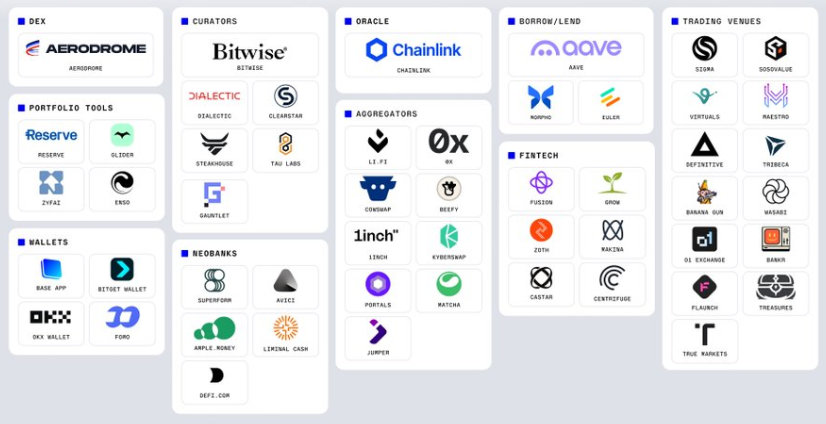
On Base, developers can therefore explore lending markets, liquidity pools, structured products and other financial applications built around tokenized equities.
Composability Creates a Network Effect
One of blockchain’s most important properties is composability.
A tokenized stock integrated into one application can potentially become part of another application without requiring an entirely new financial infrastructure.
A token could trade on a decentralized exchange, serve as collateral in a lending protocol and subsequently become part of a structured financial product.
As additional equities are introduced, developers building today could gain access to a growing universe of compatible assets.
Traditional Finance Is Moving Toward the Blockchain
The opportunity extends well beyond tokenized stocks themselves.
Large parts of traditional financial infrastructure are increasingly being explored onchain, including:
- Market making
- Securities lending
- Credit and margin
- Index products
- Derivatives
- Portfolio management
- Automated trading
If these activities can be represented through programmable blockchain infrastructure, developers have an opportunity to recreate and redesign financial products that previously depended on centralized intermediaries.
The result could be a much broader convergence between traditional finance and decentralized markets.
Tokenized Stocks Could Become an Asset for AI Agents
Another potentially important development is the emergence of autonomous AI agents capable of interacting with financial applications.
Unlike traditional financial assets, blockchain-based tokens can be accessed programmatically through software.
That makes tokenized equities potentially useful as financial primitives for autonomous agents.
An AI agent could, in principle, monitor market conditions, manage a portfolio, execute predefined strategies or interact with lending and liquidity protocols without requiring a traditional brokerage interface for every action.
This creates an emerging intersection between tokenized assets, DeFi and the agentic economy.
The market is still young, meaning many of the applications enabled by this combination have yet to be designed.
How the Tokenized Stocks Work
The underlying structure is designed to connect an onchain token with a corresponding traditional security.
Institutional participants acquire the underlying shares, which are held through a regulated broker and custodian structure. The token represents the holder’s claim to the corresponding underlying equity.
For eligible users, this creates several potential advantages compared with conventional equity infrastructure.
Global Accessibility
Eligible users outside the United States can potentially gain exposure to U.S. equities through a compatible wallet and internet connection rather than relying entirely on traditional brokerage infrastructure.
Availability remains subject to jurisdictional and issuer-specific requirements.
24/7 Markets
Traditional stock exchanges operate according to specific trading schedules.
Blockchain markets operate continuously.
Tokenized equities can therefore potentially be traded through onchain liquidity pools outside conventional market hours, allowing users to respond to earnings announcements, macroeconomic events or weekend developments without waiting for the next trading session.
Integration With DeFi
A traditional stock generally remains inside a brokerage account.
A tokenized representation can potentially interact with decentralized financial infrastructure.
For example, an eligible tokenized equity could potentially be used within a lending application, supplied to a liquidity pool or incorporated into an automated strategy, depending on the supporting protocols and applicable restrictions.
Standardized Tokens Make Integration Easier
The B20 standard is designed as an extension of the familiar ERC-20 model.
That means tokenized stocks can be represented using infrastructure that developers already understand, allowing them to interact with compatible wallets, applications and protocols.
The architecture is also designed to handle corporate actions such as dividends and stock splits through an onchain multiplier mechanism.
The objective is to ensure that balances and existing DeFi positions do not need to be constantly reconstructed when the underlying equity undergoes a corporate action.
The Bigger Opportunity Is Composability
The launch represents more than another asset listing.
The larger proposition is that traditional financial assets can become programmable components of an open financial system.
Stablecoins demonstrated the potential of putting fiat-denominated value onchain. Tokenized equities could extend that model to ownership of public companies.
Once assets become programmable, developers can combine them in ways that are difficult to achieve within traditional financial infrastructure.
A portfolio could potentially contain tokenized equities, stablecoins and other onchain assets within a single programmable environment.
Credit markets could be built around them.
Automated strategies could interact with them.
Financial applications could combine multiple asset classes without requiring every component to operate on separate infrastructure.
That composability is arguably more important than the initial tokenization itself.
Tokenized Stocks Are Still at the Beginning
The evolution of stablecoins provides an indication of what could happen next.
What began as a relatively simple attempt to represent dollars on blockchain networks eventually developed into a major financial infrastructure layer used for payments, trading, settlement and decentralized finance.
Tokenized equities could follow a similar trajectory.
The initial product is simply a digital representation of a traditional share.
The larger opportunity lies in everything developers can build around that representation.
As more equities and other real-world assets become available onchain, the number of possible combinations increases.
That could eventually create financial markets where traditional assets and crypto-native assets operate within the same programmable environment.
The Bigger Shift
The important development isn’t simply that users can now access tokenized versions of familiar stocks.
It is that equities are becoming programmable financial primitives.
For developers, that means a much larger design space.
For investors, it could mean new ways to access and use traditional assets.
For DeFi, it introduces assets with economic characteristics that have historically existed outside blockchain markets.
And for the broader financial system, it represents another step toward a world where ownership, liquidity, credit and financial applications increasingly operate on shared blockchain infrastructure.
The next phase of tokenization may not be about putting assets onchain. It may be about discovering what becomes possible once those assets can interact with everything else already onchain.