
Many crypto projects generate meaningful revenue, attract users, and build strong products yet their tokens continue to underperform. The disconnect often isn’t about the business itself. It’s about how value is distributed between equity holders and token holders.
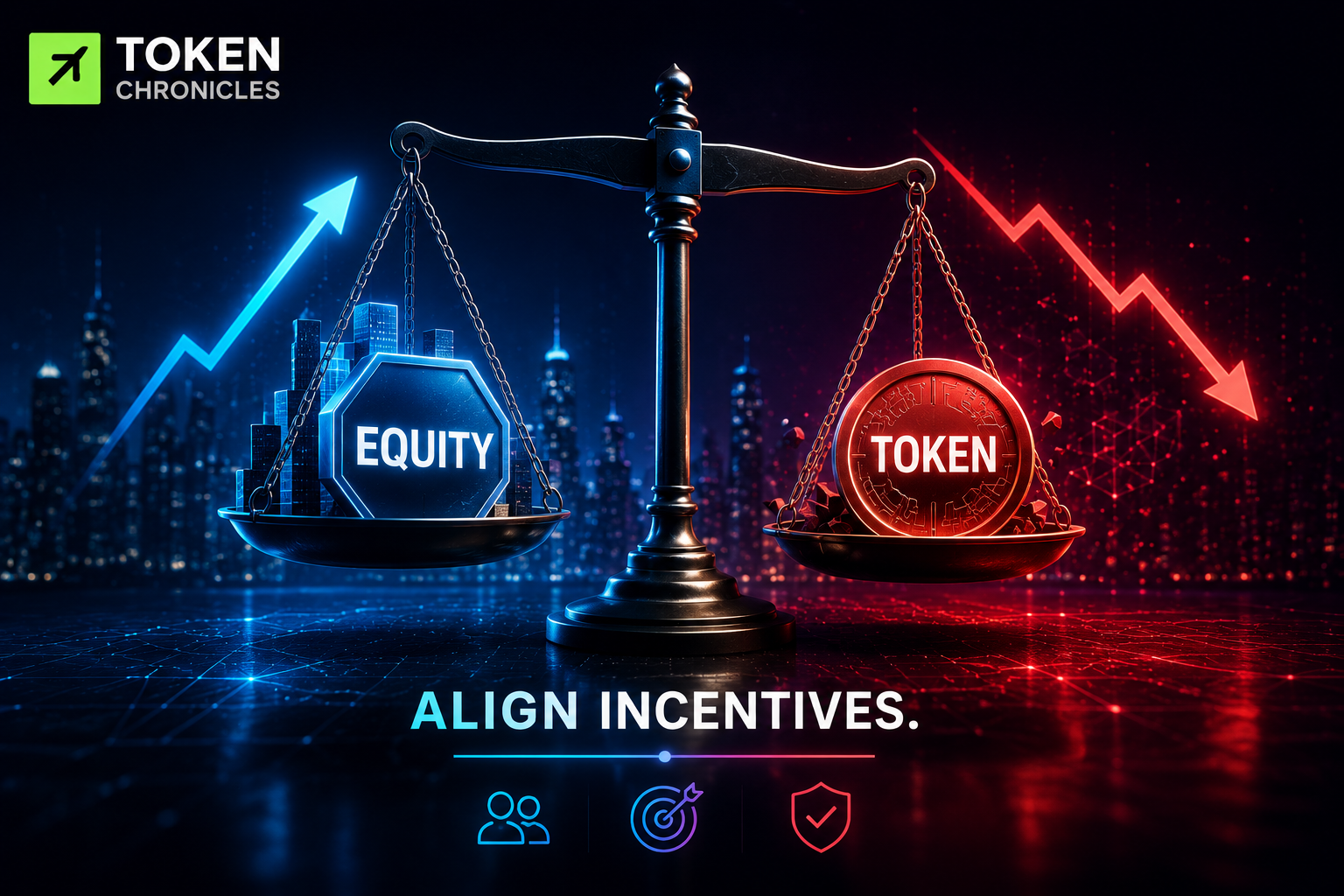
A growing debate within the crypto industry suggests that many founders have stronger financial incentives to maximize the value of their company’s equity than its native token. As long as this imbalance exists, token performance may continue to lag behind business growth.
The Equity vs. Token Conflict
Many Web3 companies operate with a dual-capital structure: a traditional company with equity alongside a publicly traded token.
While both represent the same ecosystem, they rarely receive equal treatment.
Equity offers legal protections, established governance, clearer ownership rights, and greater familiarity for institutional investors. As a result, founders and venture capital firms often prioritize equity appreciation over strengthening token economics.
Critics argue that this leaves token holders exposed to the success of the business without receiving a proportional share of its value creation.
Why Investors Price Tokens Differently
Investment valuation is largely driven by risk and expected returns.
Traditional equity investors begin with a risk-free benchmark before pricing in company, industry, and market risks. Crypto investors face those same risks while also accounting for additional uncertainties, including:
- Regulatory uncertainty
- Governance structure
- Smart contract vulnerabilities
- Token utility and rights
- Protocol sustainability
Because tokens generally carry greater risk, investors demand significantly higher expected returns. That higher required return naturally leads to lower valuation multiples compared to traditional equities.
Strong Businesses Can Still Have Weak Tokens
Even profitable crypto protocols can trade at surprisingly low token valuations if investors believe token holders lack meaningful economic rights.
Without clear claims over protocol revenue, governance influence, treasury assets, or long-term value accrual, the market often treats many utility tokens more like speculative assets than ownership interests.
As a result, projects generating tens or even hundreds of millions of dollars in annual revenue may still see their tokens valued at less than one times revenue.
Incentives Need Better Alignment
Industry participants argue that improving token performance requires stronger alignment between founders, investors, and token holders.
Rather than treating tokens as marketing tools while preserving most of the economic upside within private equity structures, projects may need to design models where token holders participate more directly in protocol growth.
Potential improvements include clearer token rights, sustainable value capture mechanisms, stronger governance, and greater transparency around how tokens fit into the project’s long-term strategy.
Why It Matters
As institutional interest in crypto matures, investors are increasingly evaluating tokens using traditional valuation frameworks rather than purely speculative narratives. Projects that successfully align business success with token value creation could attract stronger long-term capital, while those that continue prioritizing equity over token economics may struggle to convince markets that their tokens represent meaningful ownership rather than simply brand exposure.