


A regulatory-style index decision is once again putting Bitcoin treasury companies under scrutiny.
MSCI has opened a new consultation that could affect companies whose balance sheets are dominated by digital assets, including Strategy, the largest corporate holder of Bitcoin.
The consultation is not directly about Bitcoin.
But its potential consequences could reach the Bitcoin market.
That is why the timing matters.
In October 2025, a similar MSCI proposal became one of the catalysts surrounding a brutal crypto sell-off, during which roughly $19 billion in leveraged positions were liquidated.
Now, with MSCI preparing another decision, investors are asking a familiar question:
Could the same pressure return?
What Happened During the October 2025 Crash?

The original controversy began on October 10, 2025, when MSCI proposed changing how companies with large digital-asset holdings were classified within its indexes.
The proposed framework targeted companies whose digital-asset holdings represented more than 50% of their total assets.
Strategy was immediately placed under the spotlight.
Because the company holds a massive Bitcoin treasury, analysts estimated that its potential removal from MSCI indexes could trigger approximately $2.8 billion in passive selling from funds tracking those benchmarks.
The potential impact could have been even larger if other major index providers adopted similar treatment.
Some analysts estimated that broader index reclassification could eventually generate billions of dollars in additional selling pressure.
The proposal arrived during an already fragile market environment.
Bitcoin was experiencing significant volatility, while roughly $19 billion in leveraged crypto positions were liquidated during the October sell-off.
Bitcoin subsequently fell sharply from its record near $126,000.
MSCI eventually backed away from the proposal in January 2026 after significant industry opposition.
Strategy argued that it should be treated as an operating company because it maintains a substantial software business rather than functioning simply as an investment vehicle.
The controversy appeared to be over.
It wasn’t.
MSCI Has Now Returned With a Broader Framework
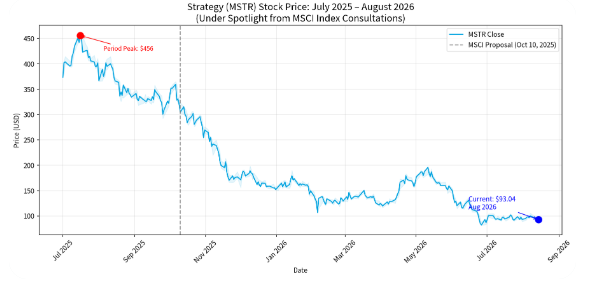
In August 2026, MSCI launched a new consultation examining the eligibility of non-operating companies within its Global Investable Market Indexes.
The terminology has changed.
The underlying concern has not.
Instead of explicitly targeting digital-asset treasury companies, the new framework uses quantitative tests designed to identify companies whose balance sheets and operations resemble investment vehicles more than traditional operating businesses.
The first threshold examines operating assets.
Companies could fail the initial test if operating assets represent less than 50% of total assets.
Additional tests then examine factors including:
- Operating intensity
- Expense intensity
- Cash flow
- Fair-value exposure
- Capital dependence
A company that fails four of the five additional tests could become ineligible for inclusion.
That distinction is important.
MSCI isn’t saying that companies cannot own Bitcoin.
It is effectively determining whether certain companies remain eligible for inclusion in its indexes based on the structure of their businesses.
Strategy Isn’t the Only Company in the Spotlight
Early simulations using the proposed methodology produced some predictable results.
Strategy was flagged for potential removal.
So were Japan’s Bitcoin treasury company Metaplanet and uranium investment company Yellow Cake.
That suggests the framework is broader than crypto.
Nevertheless, digital-asset treasury companies appear particularly exposed because their balance sheets can become heavily concentrated in a single asset.
The proposed rules also include a degree of protection for existing index constituents.
Companies would generally need to fail the relevant criteria across two consecutive review periods before removal takes effect.
That means the consultation does not automatically translate into immediate index deletion.
Strategy Pushes Back
Strategy has already responded publicly.
The company argued that index providers should measure the market rather than determine which assets companies are permitted to own.
That distinction goes to the heart of the debate.
Strategy’s business model is built around using capital markets to acquire and hold Bitcoin.
If index providers classify the company differently because Bitcoin represents a large percentage of its assets, the company could face consequences even without changing its underlying Bitcoin strategy.
The company has also made clear that it does not believe its inclusion in MSCI indexes is necessary for its long-term strategy.
But institutional index flows still matter.
Why Bitcoin Could Feel the Impact Indirectly
The biggest misunderstanding would be to assume that MSCI removing Strategy from an index automatically forces Strategy to sell Bitcoin.
It doesn’t.
Passive funds selling Strategy shares would primarily create selling pressure on MSTR stock.
The Bitcoin connection is more indirect.
If sustained selling pushes Strategy’s share price lower, the premium between its market value and the value of its Bitcoin holdings could compress.
That matters because Strategy’s capital-raising model depends partly on its ability to access equity and debt markets efficiently.
A weaker equity premium can make future capital raises more expensive or less attractive.
And that could eventually reduce the company’s ability to acquire additional Bitcoin.
In other words:
MSCI doesn’t have to force Strategy to sell Bitcoin to affect Bitcoin.
It only needs to weaken one of the mechanisms Strategy uses to finance future purchases.
The Treasury Company Model Is the Bigger Issue
This is why the MSCI consultation matters beyond a single company.
Strategy helped popularize a corporate model in which public companies use capital markets to build large Bitcoin treasuries.
Other companies have followed.
Metaplanet is one example.
The model depends on several moving parts:
Capital markets → corporate financing → Bitcoin purchases → larger treasury → stronger market perception → greater financing capacity.
If any part of that cycle becomes less efficient, the model becomes harder to scale.
Index exclusion could therefore matter even if the affected companies never sell their Bitcoin.
It could increase the cost of capital.
Reduce institutional demand for their shares.
Compress valuation premiums.
And ultimately weaken their ability to act as structural buyers of Bitcoin.
The Timing Is Critical
Bitcoin is entering this new MSCI review from a very different position than it did during the October 2025 episode.
The market is already significantly below its previous record.
Bitcoin is trading around $62,849, roughly half of the approximately $126,000 peak reached in October 2025.
That makes the market more sensitive to additional sources of forced or systematic selling.
But there is also an important difference.
The current proposal is broader and does not explicitly target digital-asset treasury companies.
The outcome is therefore far from certain.
The consultation process itself will determine how the rules evolve.
The Dates Investors Are Watching
The timeline is now straightforward.
September 30: Public feedback period closes.
October 16: MSCI is expected to announce the results of the consultation.
November 2026: Any resulting changes could become relevant during the index review.
That creates several months for companies, investors and index providers to debate the methodology.
It also gives Strategy and other affected companies time to argue that their business models should not be treated like passive investment funds.
Could October 2025 Happen Again?
There is no guarantee.
The current MSCI consultation does not mean Strategy will be removed.
It does not automatically mean billions of dollars will leave the stock.
And it certainly does not mean Strategy will be forced to sell its Bitcoin.
But the mechanism deserves attention.
The October 2025 episode demonstrated how quickly an apparently technical index decision can become a market-wide issue when leveraged positions, passive flows and concentrated crypto exposure collide.
This time, investors have advance warning.
The question is whether that warning prevents another liquidation event—or simply gives the market more time to position for it.
The real risk isn’t MSCI selling Bitcoin.
It’s MSCI potentially weakening the capital-market engine that has helped turn corporate treasury companies into some of Bitcoin’s most important structural buyers.