

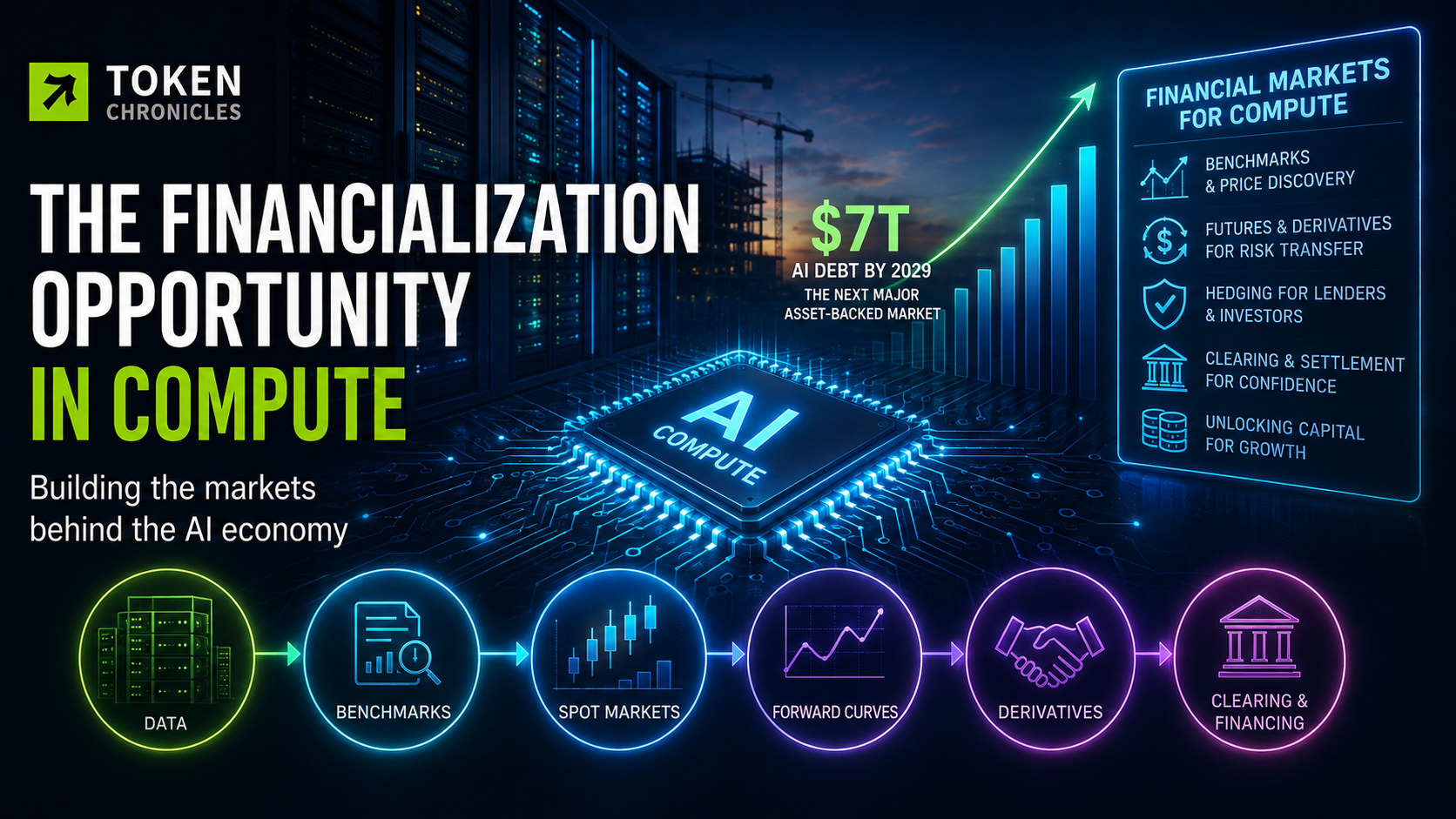
The AI boom is creating an unusual financial challenge: compute is becoming one of the most important economic resources, yet the financial infrastructure needed to fund, price and hedge it remains underdeveloped.
The scale of investment in data centers, GPUs and AI infrastructure is already far beyond most historical capital projects. As more risk becomes concentrated among a relatively small number of companies, traditional financing mechanisms are becoming less effective at distributing that exposure.
For much of the AI buildout, hyperscalers have been able to fund infrastructure largely through their own cash flows. That model is now changing. As capital requirements rise and free cash flow comes under pressure, major technology companies and infrastructure providers are increasingly turning to debt and other forms of external financing.
This creates an emerging opportunity: the financialization of compute.
Just as energy markets developed futures, benchmarks, exchanges and hedging instruments as oil became strategically important, the AI economy may require a comparable financial ecosystem around computing capacity.
AI Financing Is Becoming a Trillion-Dollar Problem
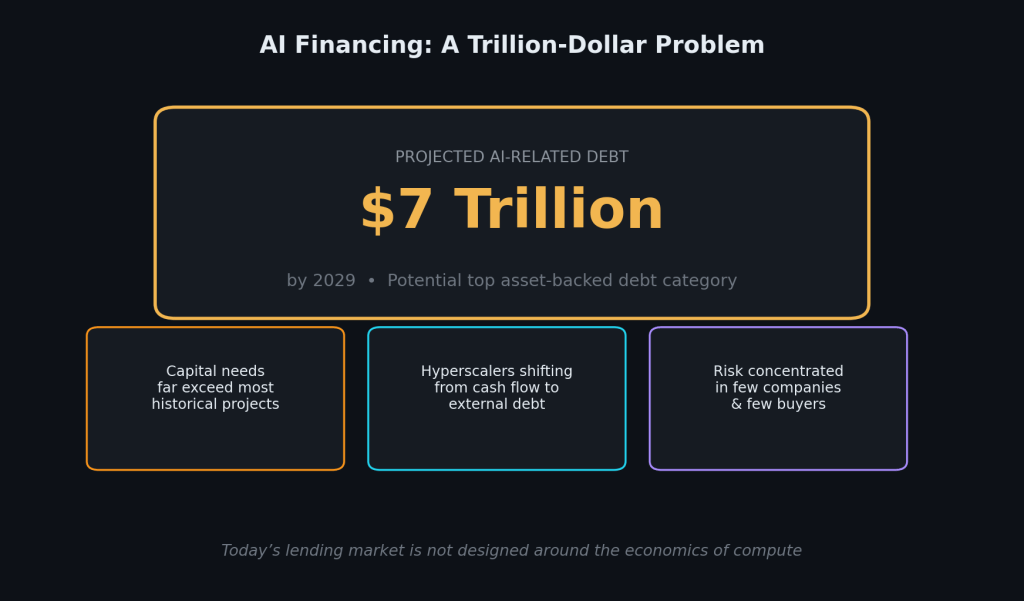
The transition from internally funded infrastructure to debt-financed expansion could create one of the largest new asset-backed financing markets of the decade.
Some industry estimates suggest AI-related debt could reach $7 trillion by 2029, potentially making it one of the largest asset-backed debt categories in the world.
The challenge is that today’s lending market is not designed around the economics of compute.
Lenders remain cautious because the value of computing capacity can change rapidly. Much of the current financing therefore depends on long-term contracts with major hyperscalers. In effect, lenders are often evaluating the creditworthiness of the customer rather than taking direct exposure to the underlying demand and pricing of compute.
That structure creates an imbalance.
AI infrastructure providers can obtain financing more easily when they have long-term contracts with highly rated customers. But financing becomes considerably more expensive when those contracts are absent. This can make it difficult for smaller cloud providers, often referred to as neoclouds, to serve a broader customer base.
The result is a market where access to capital is closely tied to a handful of major buyers.
NVIDIA Is Already Acting as a Financial Bridge
NVIDIA has begun addressing part of this problem by supporting GPU rental arrangements for infrastructure providers.
Under some structures, NVIDIA can effectively provide a minimum economic floor for GPU capacity while participating in revenue generated above that level. This can help neoclouds secure financing while allowing them to offer shorter-duration agreements to a wider range of customers.
The approach can provide several advantages:
- Broader customer diversification
- Greater lender confidence in non-hyperscaler contracts
- Stronger economics for emerging cloud providers
- Additional support for the wider AI infrastructure ecosystem
But NVIDIA cannot realistically absorb the financing risk of the entire industry.
Its involvement should therefore be viewed less as a complete solution and more as evidence that the market needs dedicated financial infrastructure for compute.
The scale of capital being assembled around AI infrastructure reinforces that point. Financing is increasingly becoming a strategic component of the AI supply chain rather than simply a source of capital.
Compute Lacks a Proper Hedging Market
The financing challenge extends beyond access to debt.
Lenders also need a way to protect themselves against a sharp decline in compute prices.
Energy markets provide a useful comparison. Banks financing energy infrastructure often require borrowers to hedge a significant portion of expected production. Those hedges provide lenders with greater confidence that falling commodity prices will not destroy the economics of the underlying project.
Compute does not yet have an equivalent market.
There is no widely accepted benchmark for GPU rental prices that lenders can use to hedge their exposure. As a result, lenders effectively charge a premium for taking compute-price risk.
That additional cost makes financing more expensive and can encourage infrastructure providers to concentrate their business around the largest, most creditworthy customers.
A functioning compute derivatives market could change this dynamic.
Instead of relying exclusively on long-term contracts, infrastructure providers could potentially hedge future GPU pricing directly. Lenders could then incorporate those hedges into financing agreements, allowing them to underwrite projects with greater confidence.
The first participants may be traders and speculators, but institutional lenders are likely to become the strongest force pushing standardized compute benchmarks into the mainstream.
Equity Investors Also Need Compute Risk Management
Compute pricing will not matter only to lenders.
As AI infrastructure becomes a larger component of corporate valuations and investment portfolios, equity investors will increasingly be exposed to changes in the economics of computing.
A publicly traded company building billions of dollars of GPU capacity, for example, faces a straightforward question: what will that capacity be worth several years from now?
Investors currently have limited tools for answering it.
A transparent compute market could provide reference prices for GPU capacity and help investors evaluate infrastructure companies, estimate asset depreciation and model future cash flows.
The market could eventually support both hedging and speculation.
The oil industry demonstrates how large the speculative component of a mature commodity market can become. Paper trading volumes can greatly exceed the physical quantity of the commodity itself as financial participants use derivatives to express views, hedge exposure and arbitrage differences between markets.
Compute could eventually develop a similar layer.
The First Requirement: A Reliable Benchmark
None of this can happen without a credible price benchmark.
There is no universal “price of compute” today. The cost of a GPU hour depends on factors including the specific chip, location, electricity costs, networking, utilization, contract duration, workload and service level.
A useful benchmark therefore needs to reflect what customers actually pay rather than simply publishing an arbitrary theoretical rate.
The initial market will likely begin with chip-specific benchmarks, particularly around major GPU families. Over time, benchmarks could evolve toward workload-based or output-based measures as the industry develops greater standardization.
Once reliable spot pricing exists, a forward curve can emerge.
That curve would provide a reference for future compute prices and allow participants to transfer risk across different time horizons. It could also give investors a more objective basis for estimating GPU depreciation and infrastructure valuations.
From Benchmarks to Exchanges and Clearing
A benchmark is only the beginning.
Once a reliable reference price exists, exchanges could develop futures and other standardized contracts around it. Banks and institutional investors could also use the benchmark for over-the-counter transactions.
The final component would be clearing and settlement infrastructure.
That layer is particularly important for lenders. A standardized, centrally cleared contract is far more useful as part of a financing agreement than an informal bilateral hedge.
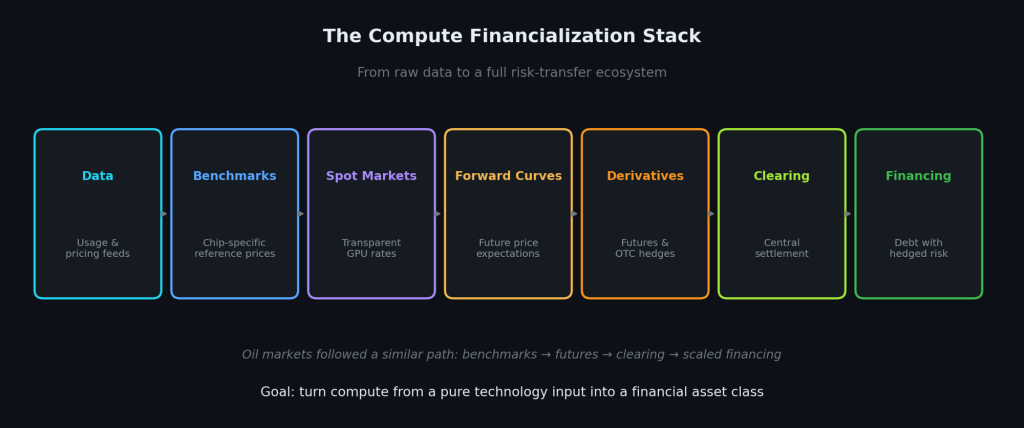
The resulting ecosystem could eventually contain:
Data → Benchmarks → Spot Markets → Forward Curves → Derivatives → Clearing → Financing
Together, these components could transform compute from a purely technological input into a financial asset class with standardized methods for pricing and transferring risk.
Oil Offers a Blueprint
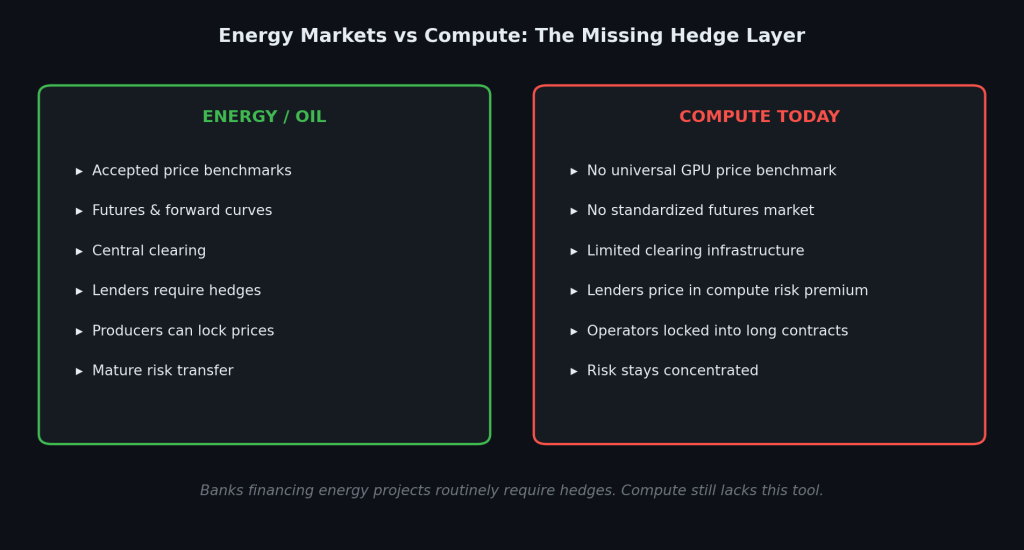
The closest historical comparison is the development of modern energy markets.
Oil became an essential economic resource long before sophisticated financial markets developed around it. Eventually, the emergence of standardized benchmarks and futures contracts allowed producers, consumers, banks and investors to manage price risk at scale.
The creation of benchmark markets produced enormous businesses around both exchanges and financial data.
The lesson for compute is straightforward: the financial infrastructure surrounding a critical commodity can become almost as valuable as the commodity itself.
As computing becomes increasingly important to global economic activity, the companies that provide pricing data, benchmarks, trading infrastructure and risk-management tools could capture significant value.
The Window for Compute Financialization Is Opening
The AI infrastructure boom is reaching a stage where technology alone is no longer the only constraint.
Capital availability, financing costs and risk management are becoming equally important.
If AI infrastructure requires trillions of dollars in additional debt, lenders will need reliable ways to understand and hedge the risks associated with GPU capacity and compute prices. Investors will need transparent market data to value infrastructure assets. Operators will need mechanisms to manage future revenue uncertainty.
That creates an entirely new financial layer around AI.
The opportunity is not simply to build another exchange or another data provider. It is to create the market infrastructure that allows compute risk to be priced, traded and financed efficiently.
Oil had decades to develop this infrastructure.
Compute is unlikely to have that luxury.
The companies building benchmarks, data platforms, exchanges, derivatives and financing systems for compute today may ultimately become the financial backbone of the AI economy.