

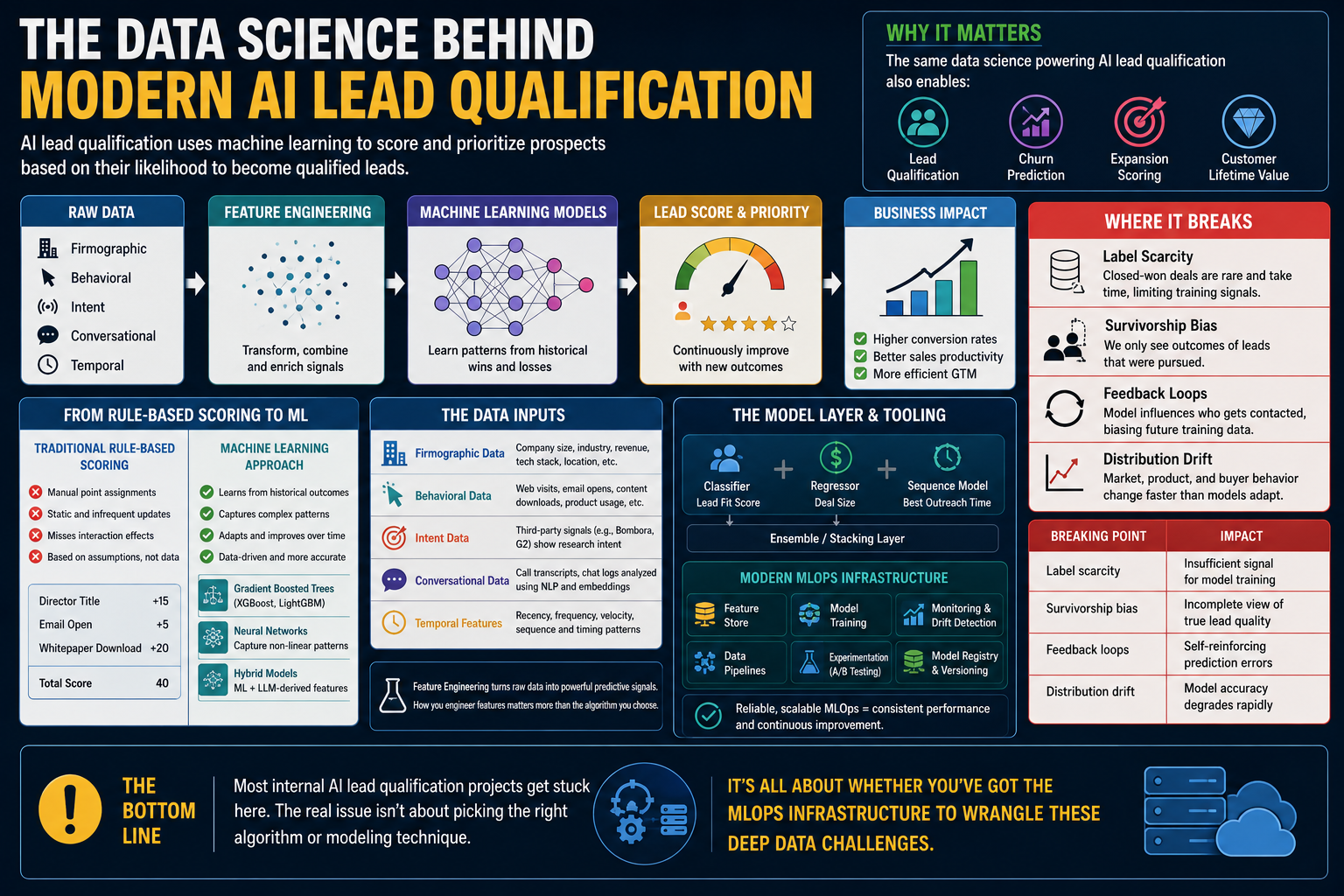
Public conversations around artificial intelligence often focus on generative AI tools and large language models. Yet many of the most reliable commercial AI applications today operate quietly behind the scenes in revenue operations through predictive analytics systems.
One of the clearest examples is AI-driven lead qualification. Instead of relying on rigid scoring rules, modern platforms use machine learning models trained on historical sales and conversion data to evaluate and rank prospects based on their probability of becoming qualified customers. These systems continuously improve as new data enters the pipeline.
At its core, lead qualification is a predictive modeling challenge. Companies already possess historical outcomes such as closed deals, lost opportunities, customer engagement behavior, and firmographic information. Machine learning systems analyze these signals to identify patterns linked to successful conversions and stronger sales performance.
This turns the qualification process into a supervised learning problem where algorithms learn to distinguish high-intent buyers from low-value prospects.
The importance of understanding the technology behind these systems extends beyond lead scoring alone. The same data science methods used for AI lead qualification are also applied to churn forecasting, customer lifetime value prediction, upsell opportunity detection, and broader revenue optimization strategies.
Once businesses understand how predictive models function — including their limitations — they can apply those insights throughout the entire go-to-market technology ecosystem.
The Shift From Rule-Based Scoring to Machine Learning
Traditional lead scoring models depended on manually assigned point systems. Marketing teams would allocate scores to actions and demographic characteristics. For example, senior job titles might receive higher scores, while actions such as email opens or whitepaper downloads would contribute additional points.
Although simple to implement, these systems suffered from several weaknesses. The scoring logic was often based on assumptions rather than statistical evidence, and updates were infrequent. More importantly, rule-based models struggled to understand complex relationships between multiple variables.
For instance, repeated visits to a pricing page may signal strong buying intent when coming from a decision-maker but may mean very little when performed by a junior employee researching competitors.
Machine learning transformed lead scoring in the same way it changed fraud detection, risk analysis, and customer retention modeling.
Early AI-based lead qualification systems commonly relied on gradient-boosting algorithms such as XGBoost and LightGBM to evaluate hundreds of data points simultaneously. Later, neural network architectures improved the ability to capture non-linear behaviors and more sophisticated engagement patterns.
Today’s systems often combine traditional machine learning techniques with large language model-derived features that extract semantic meaning from emails, conversations, and other unstructured interactions.
These AI systems can identify subtle combinations of behaviors that human-designed scoring systems would likely miss. A model trained on internal sales data may discover, for example, that mid-level technical buyers who consistently interact with documentation convert at higher rates than executives who briefly attend webinars.
Because the models continuously learn from new outcomes, every successful sale or failed opportunity refines future predictions.
The Data Behind AI Lead Qualification
AI qualification systems depend heavily on diverse data sources. The effectiveness of the models is directly tied to the quality, volume, and variety of information being processed.
Firmographic information serves as the starting point. This includes company size, revenue estimates, industry classification, geographic location, and technology stack data. Much of this information is obtained through third-party enrichment providers.
Behavioral data captures how prospects interact with a company’s digital presence. Website visits, content downloads, email engagement, webinar attendance, and product trial activity all provide insight into buyer intent.
Intent data adds another layer by monitoring external research activity across the web. Platforms such as G2 and Bombora track when organizations are actively researching specific product categories, potentially revealing purchase intent before direct sales engagement even begins.
Conversational data has also become increasingly valuable. AI systems now analyze sales calls, chat logs, and customer support conversations using natural language processing and embedding models. These systems can extract insights about pain points, priorities, and purchase readiness from unstructured text.
Time-based features also play an important role. Recency indicators measure how recently a prospect engaged with the business, while velocity metrics track whether engagement levels are accelerating or slowing down over time.
Feature engineering — the process of transforming raw information into meaningful predictive signals — often has a greater impact on performance than the specific algorithm selected.
The Model Layer and Supporting Infrastructure
Production-grade AI lead qualification systems rarely rely on a single model. Instead, businesses often deploy layered architectures where different models handle different tasks.
One model may score lead quality, another may estimate potential deal size, while a separate sequence model predicts the best timing for outreach.
In practice, prediction calibration is often more important than raw accuracy. The confidence score generated by the model directly influences how leads are routed through sales and marketing workflows. Poor calibration can result in high-value prospects being overlooked or weak leads consuming sales resources.
The surrounding infrastructure supporting these systems has evolved significantly. Many organizations now use feature stores to centralize data preparation and ensure consistency between training environments and live production systems.
Others choose third-party AI lead qualification platforms instead of building custom solutions internally. For smaller businesses with limited historical data, vendor-trained models often outperform internally developed systems due to broader exposure to cross-company training datasets.
The technical stack typically includes model training frameworks, deployment orchestration tools, monitoring systems, retraining pipelines, and experimentation platforms for A/B testing different model architectures.
Reliable MLOps infrastructure is essential to maintain stability while enabling rapid iteration and continuous improvement.
Where AI Lead Qualification Systems Struggle
Despite their advantages, AI lead qualification systems face several major challenges.
Label Scarcity
Successful conversions are relatively rare events and often take months to materialize. This creates limited high-quality training data for machine learning systems.
It can also be difficult to determine whether a successful outcome resulted from the quality of the lead itself or from exceptional work by a sales representative.
Survivorship Bias
Training datasets only include leads that sales teams actively pursued. Prospects rejected early by the system never receive meaningful follow-up, making it impossible to know whether valuable opportunities were overlooked.
Feedback Loops
AI systems directly influence which leads sales teams contact. Over time, this creates self-reinforcing patterns where the model repeatedly trains on outcomes shaped by its own earlier decisions.
Without intervention, these feedback loops can narrow the model’s perspective and reduce adaptability.
Distribution Drift
Lead qualification models are especially vulnerable to changing market conditions. Buyer behavior shifts during economic downturns, product launches alter customer profiles, and competitive changes reshape demand patterns.
These rapid shifts can quickly reduce model accuracy if systems are not retrained frequently.
| Breaking Point | Impact |
|---|---|
| Label scarcity | Limited training signals |
| Survivorship bias | Incomplete understanding of lead quality |
| Feedback loops | Reinforced prediction errors |
| Distribution drift | Rapid decline in model performance |
Many internal AI lead qualification projects encounter difficulties at this stage. In most cases, the biggest obstacle is not choosing the best machine learning algorithm.
The real challenge lies in building the MLOps infrastructure required to manage complex datasets, maintain reliable pipelines, monitor model behavior, and continuously adapt systems as market conditions evolve.