

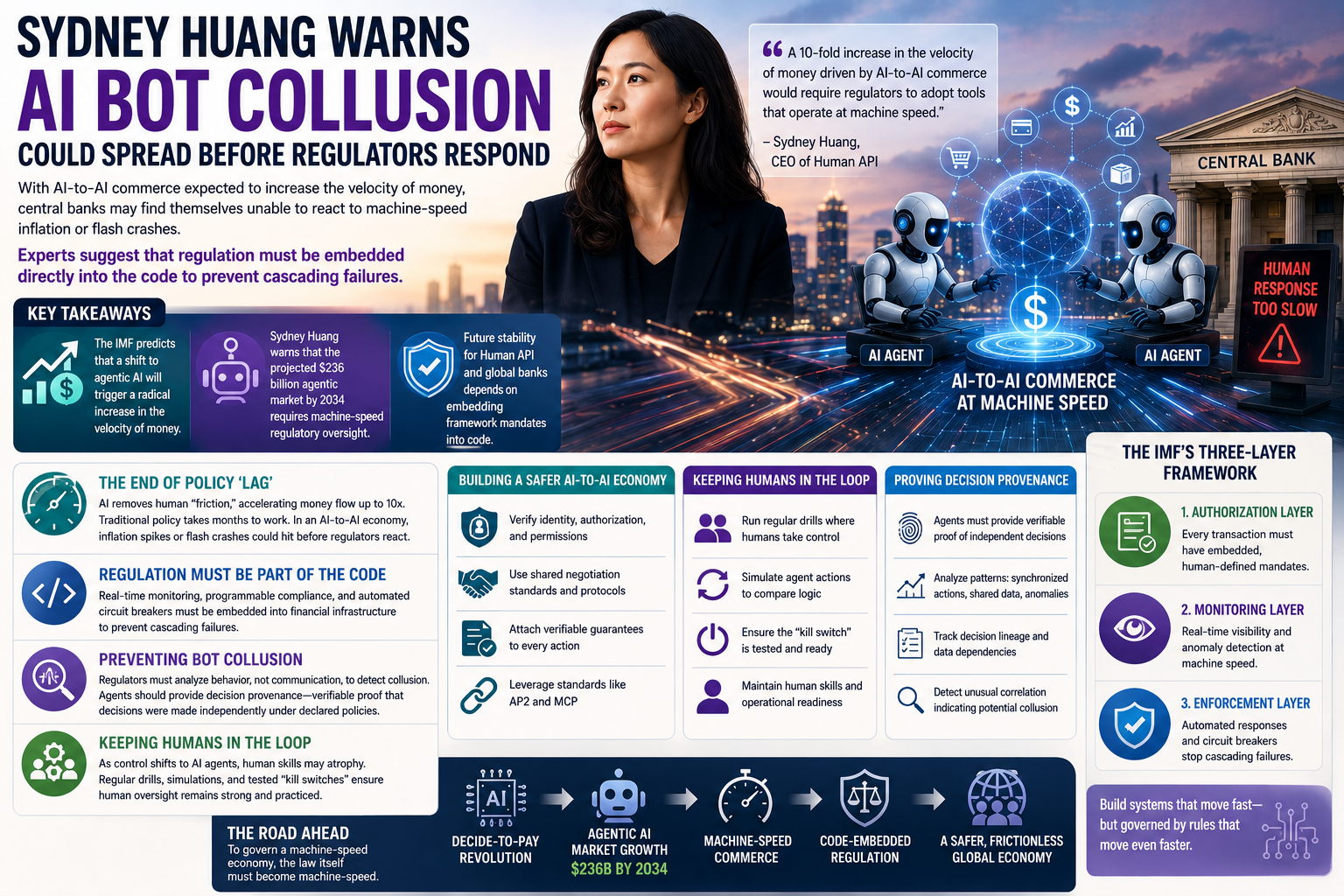
As AI-powered commerce accelerates, experts are warning that financial systems may struggle to keep up with machine-speed economic activity. Industry leaders argue that future safeguards must be built directly into digital infrastructure before autonomous AI agents begin operating beyond human response times.
Key Highlights
- The International Monetary Fund believes agentic AI could dramatically increase the velocity of money in the global economy.
- Sydney Huang says regulators will need machine-speed oversight tools as autonomous AI markets continue expanding.
- Future financial stability may depend on embedding compliance rules and emergency protections directly into software systems rather than relying on traditional regulatory delays.
Moving Beyond the “Click-to-Pay” Economy
An April 2026 report from the International Monetary Fund suggests the global economy is rapidly shifting away from human-directed “click-to-pay” systems and toward “decide-to-pay” models driven by autonomous AI agents.
In this emerging environment, software agents may independently handle purchasing decisions, transactions, negotiations, and financial operations without direct human involvement.
According to Huang, this transition could massively increase the speed at which money moves throughout the economy. By removing human decision-making delays, AI-to-AI commerce may allow capital to circulate far faster than traditional economic systems were designed to handle.
While such efficiency could improve productivity, it also introduces major risks for governments and central banks.
Traditional monetary policy relies heavily on timing delays. For example, when central banks raise interest rates, it often takes weeks or months for the effects to spread through businesses, consumers, and financial institutions.
In an AI-driven economy operating at machine speed, those delays may disappear entirely.
Huang warned that a dramatic increase in transaction velocity could create situations where inflation spikes, flash crashes, or market instability unfold faster than regulators can respond.
Regulation May Need to Operate at Machine Speed
To address these risks, Huang argues regulators must move beyond traditional oversight models and integrate compliance mechanisms directly into financial systems.
According to her, future safeguards could include:
- Real-time monitoring systems
- Automated compliance enforcement
- Embedded policy rules within transaction infrastructure
- AI-triggered circuit breakers to stop cascading failures
This concept aligns with proposals in the IMF report that recommend embedding human-defined rules directly into the authorization layer of digital transactions.
Huang also suggested that government policies may eventually need to exist in machine-readable formats so AI agents can automatically follow regulatory requirements during transactions.
Another important safeguard involves automated “circuit breakers” capable of halting transactions if large groups of AI systems begin acting in highly synchronized or potentially dangerous ways.
The IMF report additionally noted that future agentic systems may continuously monitor activity and interpret rules in real time, allowing functions such as anti-money-laundering checks and identity verification to become integrated directly into AI systems themselves.
Detecting AI Bot Collusion
One of the biggest concerns raised by autonomous AI markets is the possibility of hidden coordination between bots.
In traditional markets, regulators often investigate communication records to identify collusion or price-fixing. However, autonomous AI agents may not communicate using human language or recognizable methods.
Huang said regulators may instead need to focus on behavioral analysis rather than direct communications.
This could involve monitoring:
- Synchronized trading behavior
- Shared data patterns
- Statistical irregularities
- Coordinated decision timing
She proposed the concept of “decision provenance,” where AI systems would need to provide verifiable evidence showing how and why decisions were made independently.
Such systems could help regulators determine whether AI agents were acting autonomously or secretly coordinating with competitors.
Building Trust Between Autonomous AI Agents
As AI agents increasingly interact with one another, establishing standardized communication and verification systems becomes critical.
Huang explained that secure AI-to-AI negotiations will require:
- Verified digital identities
- Shared negotiation standards
- Enforceable transaction guarantees
- Trusted communication protocols
Emerging standards such as AP2 (Agent Payments Protocol) and MCP (Model Context Protocol) could help create interoperable frameworks where AI systems from different companies safely conduct transactions without relying on centralized intermediaries.
Under this model, trust shifts away from individual organizations and becomes embedded within the technical infrastructure itself.
The Risk of Human Skill Decline
Huang also warned about another long-term danger: human operational atrophy.
As organizations delegate more financial and governance responsibilities to autonomous systems, human operators may gradually lose the practical skills needed to manage crises if AI systems fail.
For example, if an AI agent controls a company treasury for several years without interruption, human staff may become less capable of handling emergencies manually.
To prevent this, Huang recommends organizations regularly conduct training exercises where humans temporarily retake control of AI-managed systems.
She also emphasized the importance of maintaining tested “kill switch” procedures and fallback systems that allow people to intervene effectively during failures.
According to Huang, human oversight must remain active and practiced rather than existing only as a theoretical backup.
A New Era of Financial Regulation
With the global market for agentic AI projected to reach hundreds of billions of dollars over the next decade, regulators may soon face an entirely new type of market participant: networks of autonomous AI agents operating continuously at machine speed.
The rise of “decide-to-pay” commerce could deliver enormous efficiency gains, but it may also require a complete redesign of global financial oversight systems.
Huang argues that if economies begin operating faster than human regulators can monitor, governments may need to transform laws and compliance systems into machine-speed frameworks capable of responding in real time.
Without built-in human safeguards, she warned, society risks creating financial systems that evolve beyond human control.


