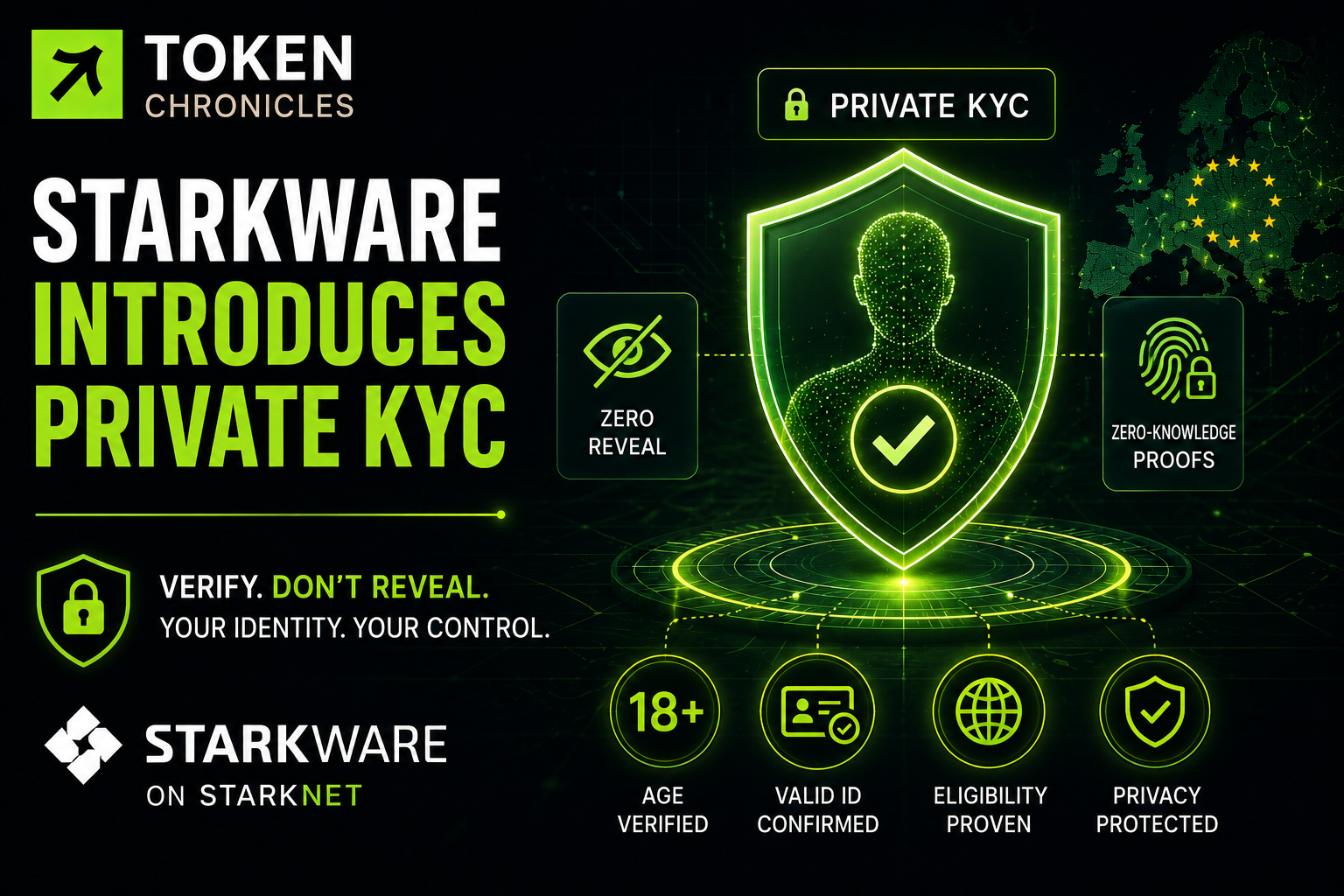
Blockchain infrastructure company StarkWare has introduced a new identity verification system called Private KYC, designed to allow users to complete regulatory checks without exposing sensitive personal information.
The solution, currently showcased as a demonstration on the Starknet network, uses zero-knowledge proofs (ZK proofs) to verify specific pieces of information—such as age, nationality, or eligibility—while keeping the user’s full identity private.
A New Approach to Digital Identity
Traditional KYC procedures often require users to submit passports, addresses, and other personal documents, creating large databases of sensitive information that can become attractive targets for hackers.
StarkWare argues that this model is outdated.
Instead of sharing an entire passport to prove a single fact, users can now verify only what is necessary. For example:
- Prove they are over 18 years old.
- Confirm possession of a valid government-issued ID.
- Demonstrate eligibility for a specific service.
- Verify residency without revealing an exact address.
The actual personal data remains encrypted and under the user’s control.
How Private KYC Works
The process begins with users scanning their passport using a smartphone. The device reads the document through its camera and NFC chip to verify authenticity.
Once verified:
- Identity information is encrypted and stored in the user’s Starknet wallet.
- Key attributes are registered on-chain without revealing personal details.
- Zero-knowledge proofs are generated whenever verification is required.
- Third parties can confirm eligibility without ever accessing the original identity data.
This creates a self-custodial identity system where users maintain control over their own information.
Privacy Becomes a Growing Concern
The launch comes at a time when data breaches are reaching record levels globally.
Cybersecurity reports show that thousands of major data breaches occurred last year alone, exposing millions of personal records and costing organizations billions of dollars.
Healthcare, financial services, and technology companies have been among the hardest hit sectors.
The crypto industry has also experienced high-profile incidents. One of the most notable was the 2020 breach of hardware wallet provider Ledger, where customer information was leaked, leading to years of phishing attacks targeting users.
Privacy and Compliance No Longer Need to Conflict
StarkWare believes regulatory compliance and privacy can coexist.
Rather than forcing institutions to collect and store massive amounts of sensitive information, Private KYC allows them to verify only the exact data required to meet legal obligations.
This significantly reduces the risks associated with storing customer identities while maintaining compliance with existing regulations.
Competing Vision for Digital Identity
The announcement also enters the broader debate around decentralized identity systems.
Projects such as World ID have attempted to solve the same problem using biometric verification methods. However, those systems have faced criticism over the storage and management of sensitive biometric data.
StarkWare is taking a different path by emphasizing self-custody and cryptographic privacy, allowing users to prove who they are without permanently handing over their identity to a central authority.
The Future of Identity Verification
As regulators demand stronger compliance while users demand greater privacy, solutions like Private KYC may represent the next evolution of digital identity.
By combining zero-knowledge cryptography with self-custody, StarkWare is aiming to create a system where users can verify themselves online without sacrificing control over their personal information, a balance that has long remained one of the biggest challenges in the digital age.