
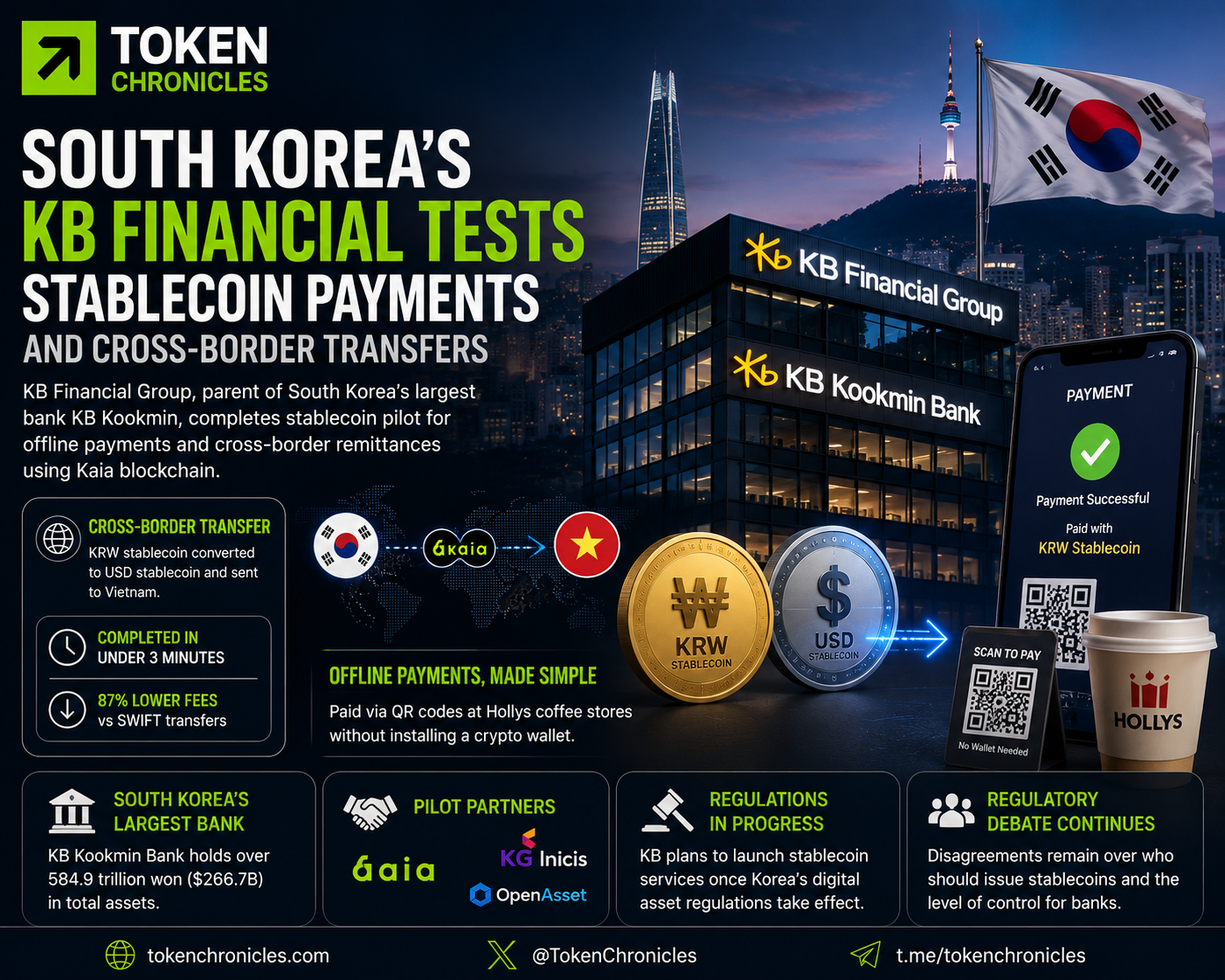
KB Financial Group, the parent company of South Korea’s largest bank KB Kookmin, has successfully completed a stablecoin pilot focused on offline payments and international remittances using the Kaia blockchain network.
The experiment marks another major step in South Korea’s growing push toward integrating stablecoins into traditional financial infrastructure ahead of upcoming digital asset regulations.
Stablecoin Pilot Covered Full Payment Lifecycle
According to local reports, the pilot tested multiple components of a South Korean won-backed stablecoin ecosystem, including:
- Stablecoin issuance
- Merchant payment settlement
- Cross-border remittances
- Offline QR-code transactions
The project was conducted in partnership with:
- Kaia blockchain
- Electronic payments company KG Inicis
- Fintech firm OpenAsset
Cross-Border Transfer Completed Faster and Cheaper
As part of the test, a Korean won stablecoin was converted into a US dollar stablecoin and transferred to a bank account in Vietnam.
The transaction reportedly:
- Completed in under three minutes
- Reduced transfer fees by roughly 87% compared to traditional SWIFT-based transfers
The SWIFT system remains the dominant global network for international banking payments, but blockchain-based stablecoin settlements are increasingly being explored as faster and lower-cost alternatives.
Offline Payments Tested Without Crypto Wallets
The pilot also included real-world offline payment testing through Seoul-based coffee chain Hollys.
Users were able to make payments using QR codes without needing to install or manage a cryptocurrency wallet, highlighting efforts to simplify blockchain-based payments for mainstream consumers.
South Korea Accelerates Stablecoin Development
The KB Financial initiative adds to a growing list of major South Korean financial institutions experimenting with digital assets and stablecoins.
Earlier this year, Shinhan Card — one of the country’s largest credit card companies — partnered with the Solana Foundation to explore stablecoin payment systems.
KB Kookmin itself remains one of South Korea’s largest financial institutions, managing hundreds of trillions of won in assets.
Regulatory Uncertainty Still Remains
Despite growing momentum, South Korea’s stablecoin regulations are still under debate.
The proposed Digital Asset Basic Act has faced delays due to disagreements between regulators regarding:
- Who should be allowed to issue stablecoins
- The level of control banks should maintain
- Innovation versus financial oversight
The Bank of Korea reportedly favors stronger bank ownership and oversight of stablecoin issuers, while financial regulators have warned that overly strict rules could slow innovation in the digital asset sector.
Formal discussions on the legislation are expected to continue after South Korea’s upcoming local elections.