
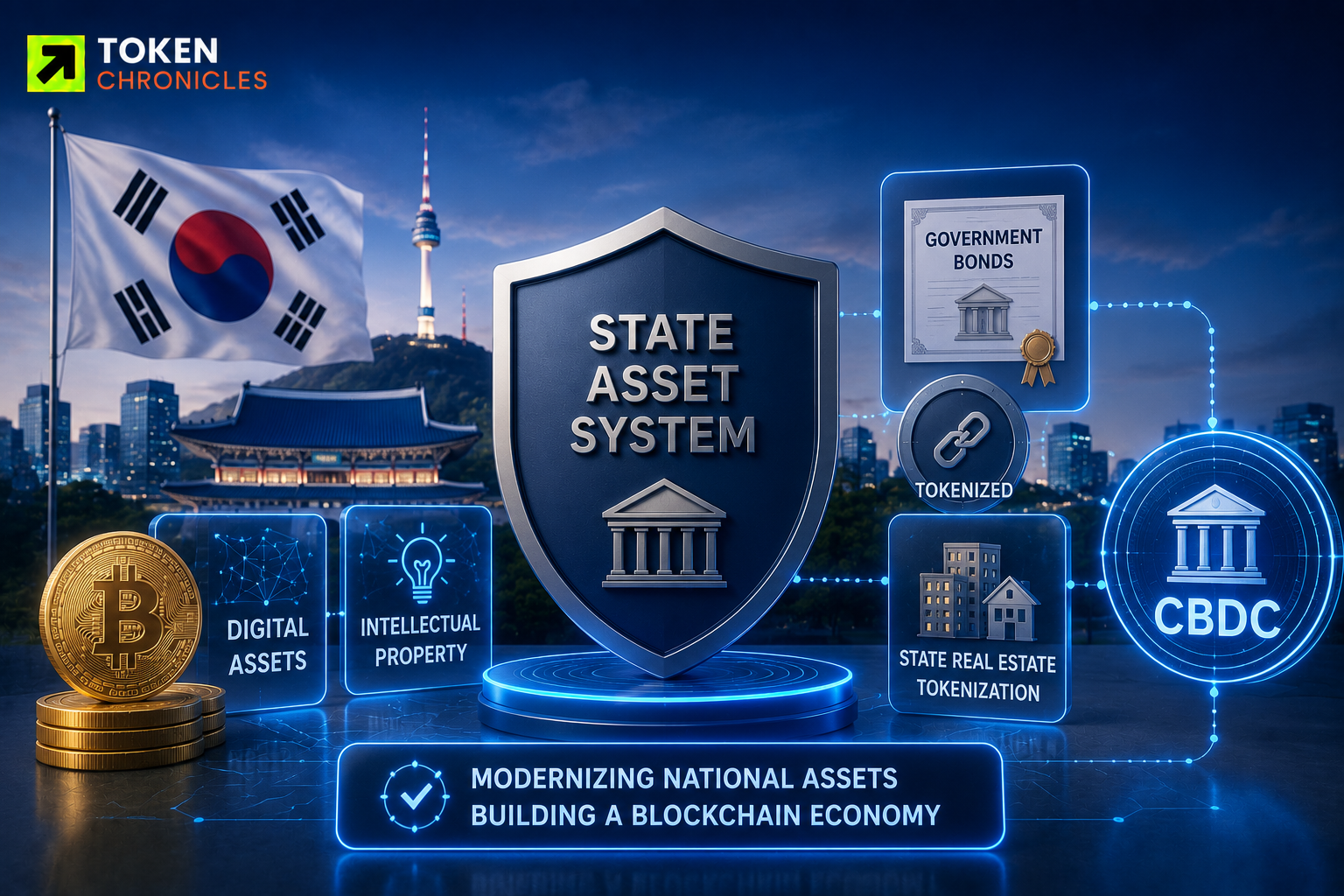
South Korea is preparing one of its most ambitious digital asset reforms yet, unveiling plans to bring cryptocurrencies, tokenized assets, and intellectual property under a modernized national asset management framework.
The Ministry of Economy and Finance (MOEF) announced that the country will introduce the National Asset Basic Act, replacing the decades-old State Property Act of 1950. The legislation aims to redefine how the government manages public assets by recognizing digital assets as part of the nation’s strategic wealth.
The move reflects South Korea’s broader vision of building a blockchain-powered digital economy while modernizing the management of state-owned assets.
A modern definition of national assets
For decades, South Korea’s asset management framework focused primarily on physical assets such as land, buildings, and infrastructure.
The proposed National Asset Basic Act significantly broadens this definition by incorporating digital assets, tokenized securities, and intellectual property into the government’s long-term asset management strategy.
Rather than viewing digital assets solely as speculative investments, policymakers are increasingly recognizing them as valuable components of the country’s economic infrastructure.
The reform seeks to shift state asset management from simple ownership toward maximizing long-term economic value and public participation.
Government bonds to move onchain
As part of the initiative, South Korea reaffirmed plans to tokenize government bonds using blockchain technology.
Authorities intend to launch a 2027 pilot program that will issue tokenized government securities, aiming to improve settlement efficiency, reduce transaction costs, and streamline financial operations.
The project represents another step in South Korea’s efforts to integrate blockchain technology into mainstream public finance.
Tokenizing public real estate
Beyond government bonds, officials are also studying the tokenization of state-owned real estate.
The proposal would allow public assets to be represented as blockchain-based digital tokens, potentially enabling broader retail participation in government-owned investment opportunities.
Under the concept being explored, citizens could invest in tokenized public assets while sharing in a portion of the returns generated from those properties.
If implemented, the initiative could expand access to investment opportunities that have traditionally been limited to institutional or government entities.
Building a blockchain Economy
The announcement forms part of South Korea’s wider strategy to build what officials describe as a “blockchain economy.”
Earlier this week, the government released its 2026 Economic Growth Strategy, outlining plans to connect tokenized government bonds with the Bank of Korea’s central bank digital currency (CBDC) infrastructure during a 2027 pilot.
Authorities also plan to study interoperability between the Bank of Korea’s CBDC platform and public blockchain networks, enabling greater flexibility for future digital financial infrastructure.
The objective is to create an integrated ecosystem where tokenized assets, digital payments, and blockchain-based financial services operate together within a regulated framework.
Tokenized securities framework nears completion
South Korea has been steadily building the legal foundations for tokenized finance.
The country’s revised Capital Markets Act and Electronic Securities Act, scheduled to take full effect in February 2027, will officially recognize blockchain ledgers as legally valid securities registries.
The legislation will move tokenized securities out of their current pilot phase and place them under the supervision of the Financial Services Commission, providing clear legal recognition for blockchain-based financial assets.
Strengthening south Korea’s digital finance leadership
South Korea already operates one of the world’s most active cryptocurrency markets, with millions of retail investors participating in digital asset trading.
By expanding national asset legislation to include blockchain-based assets while simultaneously advancing CBDCs, tokenized bonds, and digital securities, the government is positioning itself at the forefront of financial innovation.
The coordinated regulatory approach could make South Korea one of the first major economies to integrate digital assets across public finance, capital markets, and state asset management.
South Korea’s latest reforms demonstrate that governments are increasingly viewing blockchain as critical financial infrastructure rather than simply a technology supporting cryptocurrencies.
By recognizing digital assets within its national asset framework and advancing tokenization across government finance, the country is laying the foundation for a more digital, transparent, and efficient public financial system.
If successfully implemented, the initiative could serve as a model for other nations seeking to modernize state asset management while embracing blockchain technology and tokenized finance.