
South Korea is moving toward a more institution-focused digital-asset market, with a three-part policy push covering corporate crypto investment, tokenized securities and bank-issued deposit tokens.
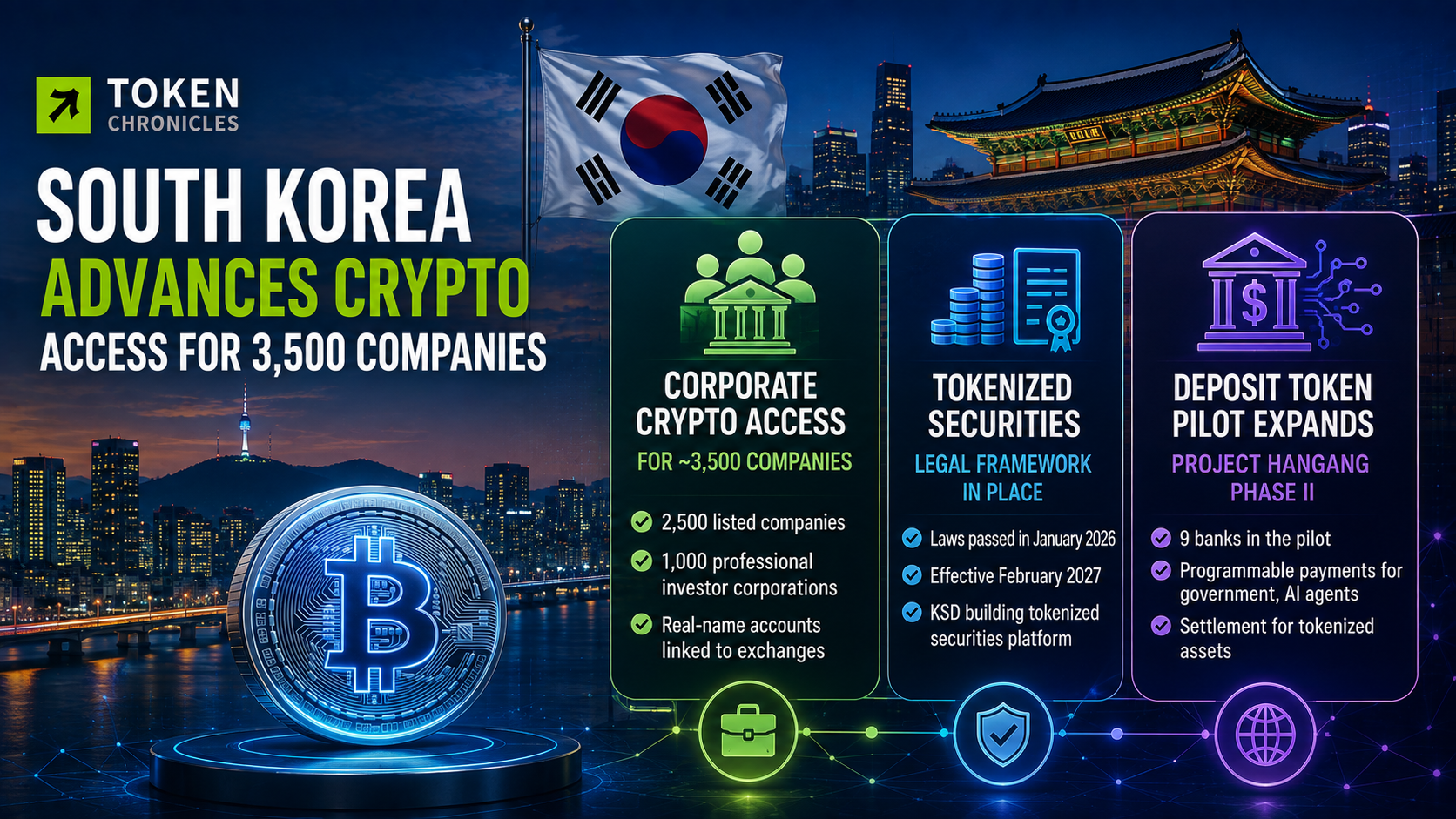
The initiative could open regulated crypto access to roughly 3,500 companies, while new securities legislation is preparing the legal foundation for tokenized assets. At the same time, the Bank of Korea is expanding trials of deposit tokens across nine banks, including experiments involving government payments, AI-agent transactions and tokenized securities settlement.
Up to 3,500 Companies Set to Enter Crypto Market
South Korea’s Financial Services Commission has been gradually opening the digital-asset market to corporations after years of effectively restricting corporate participation through real-name banking requirements.
Under the regulator’s roadmap, approximately 2,500 listed companies and 1,000 registered professional-investor corporations could eventually receive access to real-name bank accounts connected to local crypto exchanges.
Financial institutions remain excluded from this phase, and the program is structured as a controlled pilot rather than unrestricted corporate participation.
For years, Korean companies were largely unable to trade virtual assets through domestic exchanges because banks did not provide the necessary corporate real-name accounts. The initial phase instead focused on nonprofits, universities, law-enforcement agencies and crypto-related organizations that needed to liquidate assets received through donations, seizures or operating activities.
The expansion to listed companies and professional investors reflects regulators’ view that these entities have greater capacity to assess investment risks and manage digital-asset exposure.
Proposed guidelines have also considered limiting annual crypto investments to around 5% of a company’s equity capital, with eligible assets potentially restricted to the 20 largest cryptocurrencies by market capitalization across Korea’s major exchanges.
The question of whether dollar-backed stablecoins such as USDT will qualify remains under consideration.
Growing institutional participation is also increasing demand for regulated custody services. BitGo Korea, for example, recently received virtual-asset service provider registration from South Korea’s Financial Intelligence Unit, positioning it to develop custody and transfer services for institutional clients.
Tokenized Securities Receive a Legal Framework
South Korea is simultaneously building a formal regulatory foundation for tokenized securities.
Amendments to the Electronic Securities Act and Capital Markets Act were passed in January 2026 and are scheduled to take effect in February 2027.
The revised Electronic Securities Act will recognize distributed-ledger technology as a legitimate means of maintaining securities records. Rather than placing tokenized assets outside the existing financial system, the framework brings them under established securities infrastructure and registration requirements.
The Capital Markets Act amendments also expand regulation to investment-contract securities and fractional investment products, allowing licensed intermediaries to participate in their distribution.
South Korea is already preparing the technology needed for the new framework. Samsung SDS has been working with the Korea Securities Depository to develop a production-grade tokenized-securities platform capable of managing issuance records, ownership information, rights and token circulation.
Financial institutions are also experimenting with tokenized investment products ahead of the 2027 implementation date.
Bank of Korea Expands Deposit-Token Pilot
A separate initiative is targeting the payments side of digital finance.
Through Project Hangang, the Bank of Korea is testing deposit tokens issued by commercial banks and settled using wholesale central-bank money.
Unlike cryptocurrencies or retail CBDCs, deposit tokens represent commercial-bank deposits in digital form. Banks issue the tokens to customers, while tokenized central-bank money facilitates settlement between participating institutions.
The first phase began in 2025 and attracted approximately 80,000 wallet users, who completed around 118,000 transactions.
Phase II, launched in 2026, expanded participation from seven to nine banks, adding BNK Kyongnam Bank and iM Bank to the existing group of participating institutions.
The expanded pilot includes peer-to-peer transfers, biometric payment authorization and automated conversion between traditional deposits and deposit tokens.
The Bank of Korea is also testing programmable payments, including digital vouchers and government-funded transactions. Such controls could determine where funds can be spent, which recipients can receive them and how long the funds remain usable.
Deposit Tokens Could Power AI-Agent Payments
One of the more forward-looking elements of Project Hangang is its exploration of AI-driven payments.
LG CNS demonstrated a system in which an AI agent could identify a product or service, evaluate conditions defined by the user and execute a payment using a tokenized bank deposit.
The Bank of Korea is studying whether deposit tokens could become a payment mechanism for AI agents, as well as a settlement instrument for tokenized bonds and other securities.
Programmable payment rules could allow transactions to execute automatically once predetermined conditions are satisfied, potentially creating a financial infrastructure layer designed for autonomous software agents.
The central bank has also explored a broader model in which tokenized government bonds, commercial-bank deposit tokens and wholesale central-bank money operate within a common ledger environment.
South Korea Is Building a Full Digital-Finance Stack
The significance of South Korea’s strategy extends beyond simply allowing companies to buy crypto.
The country is developing three interconnected layers of digital finance:
- Crypto markets: Expanding regulated access for corporations and professional investors.
- Tokenized securities: Bringing blockchain-based ownership records into the formal securities framework.
- Digital payments: Testing deposit tokens for everyday payments, government spending, AI agents and financial settlement.
Together, these initiatives suggest that South Korea is moving from a retail-driven crypto market toward a broader institutional digital-finance ecosystem.
The focus is increasingly shifting from speculative trading toward custody, tokenization, programmable payments and settlement infrastructure. If the pilots and regulatory changes progress as planned, South Korea could become one of Asia’s more integrated markets for blockchain-based financial infrastructure.