
Solana came surprisingly close to a network-wide halt after a routing failure at infrastructure provider Teraswitch temporarily disrupted connectivity for a large portion of the blockchain’s validators.
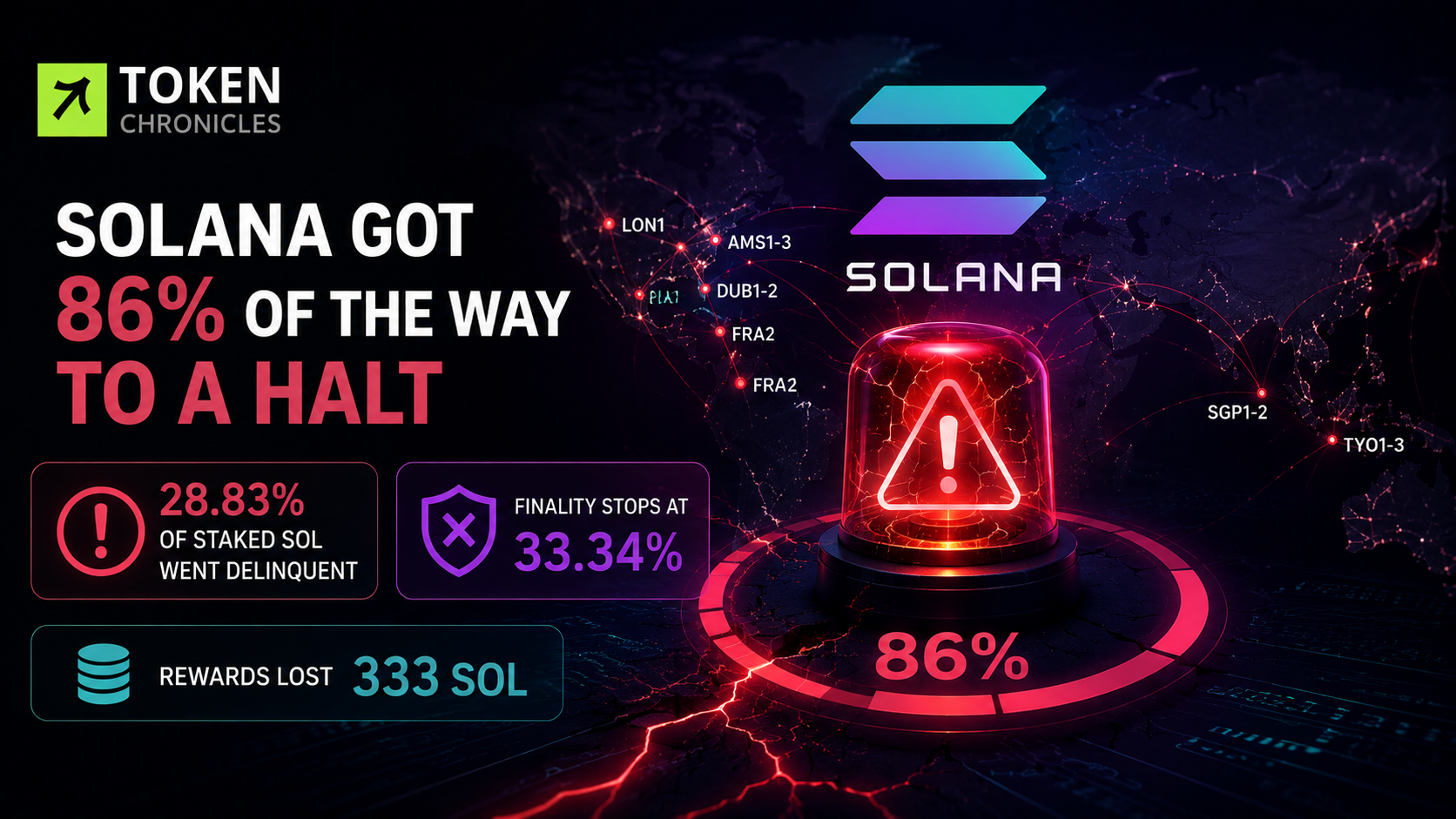
At the height of the incident, approximately 28.83% of all staked SOL became delinquent, bringing the network close to the threshold at which Solana could no longer finalize new blocks. Solana’s finality threshold is approximately 33.34% of stake becoming unavailable.
Despite the severity of the event, the incident attracted relatively little attention while it was happening.
Nearly One-Third of Staked SOL Went Offline
The incident affected enough validator stake to bring Solana within roughly 4.5 percentage points of its finality threshold.
Across the 90 validators affected by the disruption, approximately 333 SOL in staking rewards were lost, according to the analysis.
The disruption was not caused by a consensus failure, validator software bug or direct attack on the Solana blockchain. Instead, the underlying issue originated with network routing infrastructure operated by Teraswitch.
The incident demonstrates how a blockchain can remain technically operational while becoming vulnerable to failures in the internet infrastructure connecting its validators.
Teraswitch Routing Error Triggered the Outage
According to the reported post-incident analysis, the problem began at Teraswitch’s Miami facility.
A default route leaving the Miami site was accidentally advertised without the attributes normally attached to it. A route reflector in Amsterdam subsequently propagated the malformed route to multiple other Teraswitch locations.
Edge routers at those locations interpreted the advertised route as their own local default route and preferred it over the legitimate route.
However, the underlying core network rejected the route as invalid.
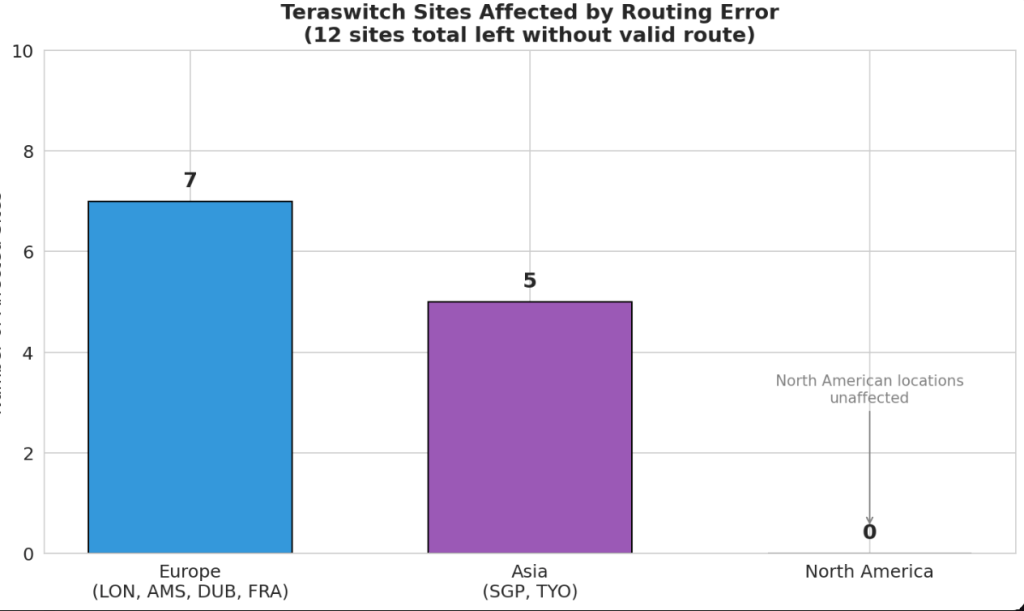
The result was that 12 sites were left without a valid route for forwarding traffic.
The affected locations included:
- LON1
- AMS1, AMS2 and AMS3
- DUB1 and DUB2
- FRA2
- SGP1 and SGP2
- TYO1, TYO2 and TYO3
North American locations were reportedly unaffected.
Teraswitch identified the problem within approximately 10 minutes, and network traffic was restored by 04:16:15 UTC.
The Miami site remained disconnected from the provider’s backbone while the company investigated what generated the incorrect route.
More Than 118 Million SOL Was Tied to the Affected Network
The incident becomes considerably more significant when validator stake is examined by autonomous system.
Analysis of the affected infrastructure found that AS20326 had approximately 118.89 million SOL associated with it.
That represents more than one-quarter of all SOL staked on the network.
Approximately 94% of that stake reportedly became unreachable at the same time.
This concentration is important because it highlights a potential weakness that is easy to miss when assessing blockchain decentralization solely by counting validators.
A network may have hundreds or thousands of validators, but if a large percentage of their stake depends on the same infrastructure provider or network path, a single infrastructure failure can affect a disproportionately large share of the network’s economic weight.
Additional Validators Were Also Affected
The disruption was not limited to AS20326.
Another approximately 14.1 million SOL became unavailable during the same period across validators associated with Latitude.sh, Limestone, Butterfly Research and Allnodes.
The available data does not establish why these additional validators experienced simultaneous disruption.
Possible explanations include a shared infrastructure dependency, a common network path or simply coincidental failures occurring during the same period.
Regardless of the cause, the event illustrates an important limitation of measuring blockchain decentralization solely according to hosting-provider labels.
If several supposedly independent validator operators ultimately depend on the same upstream network infrastructure, their operational independence may be lower than the raw validator count suggests.
Validators Recovered Only After Routing Was Restored
The recovery pattern provides another important insight into the incident.
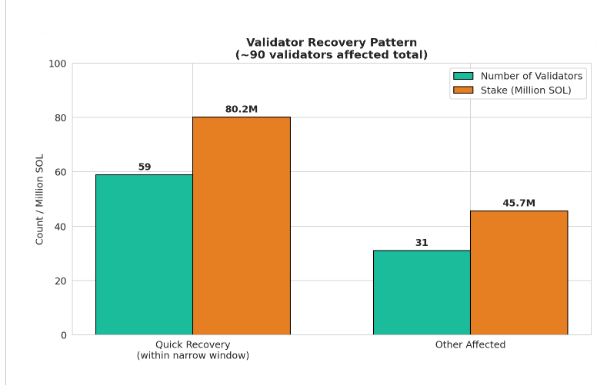
Approximately 59 validators controlling around 80.2 million SOL returned to normal operation within a very narrow time window.
The affected validators were distributed across locations including Amsterdam, Frankfurt and Tokyo.
Notably, the validators reportedly did not successfully fail over to alternative connectivity during the incident.
Instead, they remained offline or impaired until the underlying routing problem was resolved and network connectivity reconverged.
This suggests that geographic distribution alone may not provide sufficient protection if validators share critical upstream networking dependencies.
A validator located in a different country can still be exposed to the same infrastructure failure if its traffic ultimately relies on a common provider, routing system or backbone.
Why the Incident Matters for Solana
The incident did not ultimately cause a full Solana halt, but the numbers show how close the network came.
With 28.83% of staked SOL temporarily delinquent, the disruption approached the approximately 33.34% threshold associated with loss of finality.
That makes the episode significant from a network-resilience perspective even though block production and finality ultimately recovered.
The incident also highlights a broader issue facing proof-of-stake blockchains: decentralization is not only about the number of validators.
It also depends on how independently those validators are hosted, connected and routed.
If large amounts of stake depend on the same data centers, cloud providers, autonomous systems, network carriers or routing infrastructure, an outage affecting one dependency can potentially remove a large percentage of the network’s effective voting power.
The Bigger Decentralization Lesson
The Teraswitch incident provides a useful stress test for Solana’s infrastructure.
The blockchain itself did not necessarily fail. Instead, a relatively small change in conventional internet routing propagated through a network infrastructure provider and temporarily isolated a significant amount of validator stake.
That distinction matters.
For highly distributed blockchain networks, the physical and network infrastructure underneath validators can represent a hidden layer of centralization.
The incident therefore raises questions about whether validator operators should diversify not only across geographic locations and cloud providers but also across autonomous systems, network carriers and routing dependencies.
Solana avoided a full loss of finality in this incident, but coming within a few percentage points of the threshold shows how quickly an infrastructure-level failure can become a consensus-level risk.
The event ultimately serves as a reminder that blockchain resilience depends on more than consensus code. The network connecting the validators can be just as important as the validators themselves.