Russia’s newly regulated cryptocurrency market could generate more than $46 billion in trading volume during its first year, according to Sberbank Deputy Chairman Anatoly Popov. However, strict investment limits for retail participants and the narrow selection of cryptocurrencies approved for official trading could constrain the size of the regulated market, while much of the country’s crypto activity is expected to remain outside licensed platforms.
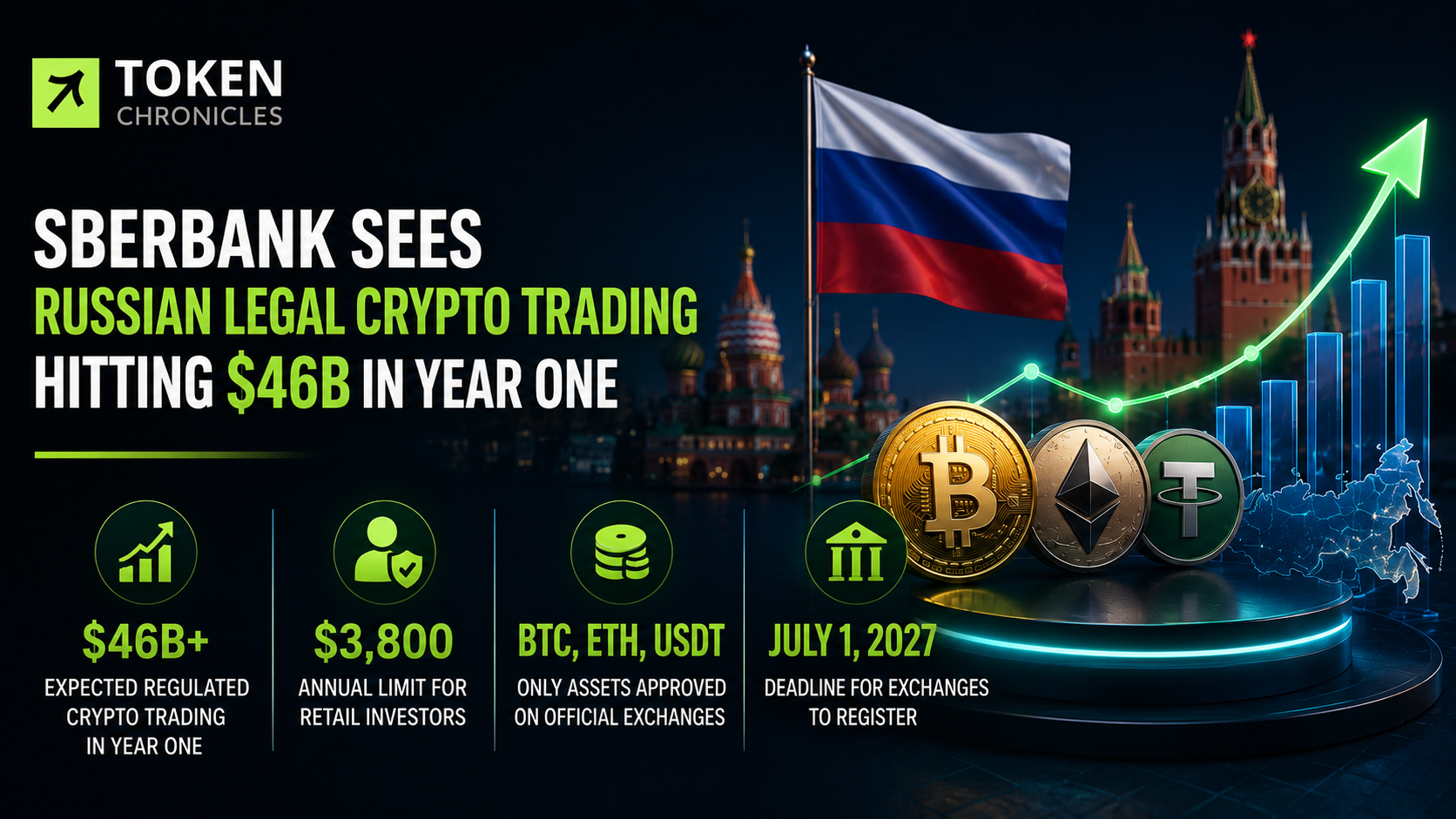
- Russia’s regulated crypto market could process more than $46 billion during its first year.
- Sberbank expects official trading volume to potentially reach $87 billion by 2029.
- Retail investors face an annual crypto purchase limit of approximately $3,800 per licensed intermediary.
- Official Russian exchanges are currently limited to Bitcoin, Ethereum, and USDT.
- A significant share of cryptocurrency activity is expected to continue through platforms outside the regulated system.
Russia Prepares for Regulated Cryptocurrency Trading
Russia is moving toward a formal framework for regulated cryptocurrency trading, with the new regime scheduled to take effect on September 1 following the Bank of Russia’s approval of draft rules allowing investors to access crypto assets through licensed brokers.
Sberbank expects the initial transition into the regulated market to be relatively gradual. According to Deputy Chairman Anatoly Popov, only a portion of Russia’s existing cryptocurrency trading activity is likely to shift to licensed exchanges during the first year.
Despite the cautious outlook, Sberbank estimates that regulated cryptocurrency trading could reach at least 4 trillion rubles, or approximately $46.43 billion, during the first year.
The bank expects that figure to grow progressively, potentially reaching around 7.5 trillion rubles, or $87.06 billion, by 2029, as more investors become comfortable using regulated channels.
Only a Portion of Existing Crypto Activity Could Move Onchain
Popov cited Finance Ministry figures indicating that cryptocurrency transactions in Russia were generating approximately 50 billion rubles in daily volume as of February, equivalent to roughly 18 trillion rubles annually.
SberCIB Investment Research estimates that around 20% of this activity could migrate to regulated exchanges during the first year of legalization. That would translate to approximately 3.5 trillion to 4 trillion rubles in annual official trading volume.
The research projects regulated volume could increase to approximately 4.75 trillion to 5.25 trillion rubles by 2028, before reaching the projected 7.5 trillion rubles in 2029.
The estimates indicate that legalization may not immediately shift the majority of Russia’s crypto activity into the formal financial system. Investors who are already accustomed to using offshore, decentralized, or otherwise unregistered services may continue using those alternatives.
Retail Investment Limits Could Restrict Market Growth
One of the most significant constraints on the regulated market is the investment ceiling imposed on non-qualified investors.
Under the framework described by the Bank of Russia, non-qualified investors can purchase up to 300,000 rubles, or approximately $3,800, per year through a single licensed intermediary. Investors must also complete a risk-awareness test before making cryptocurrency purchases.
The Bank of Russia has defended the restrictions as a measure intended to protect less-experienced investors from the risks associated with digital assets.
Russia has also recently eased requirements for obtaining qualified-investor status. However, even qualified investors are subject to investment limits of up to 3 million rubles, or approximately $38,000, according to the supplied report.
These restrictions could make it difficult for high-volume traders and larger investors to move substantial amounts of capital into the regulated market.
Limited Asset Selection Could Push Investors Elsewhere
Another potential limitation is the relatively small number of cryptocurrencies currently authorized for trading through official Russian exchanges.
At present, the approved assets are Bitcoin (BTC), Ethereum (ETH), and Tether (USDT).
The exclusion of other major altcoins could encourage investors seeking broader exposure to continue using platforms outside Russia’s official exchange system.
This could create a two-tier market in which BTC, ETH, and USDT are available through regulated brokers, while investors seeking other digital assets continue turning to alternative trading venues.
Exchanges Face a Transition Period
The regulatory framework also provides cryptocurrency exchanges with time to enter the official system.
According to the supplied information, exchanges can register under the new framework until July 1, 2027, providing a transition period for platforms to meet regulatory requirements.
The gradual rollout means the structure of Russia’s regulated cryptocurrency market could continue evolving over the coming years as exchanges register, investor participation expands, and authorities refine the rules governing digital assets.
Russia’s Crypto Market Faces a Gradual Shift
Sberbank’s forecast suggests that legalization is unlikely to move Russia’s entire cryptocurrency market into the regulated financial system immediately.
Instead, the bank expects a gradual migration of trading activity as investors become more accustomed to licensed intermediaries and regulated products. Its projection of more than $46 billion in first-year regulated volume nevertheless indicates that the formal market could become significant from the outset.
Whether that market reaches its longer-term projection of approximately $87 billion by 2029 will depend on several factors, including investor demand, regulatory changes, investment limits, the number of participating exchanges, and the range of cryptocurrencies made available through official channels.
For now, Russia appears to be taking a cautious approach: legalizing regulated crypto access while maintaining strict controls designed to limit retail exposure and channel trading through a narrow group of approved digital assets.