

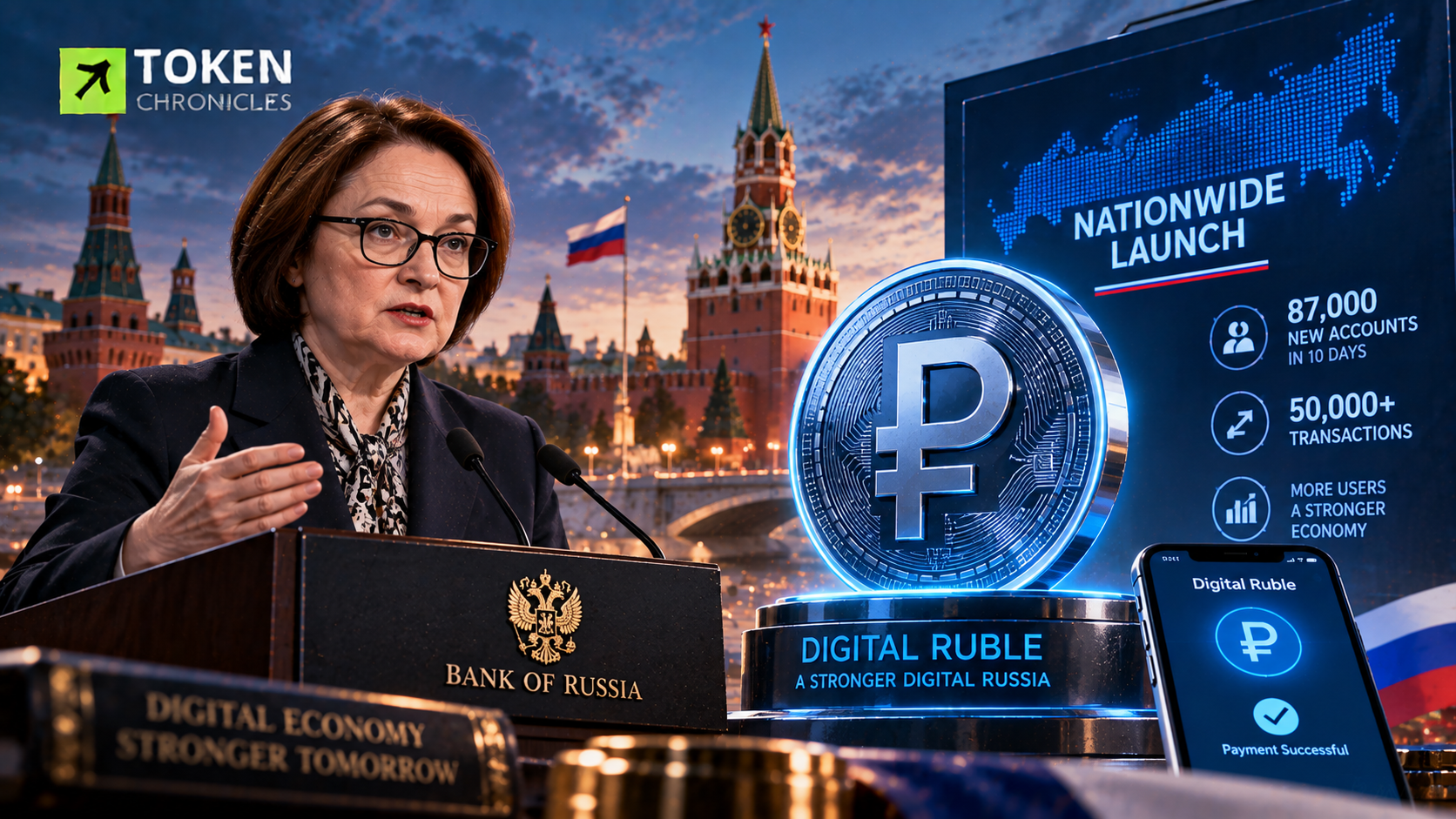
Russia’s central bank says the nationwide launch of the digital ruble has proceeded largely without disruption, with adoption accelerating as individuals and businesses experiment with the country’s new central bank digital currency (CBDC).
Digital Ruble Adoption Accelerates After Nationwide Launch
Russia has moved its digital ruble project from a lengthy testing phase into nationwide deployment, marking a major step in the country’s development of a central bank digital currency.
The digital ruble officially entered nationwide rollout on Sept. 1, following a pilot program that began testing the currency with real users in 2023.
Bank of Russia Governor Elvira Nabiullina said the initial rollout had gone smoothly, with only limited technical issues reported by some participating banks. According to Nabiullina, banks responded quickly to the problems and remained in close contact with the central bank.
She said authorities had not encountered widespread disruptions or a significant number of complaints during the first days of nationwide operation.
More importantly, early usage figures indicate that public curiosity is translating into actual activity.
87,000 Accounts Opened in Just 10 Days
According to Nabiullina, approximately 87,000 digital ruble accounts were opened within the first 10 days of the nationwide rollout.
Users also completed more than 50,000 transactions, giving the central bank an early indication of how consumers and businesses are interacting with the new payment system.
However, Nabiullina cautioned that not every new account necessarily represents sustained adoption. Some users are opening accounts simply to experiment with the technology and understand how digital ruble payments work.
The central bank hopes that familiarity will eventually translate into regular usage as people discover practical advantages over existing payment methods.
The early numbers nevertheless represent a significant increase in activity compared with the earlier pilot phase and provide Russian authorities with a much larger user base from which to evaluate the CBDC.
Bank of Russia Focuses on Improving the User Experience
Despite the smooth rollout, the central bank is already looking for ways to simplify the digital ruble experience.
Nabiullina said officials are working to reduce the number of steps required to open an account and complete transactions while maintaining strong security protections.
This balance between convenience and security is likely to remain important as adoption expands.
Central bank digital currencies typically require users to interact with new technological infrastructure while financial institutions must maintain safeguards against unauthorized access, fraud and other risks.
For the Bank of Russia, making the system easy enough for everyday consumers to use could be just as important as the underlying technology itself.
Digital Ruble Is Not Mandatory for Consumers
One important feature of Russia’s rollout is that consumers are not being required to abandon conventional forms of money.
Nabiullina emphasized that the decision over which payment instrument to use ultimately remains with individuals.
The digital ruble therefore exists alongside cash, traditional bank deposits, cards and electronic payment systems rather than immediately replacing them.
The strategy gives users an opportunity to test the CBDC without forcing an immediate transition.
For businesses, however, the rollout comes with more concrete obligations.
Major Banks and Retailers Must Accept Digital Ruble Payments
Following the Sept. 1 launch, Russia’s 12 largest banks and retailers generating more than 120 million rubles in annual revenue, equivalent to roughly $1.42 million, are required to accept digital ruble payments.
The requirement is expected to expand to additional businesses over time, with the rollout continuing through 2028.
That gradual approach could allow the digital ruble ecosystem to expand alongside merchant infrastructure.
As more retailers become capable of accepting the currency, consumers should have more opportunities to use it in everyday transactions. At the same time, wider merchant acceptance could encourage financial institutions and businesses to integrate the CBDC more deeply into their payment systems.
From Pilot Project to National Payment Infrastructure
The nationwide launch represents the latest stage in a project that has been under development for several years.
Russia began experimenting with real-world digital ruble transactions in 2023, allowing selected users and financial institutions to test the system before expanding its reach.
The transition from a controlled pilot to nationwide availability is a significantly larger undertaking because it involves far more users, banks, merchants and payment scenarios.
The initial absence of widespread technical problems will therefore be an important early milestone for the central bank.
Curiosity Is Driving Early Adoption
The first 10 days also highlight an interesting characteristic of CBDC adoption: novelty itself can generate initial demand.
Some of the 87,000 account openings may represent users who simply want to understand how a government-backed digital currency works.
The longer-term test will be whether those users continue using the digital ruble after the novelty wears off.
Sustained adoption will likely depend on practical factors such as transaction convenience, merchant acceptance, integration with existing banking services and whether users see meaningful advantages over established payment methods.
The Bank of Russia appears to recognize this distinction, which explains its emphasis on improving the number of clicks and steps involved in common transactions.
Russia’s Digital Ruble Enters Its Next Phase
The nationwide deployment places Russia among the countries pursuing large-scale central bank digital currency infrastructure.
With 87,000 accounts and more than 50,000 transactions recorded during the first 10 days, the digital ruble has generated substantial early interest, although those figures alone do not establish long-term adoption.
The next challenge for the Bank of Russia will be turning experimentation into habitual usage.
Expanding merchant acceptance, simplifying transactions and maintaining security will be central to that effort. Meanwhile, the phased expansion of mandatory acceptance through 2028 gives Russian authorities additional time to refine the system.
For now, the digital ruble has successfully moved beyond the experimental stage and into everyday financial infrastructure. Whether Russia’s CBDC becomes a widely used payment method or remains a specialized alternative will depend on what happens after the initial wave of curiosity fades.