
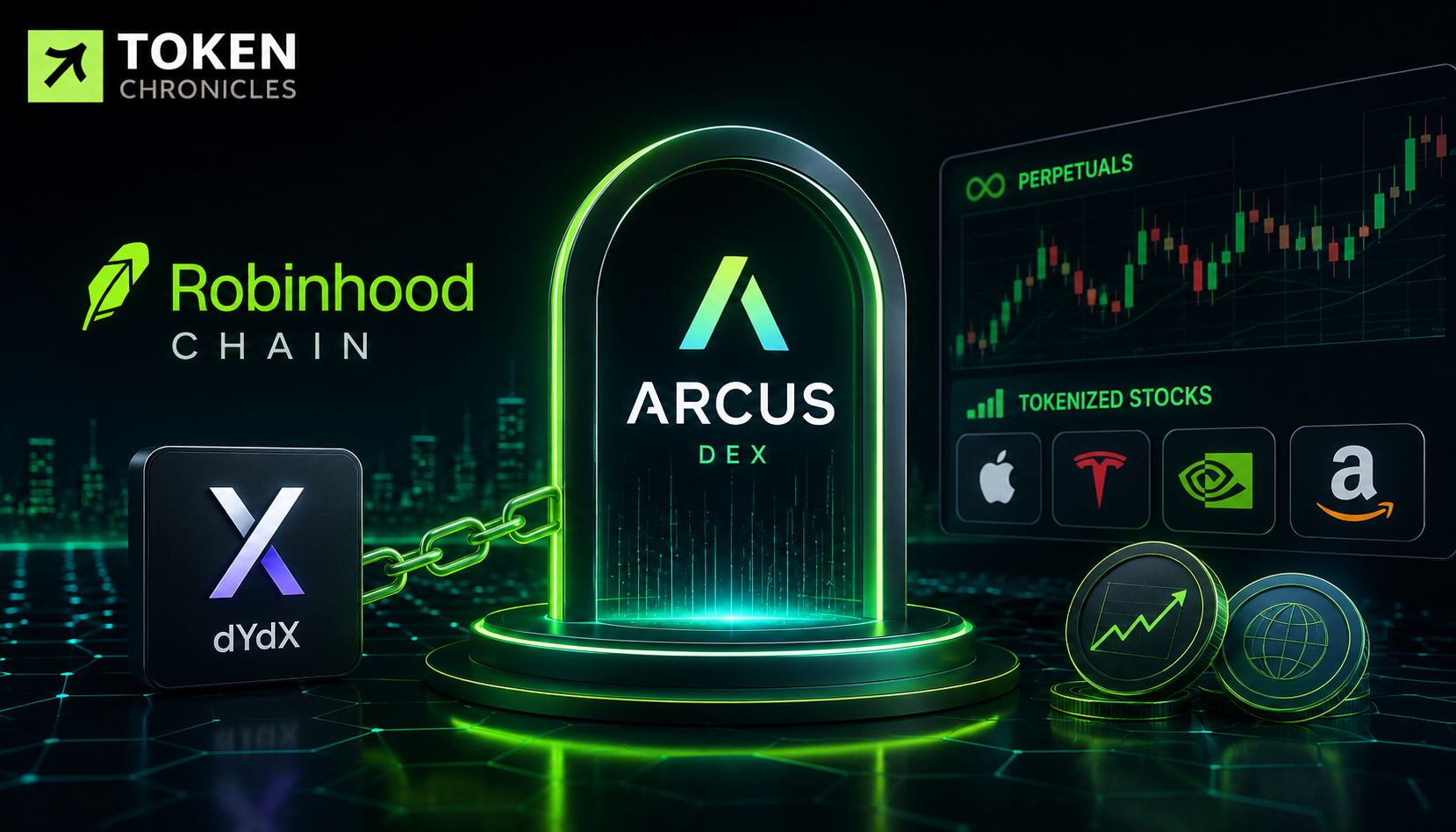
Robinhood has partnered with the team behind dYdX Labs to launch Arcus, a new decentralized trading platform that will operate on the newly introduced Robinhood Chain. The move marks a significant step in Robinhood’s strategy to expand into tokenized assets and decentralized derivatives trading.
Formerly developed under the dYdX brand, Arcus is being positioned as a next-generation decentralized exchange designed to offer broader access to global financial markets.
dYdX Labs Introduces Arcus
The team behind dYdX Labs announced that dYdX is being rebranded as Arcus for its new product on Robinhood Chain. While the new platform is built in collaboration with Robinhood, the existing dYdX blockchain and ecosystem will continue operating independently, with governance remaining under its community.
Arcus will launch as one of the flagship decentralized applications on Robinhood’s Layer-2 blockchain, which is built using Arbitrum technology.
Tokenized Stocks and Perpetual Markets
Arcus plans to combine two of the fastest-growing segments of digital finance tokenized equities and perpetual futures trading.
At launch, users will be able to trade more than 95 tokenized U.S. stocks without trading fees, alongside perpetual futures markets. The platform also intends to allow tokenized stocks to serve as collateral for perpetual positions and eventually provide access to selected private market and pre-IPO assets.
The goal is to remove traditional barriers such as geographic restrictions, limited trading hours, and institutional access requirements, creating a more accessible global trading experience.
Robinhood Deepens Its Web3 Strategy
Robinhood’s collaboration with Arcus reflects its broader push into blockchain-based financial infrastructure. The company recently introduced Robinhood Chain, a Layer-2 network designed to support tokenized financial assets, decentralized applications, and onchain trading.
Robinhood Crypto has also made a strategic investment in Arcus, although financial details of the investment were not disclosed.
The initiative comes as competition intensifies among trading platforms seeking to capture growing demand for decentralized finance and perpetual derivatives.
Growing Competition in Tokenized Finance
The launch places Robinhood in direct competition with major crypto platforms expanding beyond traditional cryptocurrency trading.
Coinbase has recently broadened its offerings by adding tokenized equities and continues developing its Base Layer-2 ecosystem. Meanwhile, decentralized perpetual trading platforms have gained significant market share as traders increasingly seek alternatives to centralized exchanges.
Several ecosystem partners have already announced support for Robinhood Chain. Bitget Wallet will integrate the network to enable tokenized stock trading, while decentralized exchange aggregator 1inch has confirmed support for the blockchain shortly after launch.
Why It Matters
Robinhood’s partnership with Arcus highlights the rapid convergence of traditional finance and decentralized infrastructure. By combining tokenized equities, perpetual futures, and blockchain-based settlement on a single platform, the company is positioning itself to serve the growing market for onchain financial products.
As tokenization continues to reshape global capital markets, platforms that integrate traditional assets with decentralized trading infrastructure are expected to play an increasingly important role in the next generation of digital finance.