
A growing debate over Robinhood Chain’s fee structure has evolved into a broader discussion about how blockchain networks can build sustainable businesses. BNB Chain executive Nina Rong argued that simply lowering transaction costs is no longer enough, while Solana and Arbitrum figures highlighted the different economic models available to blockchain operators.
Key points
- BNB Chain’s Nina Rong said further reductions in gas fees are no longer the industry’s main priority.
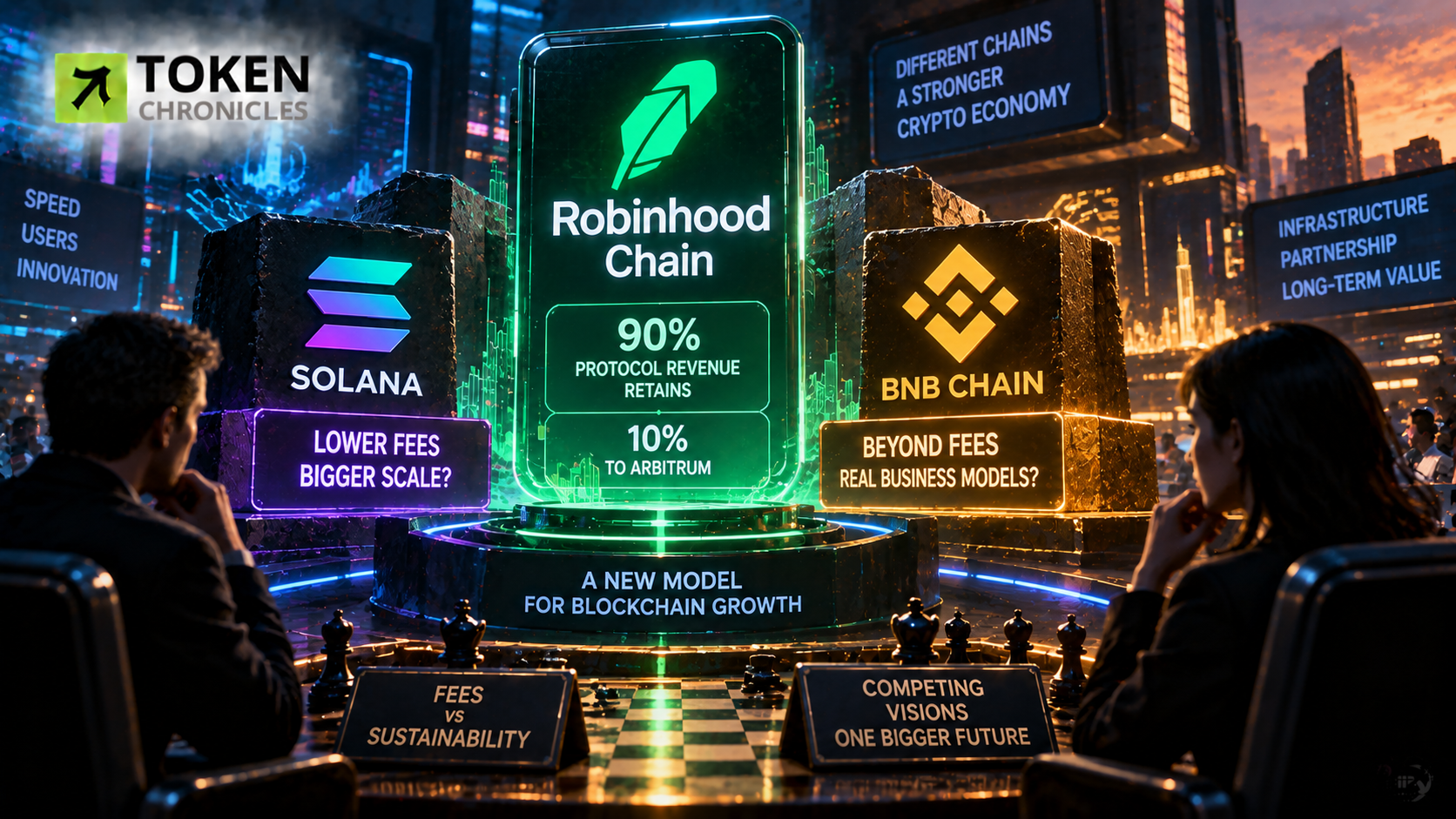
- Robinhood Chain retains 90% of its protocol net revenue, with 10% allocated through its agreement with Arbitrum.
- The debate highlights competing strategies for turning blockchain activity into sustainable revenue.
- Trading applications currently account for a significant share of Robinhood Chain’s network revenue.
Robinhood Chain Sparks Debate Over Blockchain Economics
The discussion surrounding Robinhood Chain’s economics has expanded beyond the question of how cheap blockchain transactions should be.
On Sept. 6, BNB Chain Executive Director of Growth Nina Rong argued that the industry should focus more heavily on developing sustainable commercial models capable of funding continued technology development and ecosystem expansion.
Her comments followed a public exchange involving Solana co-founder Anatoly Yakovenko and Offchain Labs co-founder Steven Goldfeder, who debated whether Robinhood could have achieved lower or even gas-free transactions by choosing a different blockchain infrastructure.
Yakovenko had pointed to Robinhood’s agreement to share 10% of its revenue with Arbitrum, suggesting that the amount could potentially have covered Solana transaction costs several times over.
Goldfeder countered that the economics of Robinhood Chain are fundamentally different because Robinhood retains most of the revenue generated by its network.
In his response, Goldfeder argued that Robinhood’s decision to build on Arbitrum allows the company to capture the majority of the network economics while paying Arbitrum for the infrastructure supporting the chain.
The exchange illustrates a broader question now facing blockchain developers: Should networks compete primarily on transaction costs, or should they focus on creating business models that generate enough revenue to finance long-term growth?
Robinhood Keeps Most of Its Network Revenue
Robinhood’s arrangement with Arbitrum provides a useful example of how blockchain infrastructure can be structured as a commercial relationship.
According to an ArbitrumDAO factsheet, Robinhood Chain operates under the Arbitrum Expansion Program and returns 10% of protocol net revenue. Of that amount, 8% goes to the ArbitrumDAO treasury, while another 2% supports the Arbitrum Developer Guild.
Robinhood therefore retains the remaining 90% of the network’s protocol net revenue.
The structure differs from operating an application on an independent public blockchain, where transaction fees generally flow through the underlying network’s established economic model.
Robinhood launched its dedicated Ethereum layer-2 network on July 1, using Arbitrum technology. The chain was designed to support products including tokenized stocks, trading applications, lending and perpetual futures.
The strategy gives Robinhood greater control over the infrastructure supporting its expanding onchain business while also creating a direct connection between network activity and the company’s economics.
The Blockchain Industry Is Rethinking the Gas-Fee Race
Rong’s argument goes beyond Robinhood.
She suggested that blockchain ecosystems have spent years competing to reduce transaction fees while simultaneously using grants, investments and other incentives to attract developers and users.
That approach can help networks grow during their early stages, but maintaining it indefinitely requires a sustainable source of funding.
Rong argued that the industry’s priority should now shift toward finding business models that generate revenue and recycle it into technology and ecosystem development.
Those models do not necessarily have to rely exclusively on gas fees.
They could include revenue-sharing agreements, commercial partnerships, application fees and other forms of economic arrangements between blockchain networks and companies building on them.
The distinction is increasingly important as blockchain infrastructure becomes more competitive.
Robinhood Chain’s Revenue Is Being Driven by Trading Activity
Robinhood Chain’s early revenue figures suggest that applications, rather than the chain’s headline tokenized-stock products, are already playing an important role.
Applications on the network generated approximately $2.66 million in revenue over a 24-hour period on Aug. 31, according to the figures cited in the original report.
Three applications GMGN, Pons and Uniswap accounted for approximately 88% of that total.
The composition of the revenue is notable because much of the activity was associated with trading terminals and token launches rather than tokenized equities, one of the key use cases highlighted when Robinhood introduced the network.
That suggests the economic value of a blockchain may ultimately depend less on what its creators initially intend users to do and more on which applications succeed in attracting sustained activity.
Base and Other Layer-2 Networks Face the Same Challenge
Robinhood Chain is also entering a competitive layer-2 market that includes Coinbase’s Base and numerous other Ethereum scaling networks.
The competition is increasingly moving beyond simple comparisons of transaction fees.
User acquisition, application ecosystems, liquidity, trading activity and distribution can all determine whether a network becomes economically sustainable.
Robinhood has an important potential advantage: its existing brokerage customer base provides a built-in distribution channel for its onchain products.
Base, meanwhile, benefits from Coinbase’s established user base and the network effects accumulated since its launch.
This creates a different competitive landscape from earlier blockchain cycles, when networks often promoted extremely low transaction costs as their primary selling point.
Lower Fees Are Only Part of the Scaling Equation
Layer-2 networks are designed to process transactions away from the underlying blockchain before ultimately settling activity on the base layer.
That architecture can increase capacity and reduce costs, but lower fees alone do not guarantee a successful network.
For network operators, the more difficult question may now be how to turn increased activity into dependable revenue without discouraging users or developers.
A network that attracts millions of transactions but generates little sustainable income may struggle to finance infrastructure, developer incentives and future upgrades.
Conversely, a network that captures too much value through fees or revenue-sharing arrangements could make itself less attractive to applications and users.
The Next Blockchain Battle May Be About Business Models
The Robinhood-Solana-Arbitrum debate ultimately reflects a larger transition in the blockchain industry.
During the previous phase of competition, networks frequently emphasized speed, scalability and cheaper transactions. Those factors remain important, but the industry’s growing maturity is forcing blockchain projects to confront another issue: how to pay for long-term development.
Robinhood Chain represents one approach allowing a company to operate a dedicated layer-2 network while retaining most of the resulting economics and sharing a defined portion with its infrastructure provider.
BNB Chain’s Rong is advocating an even broader shift toward sustainable commercial structures.
Whether those models prove more durable than the industry’s long-running race toward lower gas fees remains uncertain. But as blockchain networks mature, revenue generation, user retention and economic sustainability are becoming just as important as transaction speed and cost.