
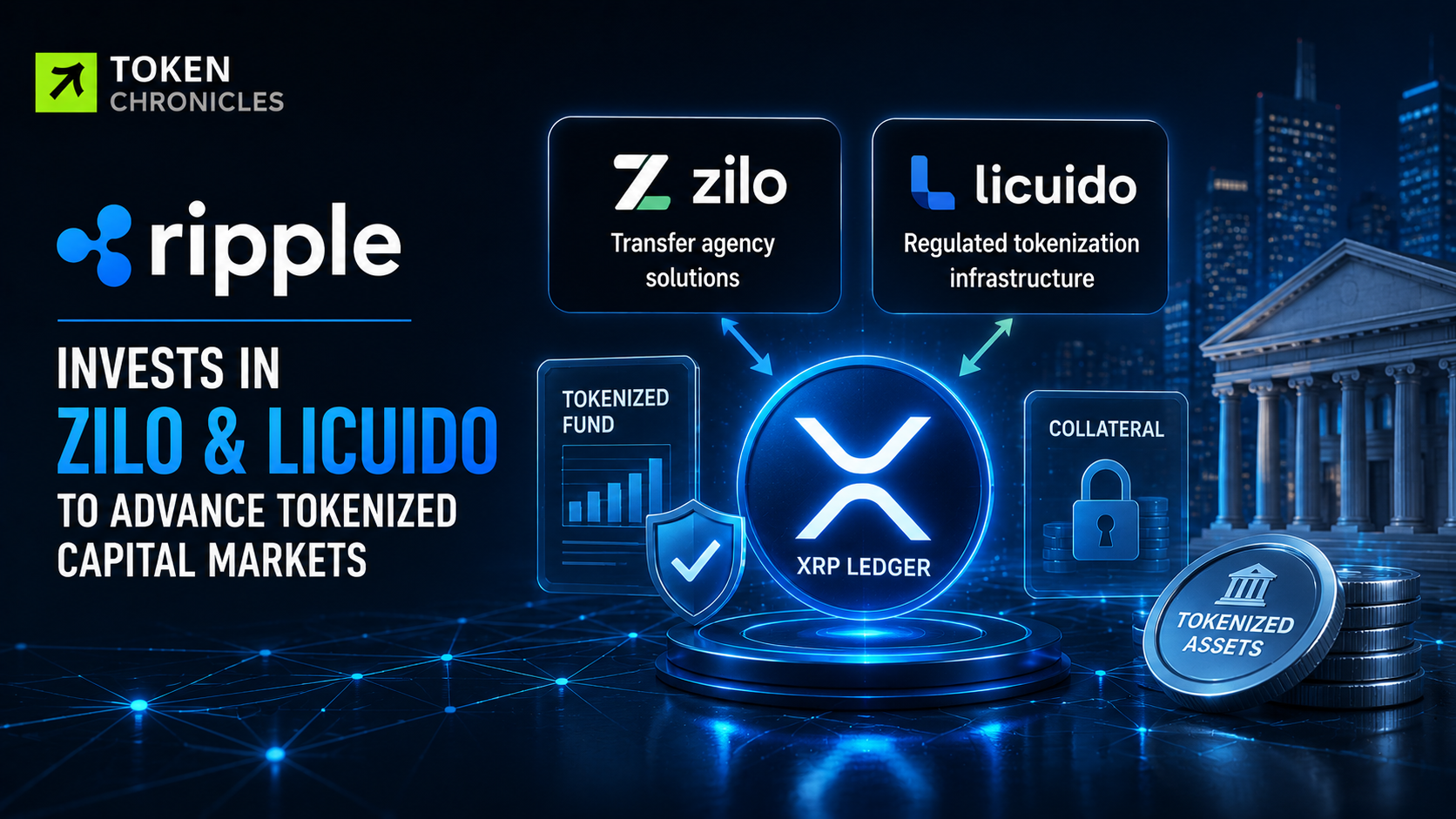
Ripple has strengthened its push into institutional tokenized finance by making strategic investments in Zilo and Licuido, two UK-based fintech firms focused on digital asset infrastructure. The move is part of Ripple’s broader strategy to accelerate the adoption of tokenized financial products and enhance the capabilities of the XRP Ledger (XRPL) for institutional capital markets.
While the company did not disclose the financial terms of the investments, the partnerships are expected to expand XRPL’s role in supporting regulated asset issuance, transfer agency services, and tokenized collateral management.
Building Infrastructure for Tokenized Finance
Ripple’s latest investments target two critical components of the tokenized asset ecosystem.
Zilo provides digital transfer agency solutions for asset managers and wealth management firms, helping modernize fund administration by replacing traditional paper-based processes with blockchain-enabled infrastructure.
Licuido, which operates under regulation from the UK Financial Conduct Authority (FCA), specializes in tokenization technology that enables financial institutions to issue and manage digital representations of traditional assets.
By integrating the expertise of both companies, Ripple aims to strengthen the institutional infrastructure available on the XRP Ledger, making it easier for regulated financial firms to issue, transfer, and manage tokenized assets.
Unlocking Collateral Mobility
One of Ripple’s primary objectives is to solve the problem of idle collateral in traditional financial markets.
In conventional finance, assets pledged as collateral often remain locked and cannot be efficiently reused across multiple financial activities.
Ripple believes tokenization can significantly improve capital efficiency by allowing digital assets to function as collateral immediately after issuance.
With support from Zilo and Licuido, institutions using XRPL could eventually issue tokenized funds that are instantly eligible for collateral use, reducing settlement delays and improving liquidity across financial markets.
This approach aligns with the broader trend toward programmable financial assets capable of moving seamlessly between trading, lending, and settlement platforms.
Momentum Builds for XRPL’s Tokenization Ecosystem
The announcement follows several recent initiatives that demonstrate Ripple’s growing focus on real-world asset (RWA) tokenization.
Last week, Aviva Investors launched a tokenized share class of its U.S. Dollar Liquidity Fund on the XRP Ledger after receiving approval from the Central Bank of Ireland, marking another step toward institutional adoption of blockchain-based fund infrastructure.
Earlier this year, Ripple also introduced Ripple Mint, a platform designed to help financial institutions issue, redeem, manage, and access Ripple USD (RLUSD), the company’s U.S. dollar-backed stablecoin.
Together, these initiatives reflect Ripple’s strategy of building a comprehensive ecosystem that supports tokenized funds, stablecoins, digital payments, and institutional asset management on a single blockchain network.
XRPL Continues Expanding in the RWA Market
The XRP Ledger has steadily increased its presence within the rapidly growing tokenized asset sector.
According to industry data, XRPL currently ranks among the world’s leading blockchain networks for tokenized real-world assets, supporting approximately $368 million in tokenized assets.
Although Ethereum continues to dominate the sector with more than $17 billion in tokenized real-world assets, Ripple is positioning XRPL as a specialized platform optimized for institutional financial applications.
The broader RWA market has continued to expand rapidly, with the number of tokenized asset holders increasing significantly over the past month while the total value of tokenized assets has climbed above $37 billion.
Ripple Targets Institutional Adoption
Rather than focusing solely on retail cryptocurrency users, Ripple’s latest investments underscore its long-term strategy of serving banks, asset managers, investment firms, and financial institutions exploring blockchain-based capital markets.
By combining regulated token issuance, transfer agency infrastructure, collateral mobility, and stablecoin services, Ripple aims to position the XRP Ledger as a comprehensive platform for next-generation financial products.
As global financial institutions continue experimenting with tokenized securities, money market funds, and digital settlement systems, Ripple’s investments in Zilo and Licuido further strengthen its ambition to become a key infrastructure provider for the evolving tokenized economy.