

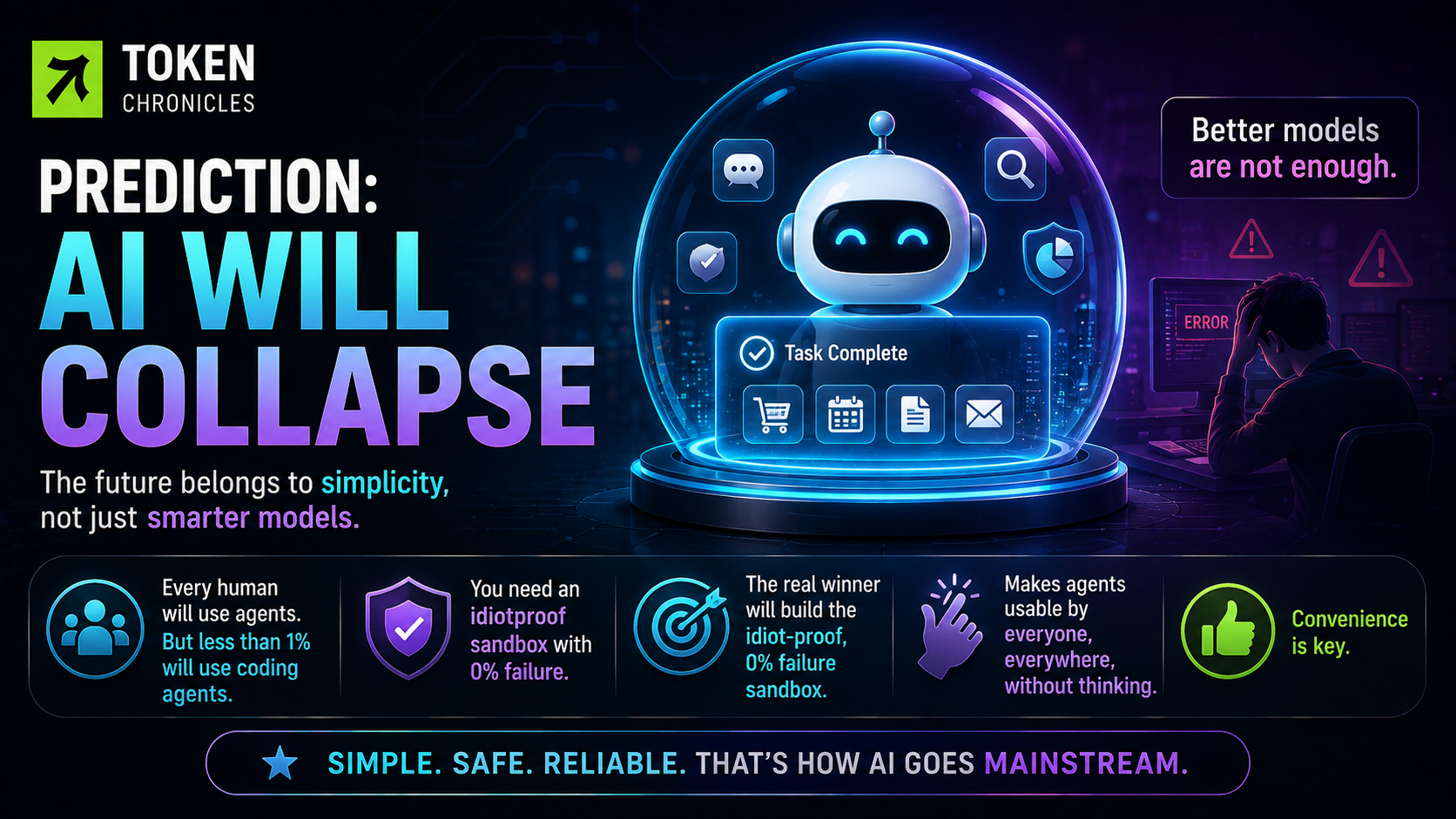
The current AI conversation may be making the same mistake as the early internet era, when people assumed that simply putting a website in front of everyone would automatically create mass adoption.
AI agents are likely to become part of everyday life, but that does not mean most people will directly use sophisticated tools such as coding agents.
- AI agents could become ubiquitous, while advanced agentic tools remain niche.
- Better models alone may not be enough to drive mainstream adoption.
- Users need environments that are extremely simple, reliable and resistant to failure.
- The biggest opportunity may belong to companies that make AI agents effortless for ordinary users.
The AI Adoption Gap
The AI industry often focuses on making models more capable: better reasoning, stronger coding abilities, longer context windows and increasingly autonomous agents.
But capability does not automatically translate into usability.
Most consumers are unlikely to spend time configuring prompts, debugging agent failures, managing permissions or understanding complex workflows. They want AI to accomplish a task without requiring them to understand what is happening underneath.
This creates a potential gap between what AI can do and what ordinary people are willing to use.
Much like the early web, simply making powerful technology available may not be enough. The internet became mainstream when complicated infrastructure was hidden behind simple products and interfaces.
AI could follow a similar path.
Most People May Use Agents Without Knowing It
The prediction is not that AI agents will fail to gain adoption. Instead, the opposite may happen: agents could become deeply integrated into everyday software while only a small minority actively interacts with advanced agent-building tools.
Millions of people may eventually use agents to organize schedules, complete purchases, manage documents, conduct research, communicate with businesses or automate repetitive tasks.
Yet very few may ever open a dedicated coding-agent environment or construct complex autonomous workflows themselves.
In other words, agent technology could become mainstream without agent development becoming mainstream.
The distinction could prove crucial for companies deciding where to compete.
Better Models Are Only Part of the Solution
The AI industry has largely competed on model intelligence. Every generation promises stronger reasoning, better coding and fewer mistakes.
However, increasingly capable models do not eliminate the need for a reliable user experience.
An agent that occasionally fails, loses context, makes an unexpected decision or requires technical intervention can still be frustrating for a mainstream user.
For AI to become genuinely universal, the surrounding product may matter as much as the underlying model.
Users may need:
- Simple interfaces
- Automatic recovery when something goes wrong
- Strong safety and permission controls
- Reliable execution
- Clear explanations when intervention is required
- Environments where experimentation cannot easily cause damage
The objective is not necessarily to make users better at operating AI. It is to remove the need for users to operate it at all.
The Real AI Opportunity Could Be the “Idiot-Proof” Sandbox
The biggest winner in the next phase of AI may therefore not be the company with the most powerful model.
It could be the company that creates the simplest and most dependable environment for using agents.
Imagine a sandbox where a user can give an AI a goal, allow it to work independently and trust that mistakes will either be prevented or automatically contained.
The technical complexity would remain behind the scenes.
For the user, the experience would be closer to using a normal application than programming an autonomous system.
That kind of environment could dramatically expand the potential AI market.
Convenience Could Define the Next AI Era
AI adoption may ultimately follow a familiar technology pattern: complexity moves behind the interface while convenience moves to the front.
People did not adopt the internet because they wanted to learn networking protocols. They adopted it because websites, search engines, smartphones and applications made the underlying technology useful.
Agents could follow the same trajectory.
The long-term competition may therefore shift from “Who has the smartest AI?” to “Who can make the smartest AI feel effortless?”
The companies that successfully hide complexity, prevent catastrophic failures and make autonomous systems accessible to everyone could have an enormous advantage.
The future of AI may not belong exclusively to the company building the most intelligent agent. It may belong to whoever builds the environment where anyone can safely use one without having to think about how it works.