
The crypto industry saw several major developments this week, from Polymarket reportedly seeking a $1 billion financing round to Cronos reversing its blockchain following a $75 million exploit. U.S. spot Bitcoin ETFs also recorded their strongest single-day inflow since January, while regulators and financial institutions advanced new initiatives involving stablecoins, tokenized securities and crypto markets.
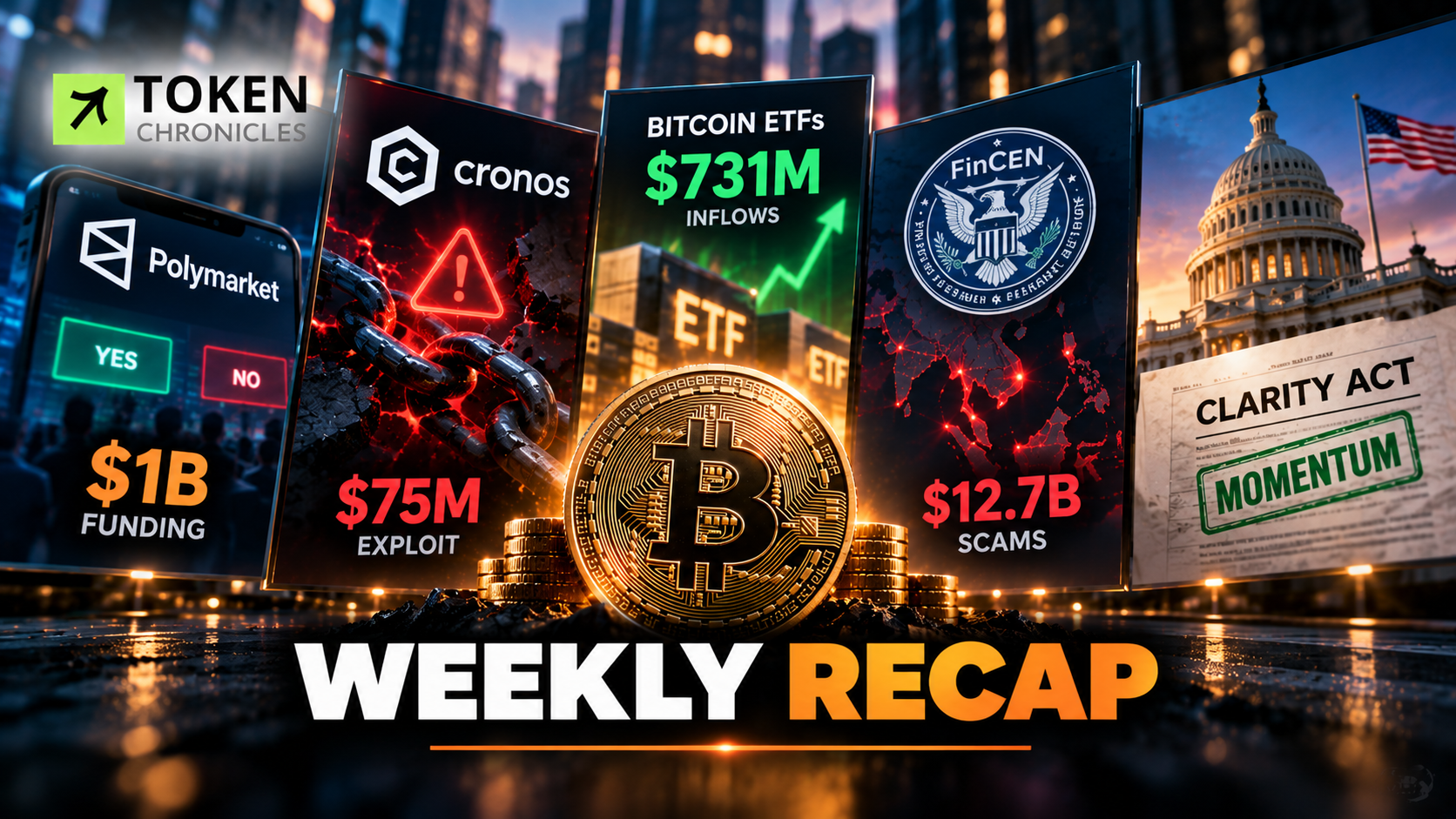
- Polymarket is reportedly pursuing $1 billion at a proposed $21 billion valuation.
- Cronos reversed its network after an exploit involving the Tectonic protocol affected roughly $75 million in assets.
- U.S. spot Bitcoin ETFs recorded $730.8 million in net inflows on Sept. 3.
- FinCEN identified $12.7 billion in transactions associated with suspected Southeast Asian crypto investment scams.
- The National Sheriffs’ Association moved from opposing the CLARITY Act to a neutral position ahead of a Senate vote.
Polymarket Targets $1 Billion Funding Round
Prediction-market platform Polymarket is reportedly preparing to raise $1 billion, with the proposed transaction potentially valuing the company at approximately $21 billion.
Donald Trump Jr.’s 1789 Capital is expected to lead the round with an investment of around $300 million. If completed, the deal would represent a significant increase from Polymarket’s previous reported valuation of nearly $15 billion.
The potential investment would also bring 1789 Capital’s publicly disclosed commitments to Polymarket to roughly $500 million.
Polymarket has been working to expand its U.S. presence after agreeing to acquire CFTC-regulated derivatives exchange QCEX for $112 million. The move marked a major step in the prediction-market platform’s effort to reestablish operations in the American market following restrictions imposed under a 2022 settlement.
Cronos Reverts Network Following $75 Million Exploit
Cronos took the unusual step of rolling back its blockchain after an exploit involving the Tectonic lending protocol put approximately $75 million in assets at risk.
Validators initially halted block production before restoring the network to a state from before the attack. The decision effectively removed the transactions associated with the exploit from the blockchain’s later history.
RedStone, an oracle provider involved in the ecosystem, disputed early suggestions that an oracle malfunction was responsible for the incident.
While the rollback helped restore the network to its previous state, the episode renewed debate over blockchain finality, validator authority and the degree of control that network operators can exercise during emergencies.
Bitcoin ETFs Record $731 Million Inflow
U.S. spot Bitcoin ETFs experienced a strong rebound on Sept. 3, registering approximately $730.8 million in net inflows their largest one-day inflow since January.
The move pointed to renewed institutional demand following a period in which the funds had experienced withdrawals.
Bitcoin also briefly moved above $82,000 before reversing lower. Stronger-than-expected U.S. employment data pushed Treasury yields higher and reduced expectations for near-term Federal Reserve easing, putting pressure on risk assets.
BTC subsequently surrendered its gains and moved back toward the $79,000 area.
FinCEN Identifies $12.7 Billion Linked to Crypto Scams
The Financial Crimes Enforcement Network (FinCEN) reported that approximately $12.7 billion in transactions were connected to suspected cryptocurrency investment scams operating from Southeast Asia between 2020 and 2025.
According to the agency, criminal groups have relied on fraudulent investment websites, social engineering campaigns and scam compounds involving forced labor to target victims.
FinCEN urged U.S. financial institutions to pay closer attention to activity involving shell companies, rapid stablecoin movements and transactions connected to investment platforms introduced through unsolicited online relationships.
The findings highlight the growing role of cryptocurrency in international fraud networks and the increasing focus on stablecoins and blockchain transactions by financial investigators.
CLARITY Act Loses Major Law Enforcement Opposition
The National Sheriffs’ Association changed its position on the CLARITY Act, moving from opposition to neutrality ahead of a planned Senate procedural vote on Sept. 15.
The organization had previously expressed concerns about how the legislation could affect anti-money laundering requirements involving decentralized finance platforms and non-custodial software.
The new position does not represent an endorsement of the legislation. However, it removes one significant source of law enforcement opposition as supporters attempt to secure the 60 votes needed to move the bill forward.
Strategy Resumes Bitcoin Purchases
Strategy returned to the Bitcoin market after more than two months without a confirmed acquisition.
The company purchased 4,603 BTC for approximately $369.7 million between Aug. 24 and Aug. 30, paying an average of $80,318 per Bitcoin.
Strategy financed the purchase through sales of MSTR shares. Following the transaction, its Bitcoin holdings increased to 845,050 BTC, acquired for a combined cost of approximately $63.73 billion and an average purchase price of $75,412 per coin.
The acquisition reinforces Strategy’s position as one of the largest publicly traded corporate holders of Bitcoin.
Major Banks Prepare New Stablecoin Venture
A group of major financial institutions is preparing to establish a new stablecoin company later in 2026, subject to the completion of required conditions.
The group includes Bank of America, Citi and Goldman Sachs, along with 18 other financial institutions.
The consortium plans to introduce a U.S. dollar-backed stablecoin during the first half of 2027 and could eventually expand into tokens denominated in other G7 currencies.
Details about the proposed stablecoin remain limited. The institutions have not yet revealed the token’s name, blockchain infrastructure, reserve custodian or final redemption structure.
SEC Moves to Update Tokenized Securities Rules
The U.S. Securities and Exchange Commission has proposed a major overhaul of its transfer-agent regulations as blockchain-based securities become more prominent in U.S. financial markets.
The proposal would update requirements covering registration, recordkeeping, transfers and protection of customer assets.
Transfer agents working with tokenized securities would also face requirements related to digital records, cybersecurity, audit trails and operational continuity.
The SEC’s proposal is significant because the existing framework dates back more than four decades. Public comments will remain open for 60 days following publication in the Federal Register.
ICE Partners With tZERO on NYSE Tokenization
Intercontinental Exchange, the parent company of the New York Stock Exchange, is partnering with blockchain infrastructure firm tZERO as it explores a platform for tokenized securities.
The agreement includes an investment in tZERO and a license for its blockchain-related patents.
The companies intend to develop infrastructure capable of supporting onchain issuance, trading and settlement of tokenized securities. tZERO is expected to contribute technology for transfer-agent and broker-dealer functions.
The proposed platform would also support around-the-clock trading, although regulatory approval remains necessary before the service can launch. ICE has not disclosed the size of its investment.
Fairshake Holds $122 Million for Election Spending
Crypto-focused political action committee Fairshake entered the final phase of the 2026 U.S. election cycle with approximately $122 million available for political activity.
The organization and affiliated groups have supported nearly 50 candidates who won their respective primary races.
Fairshake has contributed to candidates from both major U.S. political parties, particularly lawmakers who have supported cryptocurrency and digital-asset legislation.
One of its most expensive primary campaigns involved Illinois candidate Juliana Stratton, against whom the group spent more than $10 million.
Coinbase Moves Toward U.S. Stock Perpetuals
Coinbase has taken another step toward offering perpetual contracts tied to individual U.S. stocks.
The exchange submitted two notices to the SEC as it works with regulators on the proposed products.
Unlike conventional stock ownership, these contracts would provide traders with ongoing exposure to the price movements of individual companies without transferring ownership of the underlying shares.
The regulatory filings do not mean the products have been approved. Coinbase has not yet announced a launch date or confirmed which stocks could initially be supported.
Revolut Receives Conditional Approval for U.S. Bank
Financial technology company Revolut received conditional approval from the Office of the Comptroller of the Currency to establish a national bank in Stamford, Connecticut.
The company plans to contribute approximately $95 million in initial capital and is targeting a launch during the first half of 2027.
Potential services include deposits, payment cards, lending, foreign exchange and stablecoin products.
The proposed bank still requires additional regulatory clearances, including approvals involving the Federal Deposit Insurance Corporation, Federal Reserve and the OCC.
Chainlink Brings U.S. Economic Data Onchain
Chainlink has expanded its blockchain data services by bringing U.S. economic indicators to 10 blockchain networks through a Department of Commerce initiative.
The data feeds provide information from the Bureau of Economic Analysis that can be accessed by smart contracts and decentralized financial applications.
The development follows an earlier program that made U.S. gross domestic product data available across nine blockchain networks, including Bitcoin, Ethereum and Solana.
The initiative could make traditional economic statistics more accessible to blockchain-based applications and financial products.
Russia Introduces Regulated Crypto Trading Framework
Russia’s new regulatory framework for cryptocurrency trading, custody and cross-border settlements officially took effect on Sept. 1 under the supervision of the Bank of Russia.
Non-qualified investors can purchase up to 300,000 rubles worth of eligible crypto assets per year through each intermediary, provided they pass a required assessment.
Qualified investors are not subject to the same annual purchase limit.
Cryptocurrency remains prohibited as a means of domestic payment, although the new framework permits its use in certain international trade settlements.
Robinhood and AMC Clash Over Stock Tokens
A dispute between Robinhood and AMC Entertainment has highlighted growing uncertainty around tokenized stocks.
AMC CEO Adam Aron criticized Robinhood over a token linked to AMC shares, arguing that the company had not authorized the product. The disagreement escalated after Robinhood declined to remove the token.
Robinhood’s stock-token products are aimed at eligible customers outside the United States and provide price exposure rather than the same ownership and voting rights attached to conventional shares.
The dispute adds to calls for clearer regulatory treatment of tokenized equities as financial platforms increasingly explore blockchain-based representations of traditional securities.
A Week of Rapid Crypto Industry Development
Taken together, this week’s developments show how quickly the cryptocurrency sector is expanding beyond traditional spot trading.
Capital continues to flow into crypto-native companies such as Polymarket, institutional demand remains important for Bitcoin, and corporate treasury strategies are continuing to grow. At the same time, regulators and major financial institutions are moving deeper into stablecoins, tokenized securities, blockchain data and digital-asset infrastructure.
The week also underscored the risks that remain. The Cronos exploit, the growing scale of crypto-enabled investment scams and the regulatory dispute over tokenized stocks demonstrate that the industry’s expansion continues to bring significant security and policy challenges alongside new opportunities.