
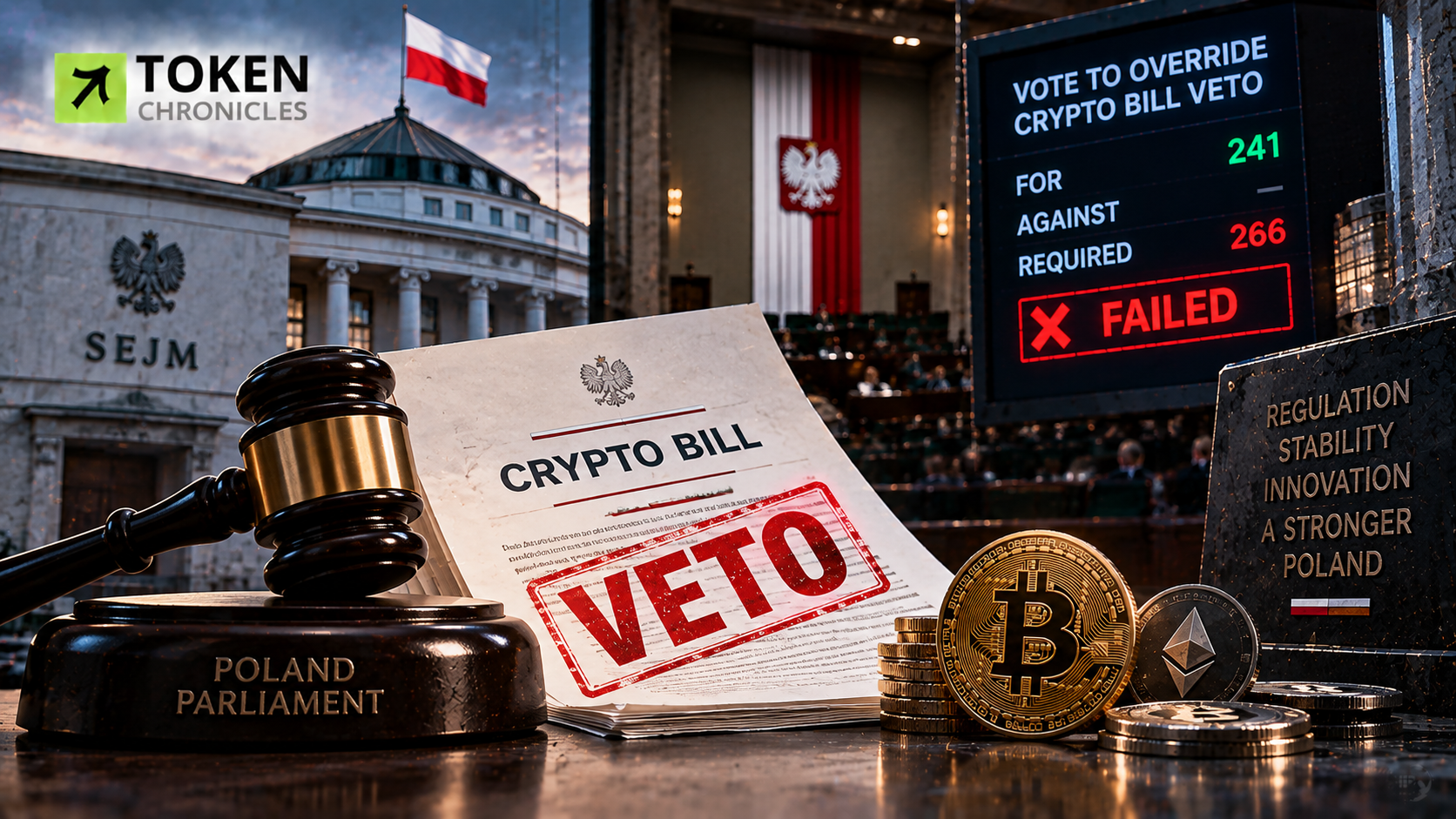
Poland’s Sejm has again failed to override President Karol Nawrocki’s veto of the country’s Crypto-Asset Market Act. The defeat leaves local crypto businesses facing regulatory uncertainty under Europe’s MiCA framework, while the vote comes amid a wider political and corruption investigation involving the collapse of cryptocurrency exchange Zondacrypto.
- The Sejm secured 241 votes, falling short of the 266 required to override the presidential veto.
- The failed vote means Poland’s proposed crypto-market legislation remains blocked.
- Local crypto companies may need to establish or register operations in other jurisdictions to comply with MiCA.
- The parliamentary dispute comes amid an investigation involving alleged financial losses and political connections surrounding Zondacrypto.
Sejm Again Fails to Override Crypto Bill Veto
Poland’s cryptocurrency industry remains caught in a regulatory standoff after lawmakers failed for a third time to overturn President Karol Nawrocki’s veto of the Crypto-Asset Market Act.
Prime Minister Donald Tusk had pushed for the Sejm to reconsider the legislation after Nawrocki rejected it, arguing that the proposed framework could have significant consequences for individual freedoms and financial stability.
The issue was added to the Sejm’s agenda on Thursday, allowing lawmakers to debate the matter before Friday’s vote.
The effort ultimately fell short.
The motion received 241 votes, while 266 were required to override the presidential veto. As a result, the proposed legislation remains blocked.
The latest defeat marks the third unsuccessful attempt by the Sejm to reverse Nawrocki’s decision.
MiCA Compliance Remains a Challenge for Polish Crypto Firms
The continuing political dispute creates additional uncertainty for cryptocurrency businesses operating in Poland.
The European Union’s Markets in Crypto-Assets (MiCA) framework establishes common rules for crypto-asset issuers and service providers across the bloc. Without a domestic framework that aligns with the new European regime, Polish companies can face difficulties obtaining the regulatory clarity needed to operate locally.
Some businesses may therefore consider establishing regulated operations in other European jurisdictions where the applicable licensing framework is already clearer.
For Poland’s crypto sector, the repeated failure to resolve the legislation leaves companies navigating an uncertain domestic regulatory environment while European-wide requirements continue to take effect.
Zondacrypto Investigation Adds Political Pressure
The parliamentary dispute is unfolding against the backdrop of an investigation surrounding Zondacrypto, once described as Poland’s largest cryptocurrency exchange.
Authorities are investigating allegations connected to the exchange and reported customer losses that have been placed at approximately $94 million.
The investigation has also drawn political figures into the controversy.
Polish Olympic Committee President Radosław Piesiewicz was reportedly detained as part of the investigation, adding further political sensitivity to the case.
The developments have intensified scrutiny of the relationships between cryptocurrency businesses, political figures and influential institutions in Poland.
Tusk Accuses Opposition of Political Connections to Zondacrypto
The crypto controversy has also triggered a sharp political confrontation between Tusk’s government and opposition lawmakers aligned with Nawrocki.
During his address to the Sejm, Tusk accused political opponents of helping Zondacrypto gain access to influential circles and argued that the company had been given unusually close connections to Poland’s political establishment.
Tusk specifically criticized politicians whom he said had helped bring former Zondacrypto CEO Przemysław Kral into mainstream political and public circles.
He went further, alleging that Zondacrypto had gained influence within the Polish state because senior politicians had facilitated relationships between the company, its owners and government institutions.
The opposition has disputed the broader political narrative surrounding the controversy, while the investigation continues.
Crypto Regulation Remains Politically Divisive
The failed vote illustrates how cryptocurrency regulation has become intertwined with Poland’s wider political struggle.
Supporters of the legislation argue that Poland needs a modern regulatory framework capable of bringing domestic crypto businesses into compliance with European rules while strengthening oversight of the industry.
Nawrocki and his supporters have raised concerns about the proposed law and its potential impact on individual freedoms and economic activity.
Meanwhile, the Zondacrypto investigation has added another layer of complexity, with allegations involving financial losses and political connections shaping the debate around how the cryptocurrency sector should be supervised.
For Polish crypto companies, the immediate consequence is continued uncertainty.
With the Sejm once again unable to overturn the presidential veto, Poland remains without the proposed domestic crypto framework, leaving businesses to navigate MiCA compliance while lawmakers and the presidency remain divided over the country’s approach to digital-asset regulation.