

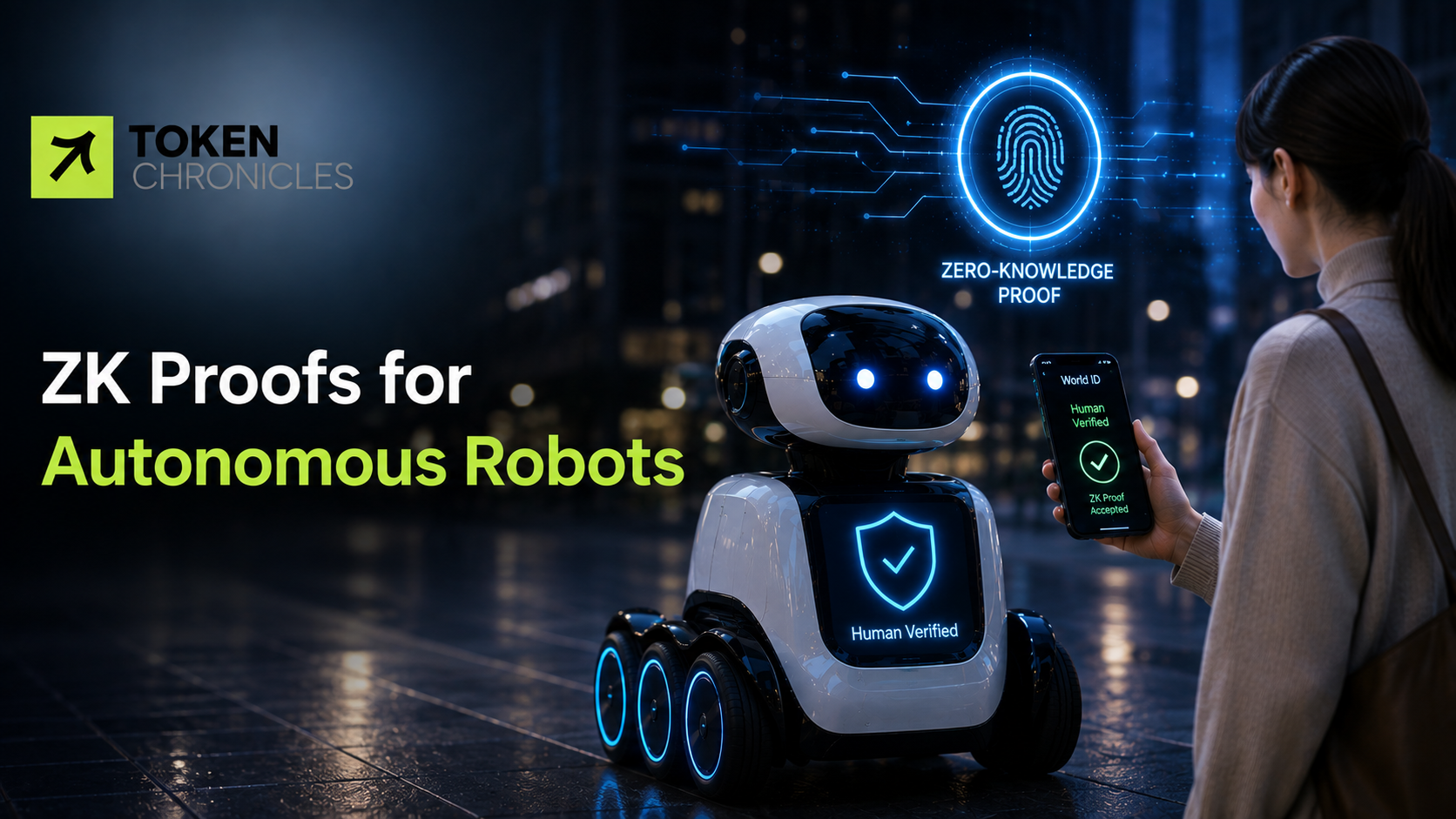
Autonomous machines can now verify that they are dealing with real, unique humans without needing to collect names, facial information or other sensitive identity details, following a new integration between PeaqOS and World ID.
The integration, launched on Aug. 21, 2026, is available through robotic.sh and enables robots and other connected machines operating on PeaqOS to request and validate World ID proofs directly.
Key developments
- PeaqOS has added native World ID verification for autonomous machines through robotic.sh.
- The system uses zero-knowledge proofs so users can demonstrate that they are human without revealing their underlying identity.
- The technology is designed to improve trust and security across DePIN and robotics applications.
- PeaqOS plans to expand privacy-preserving verification across additional autonomous-machine use cases.
Zero-Knowledge Verification for Autonomous Machines
As robots increasingly interact directly with people, developers face a growing challenge: how can a machine determine whether a user is legitimate without requiring passwords, pickup codes, identification documents or personal information?
The PeaqOS and World ID integration is designed to address that problem through zero-knowledge technology.
Instead of providing a robot with someone’s identity, World ID allows the individual to generate a cryptographic proof confirming that they meet a required condition, such as being a real human. The machine can validate that proof without receiving the person’s underlying identity information.
PeaqOS provides the infrastructure through which autonomous machines can access the verification system. A robot can request authentication, receive the corresponding zero-knowledge proof and record an auditable interaction while minimizing the amount of identity information it handles.
Supporting Uniqueness Without Identity Databases
The system can also be used to establish uniqueness, allowing machines to enforce rules based on one verified human without maintaining a database containing users’ identities.
For example, a promotional delivery robot could use the system to ensure that an individual receives an item only once. Shared autonomous machines could similarly restrict access to verified humans without requiring traditional account registration.
This approach could become particularly useful as autonomous systems move beyond controlled environments and begin handling deliveries, access control and other real-world services.
Autonomous Medication Delivery Example
One potential application involves automated medication delivery.
A patient could first verify through the World App before an order is accepted. The pharmacist could then perform another verification before handing the medication to the delivery robot. When the machine reaches the destination, the recipient could verify again.
The robot would then be able to confirm that the person receiving the package satisfies the required verification conditions before opening its secure compartment, without needing to store the individual’s identity.
The same model could potentially be adapted for parcel delivery, promotional distribution, shared autonomous equipment and other machine-to-human interactions.
A Privacy Layer for the Machine Economy
The integration gives robots running PeaqOS another tool for establishing trust with users while reducing their exposure to personal information.
For decentralized physical infrastructure networks (DePIN), this distinction could become increasingly important. Autonomous machines may need to determine who is eligible to access a service or receive a resource, but storing large amounts of personal data introduces additional security and privacy risks.
By relying on cryptographic proofs rather than conventional identity records, PeaqOS and World ID are positioning zero-knowledge verification as a potential foundation for interactions between humans and autonomous machines.
World ID support is now available for compatible robots and machines running PeaqOS through robotic.sh, with the technology potentially extending to broader autonomous delivery and DePIN applications.