
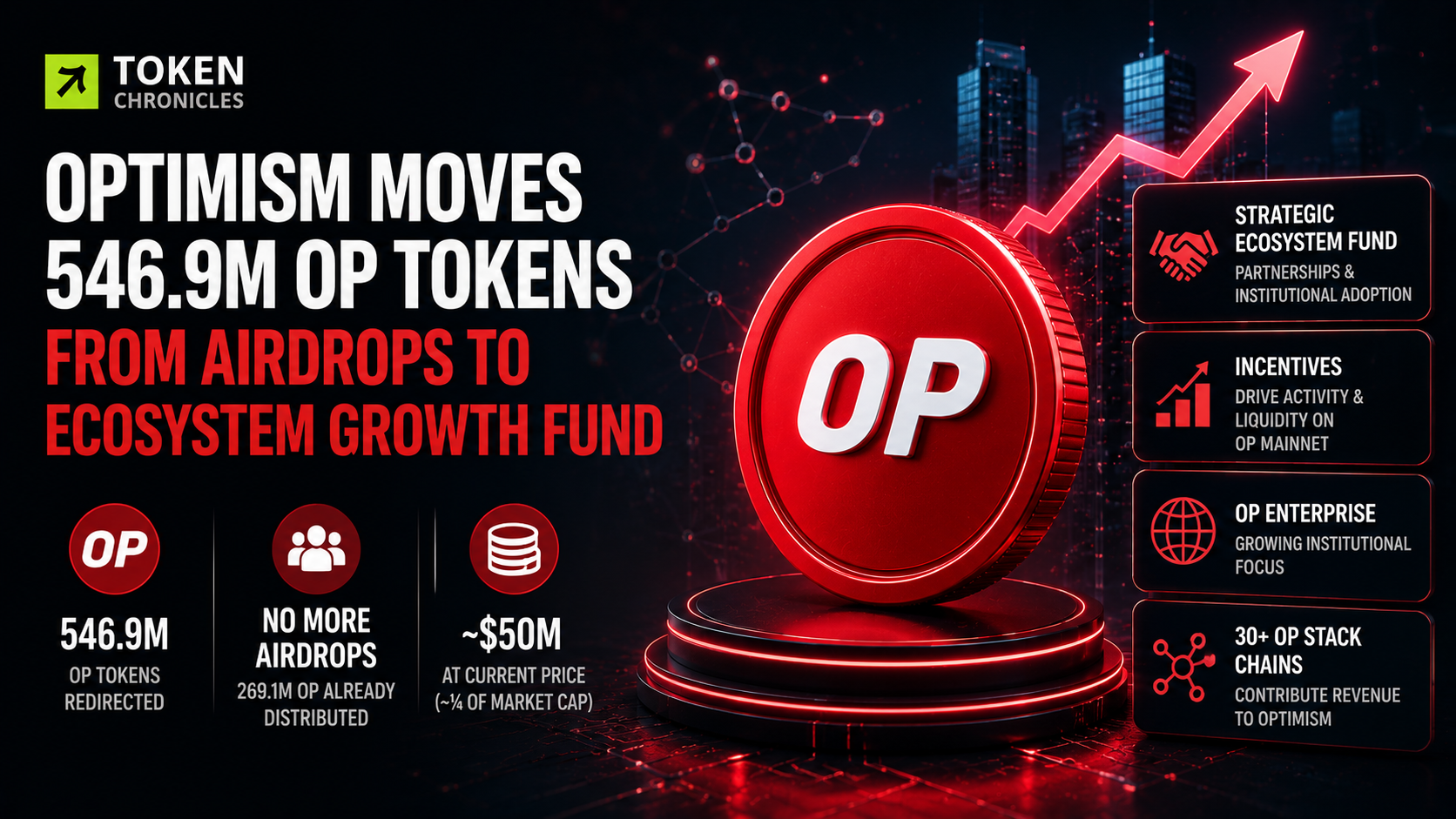
Optimism governance has approved a proposal to redirect 546.9 million OP tokens previously reserved for future user airdrops into a new Strategic Ecosystem Fund focused on ecosystem expansion, institutional adoption and network growth.
The allocation will support partnerships with blockchain networks, protocols and institutions, while also funding incentives designed to increase activity and liquidity on OP Mainnet and expand OP Enterprise.
The decision represents a shift in Optimism’s strategy from broad user acquisition through token distributions toward targeted investments aimed at attracting businesses, institutions and developers to its ecosystem.
Optimism Ends Plans for Additional Airdrops
Optimism said it does not currently plan to conduct additional user airdrops after distributing approximately 269.1 million OP across five previous rounds.
The project argued that airdrops were more appropriate during an earlier phase of the network’s development, when the priority was attracting users and building awareness.
As Optimism increasingly focuses on institutional adoption and enterprise partnerships, governance supporters argued that the unused allocation could generate greater value if deployed toward ecosystem development instead.
The decision was not universally supported.
Some governance delegates objected to redirecting tokens that had originally been associated with future airdrops. They questioned whether the foundation should be able to repurpose those tokens and how the Strategic Ecosystem Fund would measure its return on investment.
Supporters, however, argued that retaining the tokens for potential future airdrops would be less effective than using them to compete for major partnerships and increase network activity.
Strategic Fund Targets Institutions and Network Growth
The new Strategic Ecosystem Fund will focus on several areas of growth.
Optimism plans to use the allocation to develop relationships with other blockchain networks, protocols and institutional partners while providing incentives designed to increase liquidity and usage across its ecosystem.
The strategy also includes expanding OP Enterprise, reflecting Optimism’s broader effort to position its technology as infrastructure for businesses and institutional users.
Optimism is the developer behind OP Mainnet and the OP Stack, an Ethereum scaling framework used by several major networks, including Base, Unichain, Ink and Soneium.
More than 30 OP Stack chains currently contribute revenue to Optimism, according to the project, making the broader Superchain ecosystem an important component of its growth strategy.
546.9M OP Represents a Significant Allocation
OP was trading around $0.09, with the token gaining approximately 11% over the previous 24 hours amid a broader cryptocurrency market recovery.
Despite the rebound, OP remains more than 93% below its all-time high.
At the current price, the 546.9 million OP allocation is worth approximately $50 million.
That represents nearly one-quarter of Optimism’s roughly $211 million market capitalization, making the governance decision significant relative to the size of the token’s current market.
The fund therefore gives Optimism substantial capital to deploy toward ecosystem incentives and strategic partnerships, but its effectiveness will ultimately depend on whether those investments translate into sustained network usage, liquidity and revenue.
Optimism Expands Institutional Strategy
The decision comes as Optimism continues to explore institutional use cases.
In July, the project announced a memorandum of understanding with Viva Republica, the operator of South Korean mobile financial platform Toss, for a three-month proof of concept focused on Korean won-based stablecoin infrastructure for institutional payments.
The initiative reflects a broader industry trend in which blockchain networks are increasingly targeting stablecoins, payments and tokenized financial infrastructure rather than relying solely on retail users and speculative activity.
For Optimism, redirecting its remaining airdrop allocation toward this strategy signals a similar evolution.
The project is effectively moving from “distribute tokens to attract users” toward “deploy capital to attract institutions, liquidity and sustainable network activity.”
Whether that shift creates greater long-term value for OP holders will depend on how effectively the Strategic Ecosystem Fund converts its substantial token allocation into measurable growth across the Optimism ecosystem.