

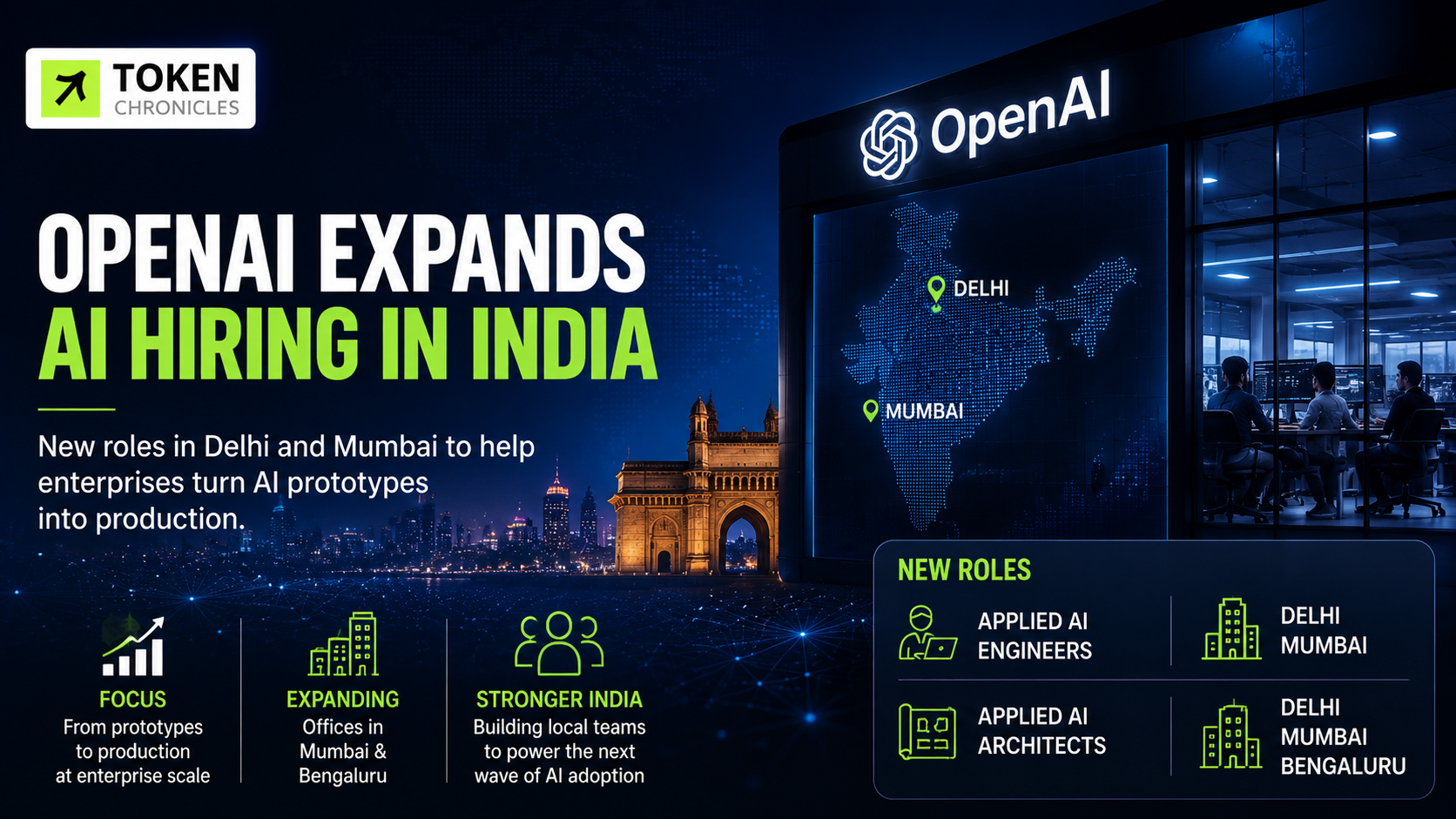
OpenAI is expanding its India operations with new Applied AI Engineer and Applied AI Architect roles, strengthening its ability to help businesses turn experimental AI projects into production-ready systems.
The company currently lists both positions in Delhi, while its Applied AI Architect role can also be based in Mumbai or Bengaluru.
Focus shifts from AI experiments to production
The hiring push reflects a broader shift in enterprise AI. Companies are moving beyond demonstrations and pilot projects and increasingly need engineers who can integrate AI into real business infrastructure.
OpenAI’s Applied AI teams work directly with customers to identify valuable use cases, design architectures and move systems from prototypes through deployment, evaluation and long-term adoption. The work can involve models, agents, APIs, data integration, security, privacy, governance, reliability and cost management.
The Applied AI Architect position is particularly focused on senior technical leadership. Architects are expected to guide customer organizations through AI strategy, technical evaluations, deployment planning and production adoption while working with engineering, security and business leaders.
India becomes a major strategic market
The hiring expansion comes as OpenAI builds a much larger presence in India.
In February 2026, OpenAI announced OpenAI for India, a nationwide initiative focused on AI infrastructure, enterprise adoption, education and workforce development. The company said India already had more than 100 million weekly ChatGPT users at the time of the announcement.
OpenAI also announced plans to establish offices in Mumbai and Bengaluru, alongside its existing New Delhi presence.
The company has simultaneously been expanding its local workforce. Its current careers listings include roles spanning applied AI, enterprise deployment, partnerships, marketing, workplace operations and other functions in India.
Enterprise deployment is becoming the next battleground
For OpenAI, the opportunity in India extends beyond consumer adoption.
Indian businesses are increasingly experimenting with AI across software development, customer service, financial services, education, healthcare, commerce and internal operations. Turning those experiments into dependable production systems requires specialized technical expertise.
That is where Applied AI Engineers can play a critical role. Their work includes building prototypes, creating evaluation systems, integrating AI with existing applications and helping customers address challenges involving latency, security, reliability, data governance and operational costs.
The Architect role operates at a more strategic level, helping organizations establish an AI roadmap and prioritize use cases based on measurable business outcomes.
Infrastructure ambitions extend beyond hiring
OpenAI’s India strategy also includes building local AI infrastructure.
The company has partnered with Tata Group to develop AI-ready data-center capacity in India, initially targeting 100 megawatts with the potential to scale toward 1 gigawatt. The initiative is intended to support data residency, security and lower-latency access to advanced AI systems.
OpenAI and Tata have also announced plans for large-scale enterprise deployment, with Tata Consultancy Services intending to deploy ChatGPT Enterprise across its workforce and use Codex to support AI-native software development.
India could become a key AI deployment hub
The combination of a large technology workforce, rapidly growing AI adoption, major enterprise customers and expanding infrastructure makes India an increasingly important market for OpenAI.
The company’s latest hiring therefore appears to be about more than simply adding employees. It is part of a broader effort to build the technical, commercial and infrastructure ecosystem required to deploy advanced AI at enterprise scale.
As companies move from asking “What can AI do?” to “How do we safely deploy it across our business?”, professionals capable of bridging frontier AI technology and real-world enterprise systems are likely to become increasingly valuable.


