
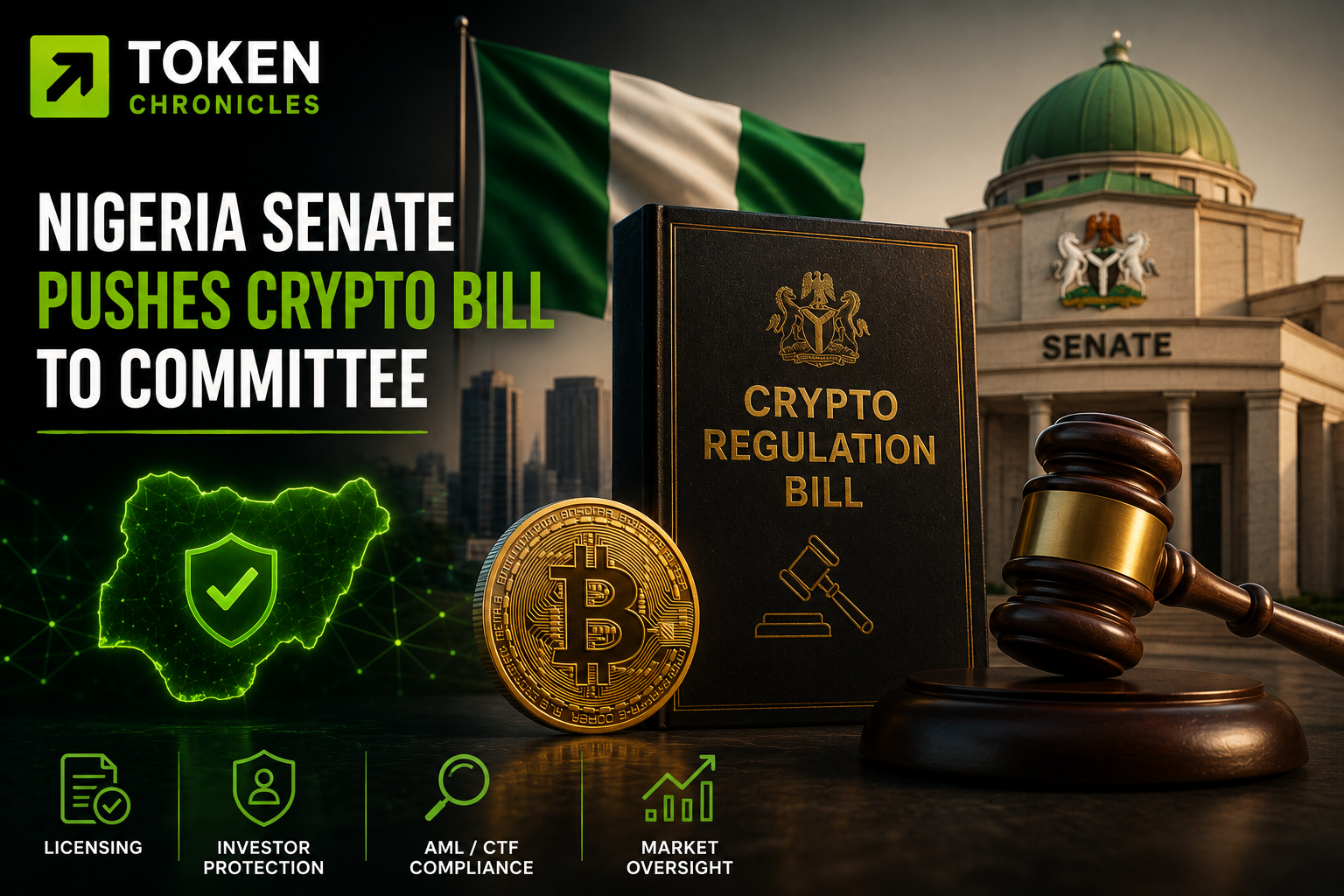
Nigeria has taken a significant step toward establishing a formal regulatory framework for cryptocurrencies and digital assets, as the country’s Senate advanced a landmark crypto regulation bill through its second reading on June 9.
The development marks one of the most important legislative moves in Nigeria’s digital asset sector to date and could pave the way for the nation’s first comprehensive legal structure governing cryptocurrency exchanges, investor protection, compliance requirements, and anti-money laundering standards.
As Africa’s largest economy and one of the world’s most active cryptocurrency markets, Nigeria’s decision to formalize the sector is being closely watched by investors, fintech companies, blockchain startups, and policymakers across the continent.
Senate Approves Bill for Committee Review
The proposed legislation successfully passed its second reading following a majority voice vote in the Senate session presided over by Deputy Senate President Barau Jibrin.
With the second reading complete, the bill has now been referred to the Senate Committee on Capital Market, which has been tasked with conducting stakeholder consultations, organizing public hearings, and submitting its recommendations within four weeks.
If approved, the legislation would introduce a structured regulatory framework covering:
- Mandatory licensing for cryptocurrency exchanges and virtual asset service providers.
- Investor protection standards.
- Anti-money laundering (AML) compliance requirements.
- Counter-terrorism financing measures.
- Enhanced market oversight and transparency obligations.
- Consumer safeguards against fraud and market manipulation.
Lawmakers described the bill as a necessary response to the rapid expansion of digital asset activity throughout Nigeria.
A Massive Crypto Market Operating Without Clear Rules
Despite years of regulatory uncertainty, Nigeria has emerged as one of the world’s largest cryptocurrency adoption hubs.
Millions of Nigerians actively use Bitcoin, stablecoins, and other digital assets for:
- Cross-border payments.
- Remittances.
- Savings preservation.
- Business transactions.
- Peer-to-peer commerce.
However, much of this activity has developed without a clear legal framework, creating challenges for both users and regulators.
Supporters of the bill argue that the absence of dedicated legislation has left investors vulnerable to scams, cybercrime, unlicensed operators, and financial misconduct.
Senate Chief Whip Tahir Monguno, who sponsored the legislation, emphasized the urgency of bringing clarity to the sector.
“The absence of a clear legal framework has exposed investors to risks and enabled illicit activities to thrive.”
According to Monguno, the proposed legislation reflects the realities of an increasingly digital financial landscape and recognizes the growing role cryptocurrencies play in modern commerce.
Lawmakers Warn Against Driving Crypto Underground
Several senators stressed that failing to regulate the sector could ultimately create larger problems by pushing crypto activity into unregulated channels.
Senator Shuaib Salisu of Ogun Central argued that regulatory clarity is essential for transparency and accountability.
“If you do not provide a regulatory framework for this sector, it will go under the table in a black market environment.”
He warned that a lack of oversight often creates opportunities for criminal activity and reduces visibility into financial transactions occurring within the digital asset ecosystem.
Other lawmakers highlighted Nigeria’s slow progress relative to neighboring African countries.
Senator Oyelola Ashiru questioned why nations such as Kenya, South Africa, and Ghana have moved more quickly in establishing crypto-friendly regulatory environments.
Meanwhile, Senator Adetokunbo Abiru called for close coordination between the proposed legislation and existing financial regulations to avoid conflicting oversight structures.
Industry Leaders Say Nigeria Lost Valuable Time
The Senate’s latest move has been welcomed by many participants in Nigeria’s blockchain and cryptocurrency community.
Among the strongest reactions came from Rume Ophi, co-convener of Decentralised Nigeria and programs lead at the Virtual Asset Service Providers Association (VASPA).
Ophi argued that years of policy uncertainty have significantly slowed Nigeria’s progress in digital finance.
“Nigeria is always learning from its own experience, which is very sad. Countries like Kenya, South Africa, and Ghana are way ahead of us because we often fight what we don’t fully understand.”
According to Ophi, Nigeria’s status as the “Giant of Africa” should have positioned it as a leader in blockchain innovation and virtual asset adoption.
Instead, he believes regulatory indecision caused the country to miss critical opportunities.
“We wasted five years, just for the fun of it.”
The Lasting Impact of the 2021 Banking Ban
Much of the industry’s frustration stems from the controversial cryptocurrency banking restrictions introduced in February 2021 under former Central Bank of Nigeria Governor Godwin Emefiele.
The policy prohibited banks and financial institutions from facilitating cryptocurrency-related transactions, effectively isolating much of the industry from the traditional banking system.
Although crypto activity continued through peer-to-peer channels, many industry participants argue the restrictions slowed innovation, discouraged investment, and pushed legitimate businesses offshore.
Ophi criticized the approach, saying policymakers failed to understand why Nigeria had become one of the world’s largest cryptocurrency markets.
“Rather than learn from the reasons Nigeria became one of the world’s largest crypto markets, they fought the interests of young Nigerians.”
While the restrictions were eventually relaxed, many believe the country lost valuable momentum during that period.
President Tinubu’s Digital Economy Vision
Industry leaders now see an opportunity for Nigeria to reposition itself as a regional hub for blockchain innovation under President Bola Tinubu’s administration.
Ophi noted that the current government has shown greater openness toward financial innovation and digital transformation.
He argued that completing the regulatory framework could support broader economic goals, including President Tinubu’s ambition to expand Nigeria into a trillion-dollar economy.
According to industry stakeholders, a clear legal environment could help attract:
- International investment.
- Blockchain startups.
- Fintech innovation.
- Digital infrastructure development.
- Employment opportunities for young Nigerians.
- Foreign capital inflows.
“The political will to create laws that attract investors, founders, and innovators cannot be overemphasized.”
A Defining Moment for Africa’s Largest Economy
The Senate’s decision represents more than a legislative milestone it signals a broader shift in how Nigeria is approaching the digital asset economy.
For years, Nigeria’s cryptocurrency ecosystem thrived despite regulatory uncertainty. Now, lawmakers appear increasingly willing to acknowledge the sector’s importance and establish rules that encourage innovation while protecting consumers.
If the bill successfully passes through committee review and ultimately becomes law, Nigeria could become one of the most influential regulated cryptocurrency markets in Africa.
The coming weeks will be critical as lawmakers, regulators, financial institutions, industry participants, and the public weigh in on the proposed framework.
For many observers, the question is no longer whether cryptocurrencies will play a role in Nigeria’s future economy but how quickly the country can build the regulatory foundation needed to support that growth.