
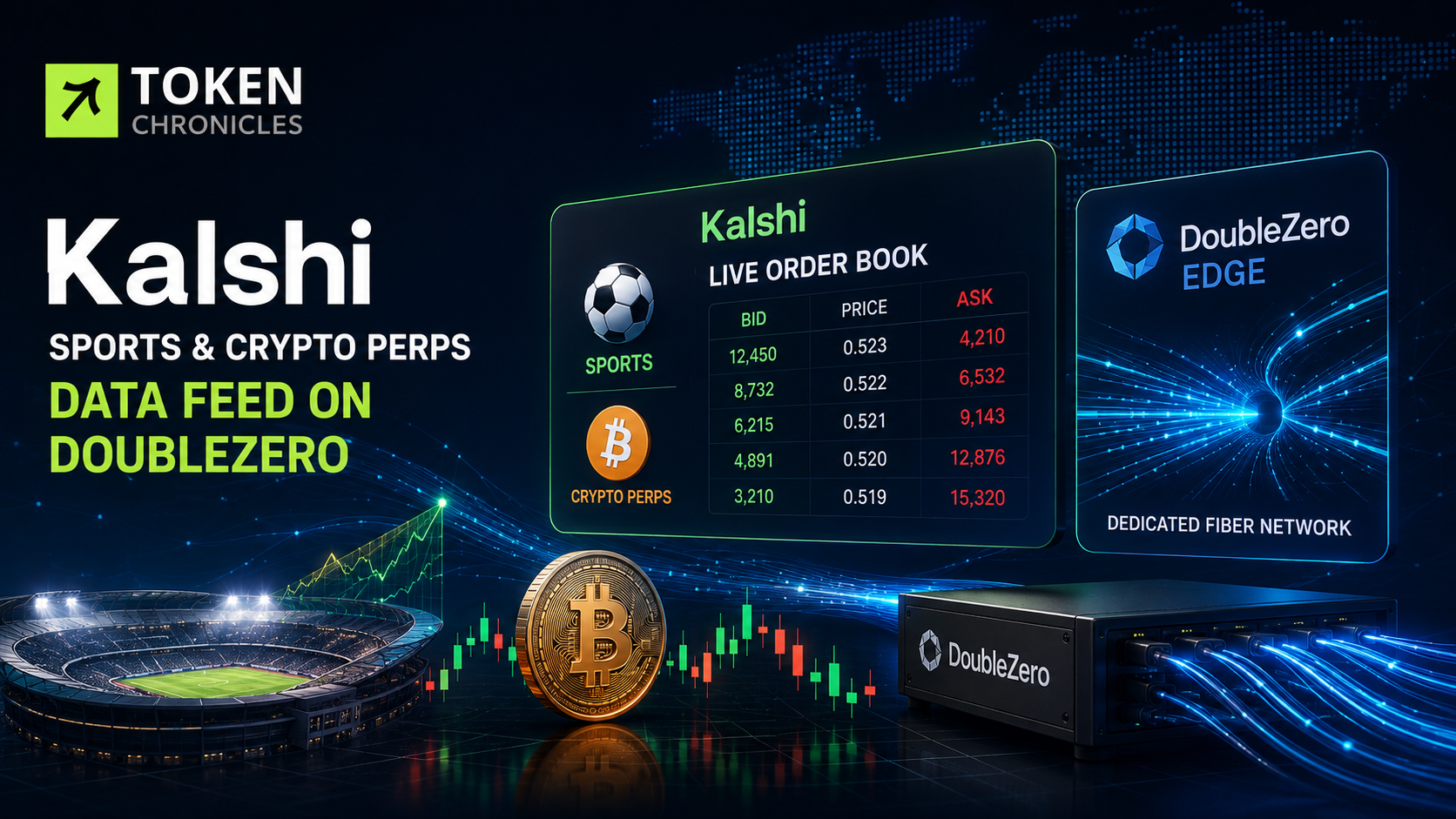
Prediction market platform Kalshi has partnered with DoubleZero Edge to make its real-time order book data available through DoubleZero’s dedicated fiber network, giving institutional users faster and more structured access to trading data.
Under the new arrangement, Kalshi’s live order book for sports and crypto perpetual event contracts will be distributed through DoubleZero Edge’s dedicated network infrastructure and made available to new subscribers.
The companies say the initiative is designed to provide institutional participants with a machine-readable data feed without requiring them to build their own systems to collect, process and organize information from Kalshi’s order books and application programming interfaces.
Kalshi Brings Prediction-Market Data to Institutional Infrastructure
Real-time market data is a critical component of modern trading infrastructure, particularly for institutions that rely on low-latency information to develop trading strategies, monitor liquidity and manage risk.
DoubleZero co-founder Austin Federa said data access has historically been an overlooked component of emerging financial markets, including crypto, perpetual contracts and prediction markets.
The partnership aims to address that gap by bringing Kalshi’s live market data onto dedicated network infrastructure designed for professional market participants.
Rather than repeatedly querying APIs or reconstructing order books independently, subscribers can access a standardized data feed through DoubleZero Edge.
Kalshi describes the launch as the first time a prediction market has distributed real-time order book data for sports and crypto perpetuals event contracts through this type of dedicated institutional data infrastructure.
Sports and Crypto Are Major Parts of Kalshi’s Trading Activity
The partnership comes as sports and cryptocurrency contracts become increasingly important segments of Kalshi’s business.
According to Dune data, sports accounted for approximately 37.8% of Kalshi’s weekly notional trading volume, making it the platform’s second-largest category.
Crypto ranked third, representing approximately 20.3% of weekly notional volume.
The largest category was exotics, which accounted for approximately 39.4% of weekly notional trading activity.
The figures demonstrate why institutional-grade data infrastructure could become increasingly important for Kalshi as trading activity expands across sports, crypto and other event-based markets.
For professional traders, access to real-time order book information can provide visibility into liquidity, spreads, market depth and changing probabilities.
Prediction Markets Are Moving Closer to Mainstream Financial Infrastructure
Kalshi’s partnership with DoubleZero represents another step toward treating prediction-market data as a financial-market information product rather than simply a retail betting interface.
Prediction markets allow users to trade contracts tied to future events, effectively assigning market-based probabilities to outcomes.
As the sector grows, professional investors and technology companies are increasingly integrating prediction-market information into broader financial and information systems.
In early July, OpenAI began displaying Kalshi prediction-market odds for FIFA World Cup matches in ChatGPT search results, providing another example of prediction-market data moving into mainstream digital platforms.
The DoubleZero integration takes a different approach, focusing on professional market infrastructure rather than consumer-facing information.
Sports Contracts Remain at the Center of a Regulatory Dispute
Kalshi’s expansion into sports markets is taking place against the backdrop of an ongoing regulatory battle in the United States.
The central question is whether Kalshi’s sports event contracts should be treated as gambling products governed by state laws or as derivatives regulated under federal commodities law.
State regulators argue that sports-related event contracts effectively constitute wagers and therefore fall under state gambling regulations.
Kalshi and the Commodity Futures Trading Commission (CFTC), however, maintain that the contracts are federally regulated derivatives and that the CFTC has exclusive jurisdiction over them.
The dispute has already resulted in legal action across several states.
States Challenge Kalshi’s Sports Markets
On June 29, a Michigan judge temporarily blocked Kalshi from allowing residents to participate in its sports event markets.
Kentucky also sued five prediction-market platforms, including Kalshi and Polymarket, accusing the companies of operating unlicensed sports-betting platforms.
Nevada previously issued a temporary ban against Kalshi in March.
These cases have created significant uncertainty for prediction-market operators seeking to offer sports contracts across the United States.
The legal conflict is particularly important for Kalshi because sports have become one of its largest trading categories.
Any restrictions on sports contracts could therefore have a meaningful impact on trading volumes, liquidity and the company’s broader market strategy.
CFTC Defends Federal Authority
The CFTC has taken the opposite position from state regulators.
The federal agency has argued that federally regulated event contracts fall under its exclusive jurisdiction and that states should not be able to independently prohibit products that have been approved within the federal derivatives framework.
The dispute could ultimately determine the regulatory boundaries for the rapidly expanding prediction-market industry.
If federal regulators prevail, platforms such as Kalshi could potentially operate sports event markets under a more unified national framework.
If state authorities succeed, prediction-market operators could face a fragmented landscape in which sports contracts are permitted in some states but prohibited or restricted in others.
What the DoubleZero Partnership Means for Kalshi
The new data-feed arrangement comes at an important point in Kalshi’s development.
The company is simultaneously expanding its market infrastructure, increasing institutional access to its data and navigating legal challenges over the nature of its contracts.
For institutional traders, access to a dedicated real-time feed could make Kalshi markets easier to integrate into automated trading systems, quantitative models and professional risk-management platforms.
For Kalshi, broader institutional access could increase liquidity and potentially deepen participation in its sports and crypto markets.
The partnership does not resolve the underlying regulatory dispute, however.
The immediate development is infrastructure rather than regulation: Kalshi’s live order book data for sports and crypto perpetual event contracts is now being made available through DoubleZero Edge’s dedicated network.
As prediction markets continue to evolve toward more sophisticated financial infrastructure, the combination of institutional-grade data, automated trading technology and regulatory clarity could determine how large the sector ultimately becomes.