
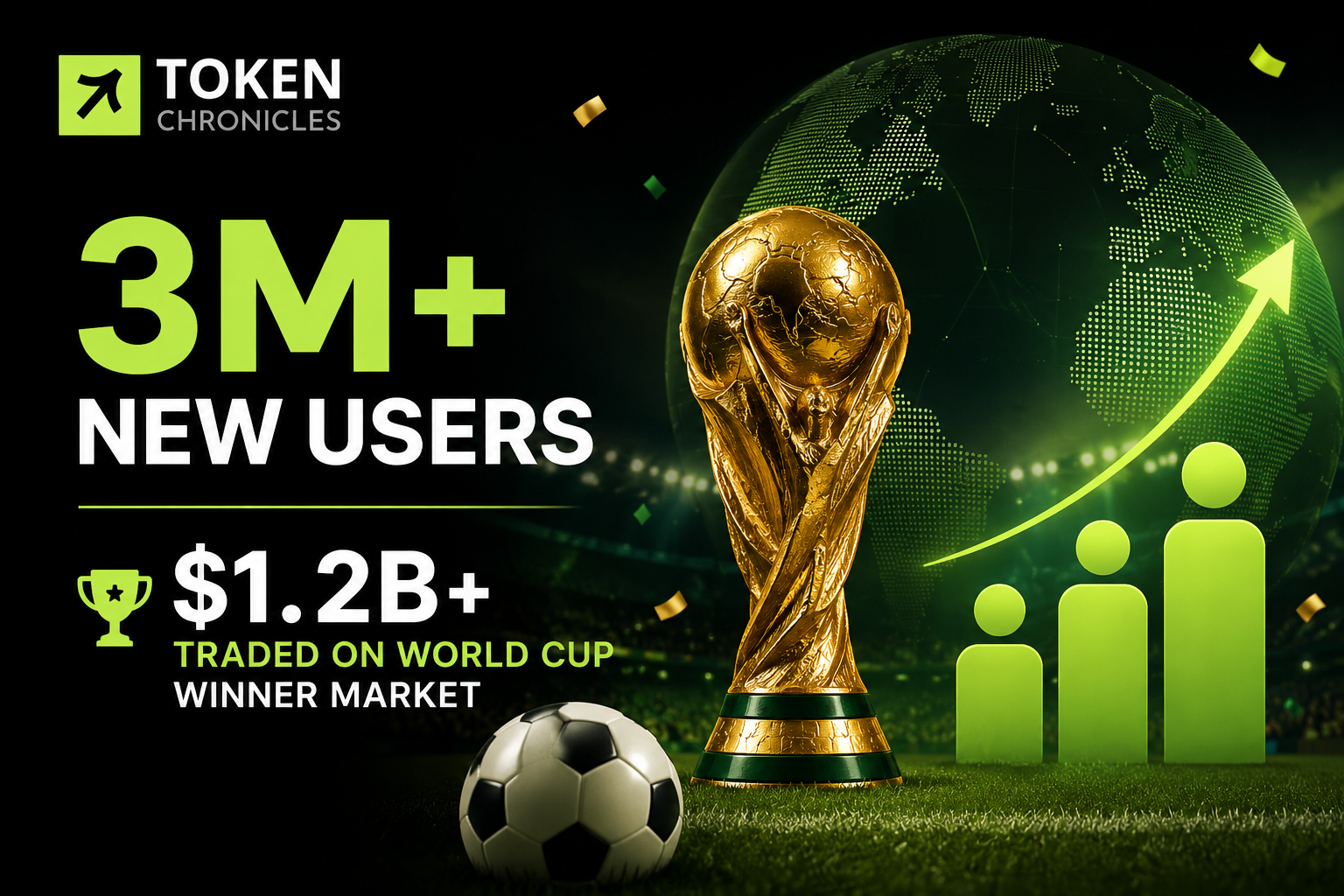
Prediction market platform Kalshi added three million new users during the 2026 FIFA World Cup, as global interest in the tournament fueled a sharp increase in trading activity and pushed one of its sports markets to a platform record.
More than $1.2 billion was traded on Kalshi’s World Cup winner contract, making it the largest single market in the platform’s history. The contract concluded after Spain defeated Argentina 1-0 in the final.
The surge highlights how major global sporting events are becoming powerful acquisition channels for prediction platforms, while also raising a larger question for the industry: whether event-driven spikes in participation can translate into sustained user activity after the tournament ends.
World Cup becomes a major growth engine
Kalshi used the global reach of football to significantly expand its audience during the tournament. With billions of fans following the competition worldwide, the World Cup offered the platform an opportunity to introduce prediction markets to users beyond their traditional finance and politics-focused audience.
The company supported that push with an extensive marketing strategy built around partnerships, high-profile personalities, and tournament visibility.
Kalshi partnered with ADI Predictstreet, FIFA’s official prediction market sponsor, on stadium co-branding initiatives and ran campaigns involving prominent football figures including Luka Modrić and José Mourinho. It also partnered with Argentina’s national team and expanded the visibility of its market probabilities across digital platforms.
Kalshi CEO Tarek Mansour described the company’s strategy as one focused on responding quickly to events capturing public attention, rather than simply maximizing the number of markets available.
The approach reflects a broader evolution in prediction markets, where major news, sports, politics, and cultural events increasingly act as real-time distribution channels capable of attracting large numbers of new participants.
Prediction markets still face regulatory uncertainty
Kalshi’s rapid growth comes as sports-related event contracts remain at the center of a regulatory dispute in the United States.
Prediction platforms generally position event contracts as federally regulated financial instruments, while several state authorities argue that sports-related contracts function similarly to traditional sports betting and should therefore fall under state gambling regulations.
The disagreement has created an increasingly complex legal environment as prediction markets expand deeper into mainstream sports.
Greater visibility may also increase regulatory scrutiny. While aggressive marketing does not necessarily determine how courts classify prediction contracts, the way these products are presented to consumers could influence broader perceptions among regulators, policymakers, and the public.
Can Kalshi keep users after the World Cup?
The larger challenge for Kalshi begins after the tournament.
Major events can generate enormous bursts of trading activity, but prediction platforms often experience declining volumes when there are fewer high-interest events available. Mansour has acknowledged that activity tends to fluctuate around major news and sporting moments.
For Kalshi, converting three million newly acquired users into recurring participants could therefore be more important than the initial World Cup surge itself.
The company is betting that a continuous cycle of sports, politics, financial markets, and breaking news will provide enough catalysts to keep users engaged.
Kalshi’s World Cup performance demonstrates the enormous distribution potential of event-driven prediction markets. But the next phase will test whether these platforms can evolve beyond temporary spikes around major events and build lasting marketplaces where users continuously trade on the outcomes shaping sports, finance, politics, and global events.