
JP Morgan Chase has filed with the US Securities and Exchange Commission (SEC) to launch a second tokenized money market fund on Ethereum, further accelerating Wall Street’s growing move into blockchain-based financial infrastructure.
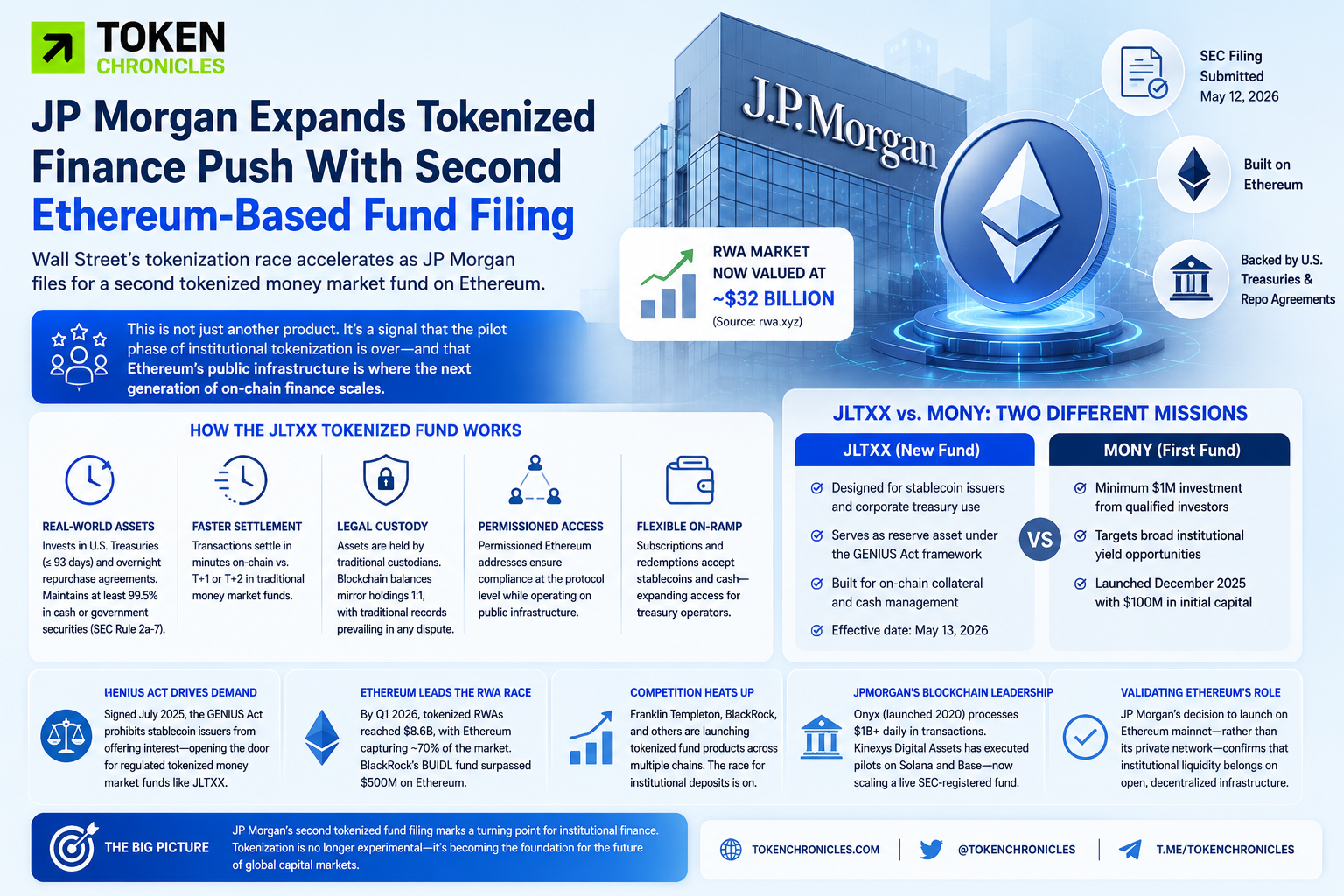
The filing, submitted on May 12, outlines a new institutional product that would issue blockchain-based digital tokens backed by short-term US Treasury securities and overnight repurchase agreements. Investors would be able to hold these tokenized fund shares directly in digital wallets or use them as on-chain collateral within regulated financial ecosystems.
The move highlights how rapidly the tokenized real-world asset (RWA) sector is evolving. According to data from rwa.xyz, the tokenized RWA market has now grown to roughly $32 billion in value, with major institutions increasingly racing to establish blockchain-native financial products.
Institutional Tokenization Moves Beyond the Pilot Phase
JP Morgan’s latest filing represents more than just another financial product launch. It signals that major banks now view tokenization as moving from experimental pilot programs into large-scale institutional deployment.
Perhaps most notably, the bank chose Ethereum’s public blockchain infrastructure instead of relying solely on its own private blockchain network, Kinexys Digital Assets. That decision is being viewed across the industry as a significant acknowledgment that institutional liquidity and capital markets activity are increasingly gravitating toward public blockchain ecosystems rather than isolated permissioned networks.
The filing suggests that Ethereum is continuing to strengthen its position as the primary settlement layer for tokenized institutional finance.
How the JLTXX Fund Will Work
The proposed fund, named JLTXX, is structured under JP Morgan Trust IV as Token Class Shares and is expected to become effective on May 13, 2026.
The underlying portfolio will primarily consist of:
- US Treasury securities with maturities of 93 days or less
- Overnight repurchase agreements backed by Treasuries or cash
- Highly liquid government-backed assets meeting SEC Rule 2a-7 standards
Unlike traditional money market funds that settle over T+1 or T+2 timeframes, blockchain-based transactions involving JLTXX are expected to settle within minutes.
Although ownership balances will be represented on Ethereum, legal custody of the underlying assets will still remain with traditional custodians. In the event of any dispute, conventional financial records and book-entry systems will continue to serve as the official source of ownership verification.
Designed Specifically for Stablecoin Issuers
JP Morgan’s first tokenized fund, MONY, focused broadly on institutional yield products for qualified investors. JLTXX, however, has been specifically structured to serve stablecoin issuers and corporate treasury managers operating under the regulatory framework established by the GENIUS Act.
The GENIUS Act, signed into law in July 2025, prohibited stablecoin issuers from directly offering interest-bearing stablecoins, effectively separating payment-focused stablecoins from yield-generating investment products.
That regulatory change created a significant opportunity for tokenized money market funds like JLTXX, allowing stablecoin issuers to park reserve assets in regulated yield-bearing instruments while remaining compliant with US law.
The new fund will also support:
- Stablecoin-based subscriptions and redemptions
- Permissioned Ethereum wallet access for compliance controls
- Institutional-grade on-chain collateral functionality
- Treasury and cash management operations
This hybrid structure allows the product to operate on a public blockchain while still meeting strict regulatory and compliance requirements.
Ethereum Emerges as Core Institutional Infrastructure
The filing also reinforces Ethereum’s growing dominance in tokenized finance.
By Q1 2026, Ethereum reportedly hosted nearly 70% of all tokenized real-world assets, cementing its role as the leading blockchain network for institutional tokenization.
Major competitors are also aggressively expanding in the sector:
- BlackRock’s BUIDL tokenized fund surpassed $500 million in assets after launching on Ethereum in 2024.
- Franklin Templeton continues broadening its blockchain-based treasury products.
- Additional tokenized fund launches are expected across Solana and other networks as institutions compete for corporate deposits and treasury flows.
Industry analysts now describe the sector as a multi-billion-dollar race to control the infrastructure layer for institutional digital finance.
JP Morgan Deepens Blockchain Expansion
JP Morgan has steadily expanded its blockchain strategy over recent years.
Its Onyx blockchain platform, launched in 2020, reportedly processes more than $1 billion in daily transactions. Through Kinexys Digital Assets, the bank has already completed several blockchain-based pilots, including:
- A $50 million tokenized commercial paper transaction on Solana
- JPMD deposit token issuance on Coinbase’s Base network
- Multiple cross-border tokenized settlement experiments
The launch of MONY in late 2025 served as an early proof-of-concept for institutional tokenized funds. JLTXX now appears positioned as a larger-scale product aimed directly at the rapidly expanding stablecoin reserve market.
Wall Street’s Blockchain Transition Accelerates
Momentum behind institutional blockchain adoption continues building rapidly across the financial sector.
Firms such as Charles Schwab, BlackRock, Franklin Templeton, and Morgan Stanley have all expanded their digital asset strategies, while tokenized assets increasingly move from niche experimentation into mainstream financial infrastructure.
JP Morgan’s decision to launch a second SEC-registered tokenized fund directly on Ethereum may ultimately become one of the clearest signs yet that major banks now see public blockchain networks as a permanent component of the future global financial system.