

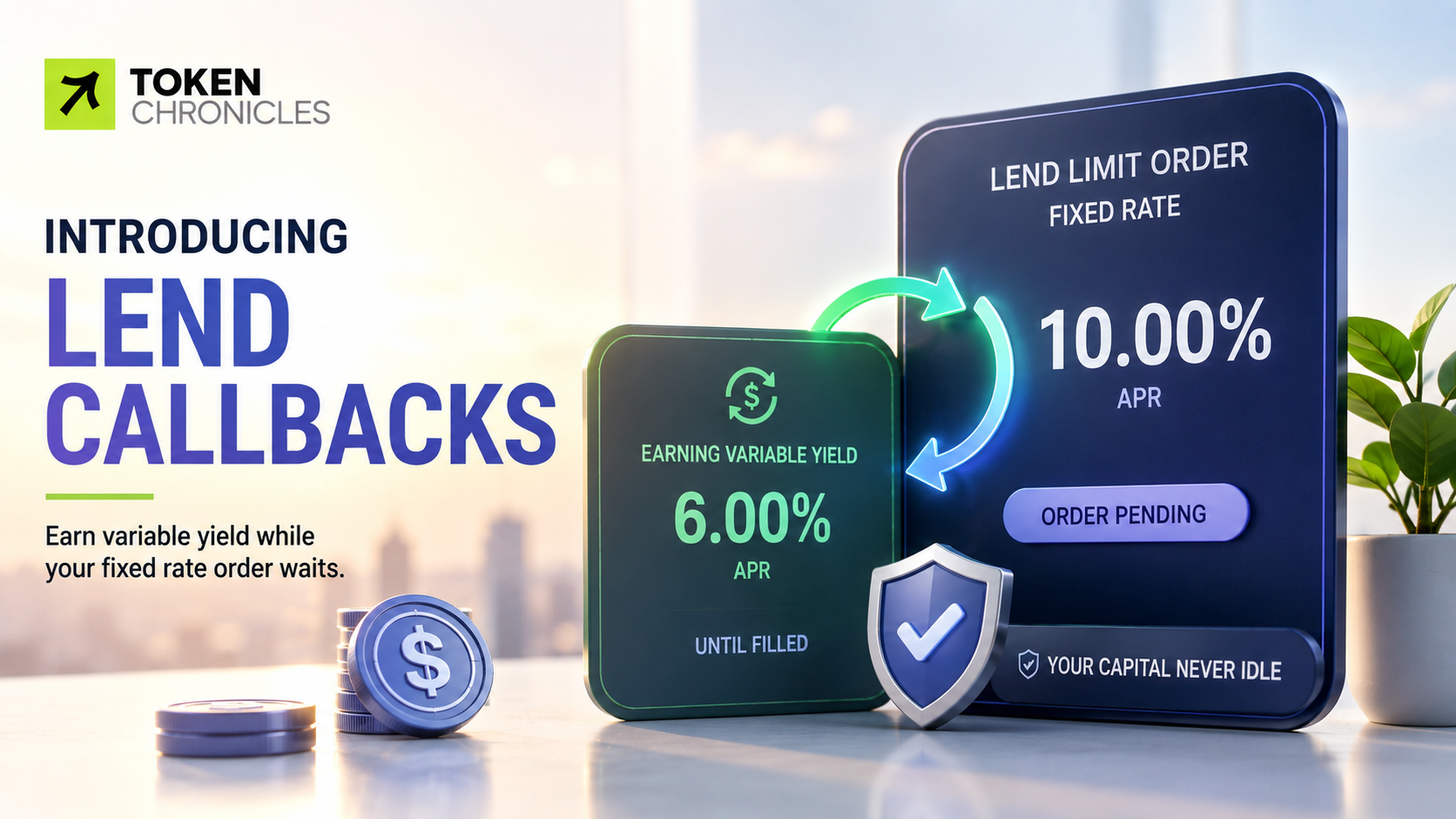
Lending markets are often built around a simple trade-off: users can either lend assets at a variable rate and earn yield immediately, or place a fixed-rate lending order and wait for a borrower to accept it. The problem with the second approach is that capital can remain idle while the order waits to be filled.
Lend Callbacks are designed to solve this inefficiency by allowing fixed-rate lending orders to generate variable yield while they remain unfilled.
How Lend Callbacks Work
With Lend Callbacks, users can place a limit order on a fixed-rate lending market while simultaneously earning the prevailing variable lending rate on their capital.
This creates a two-layer yield strategy:
- Variable yield acts as the floor: Capital continues generating income while the fixed-rate order is waiting.
- Fixed rate acts as the target: If a borrower accepts the order, the position transitions to the quoted fixed rate.
- Capital efficiency improves: Funds no longer have to sit idle simply because a fixed-rate order has not yet been matched.
For example, imagine a user wants to lend USDC at a 10% fixed annual rate, while the current variable lending rate is 6%. Without Lend Callbacks, the user’s capital could remain unused while waiting for a borrower willing to accept the 10% fixed rate.
With Lend Callbacks, the same capital can continue earning the 6% variable yield until the fixed-rate order is filled. Once a borrower matches the order, the lending position can move to the 10% fixed rate.
A Better Way to Quote Fixed Rates
The feature essentially allows lenders to quote a premium without sacrificing interim yield.
Instead of choosing between:
Immediate yield at a variable rate
or
Waiting for a potentially higher fixed rate
users can pursue both at the same time.
This makes fixed-rate markets more attractive for lenders because they can set their desired rate while maintaining exposure to the current variable market yield.
Improving Liquidity in Fixed-Rate Markets
Lend Callbacks could also improve liquidity and market efficiency.
One challenge in fixed-rate lending markets is that lenders may hesitate to place limit orders far above the prevailing rate because their capital could remain unused for an extended period. That can reduce the depth of available liquidity and make it harder for borrowers and lenders to find suitable counterparties.
By allowing unfilled orders to continue generating variable yield, the opportunity cost of quoting a fixed rate becomes significantly lower.
This could encourage lenders to provide more liquidity across different rate levels, creating a deeper and more competitive fixed-rate market.
Why It Matters
The key idea behind Lend Callbacks is simple: waiting should no longer mean earning nothing.
Lenders can remain active in the fixed-rate market while their capital continues producing variable income. If market conditions change and a borrower accepts the quoted fixed rate, the lender can then capture the higher fixed yield they originally targeted.
This creates a more flexible lending experience where users can balance current income, rate expectations and liquidity rather than having to choose only one.
Ultimately, Lend Callbacks turn an otherwise idle limit order into a potentially productive position, making fixed-rate lending more capital-efficient and giving lenders greater control over how they deploy their assets.