
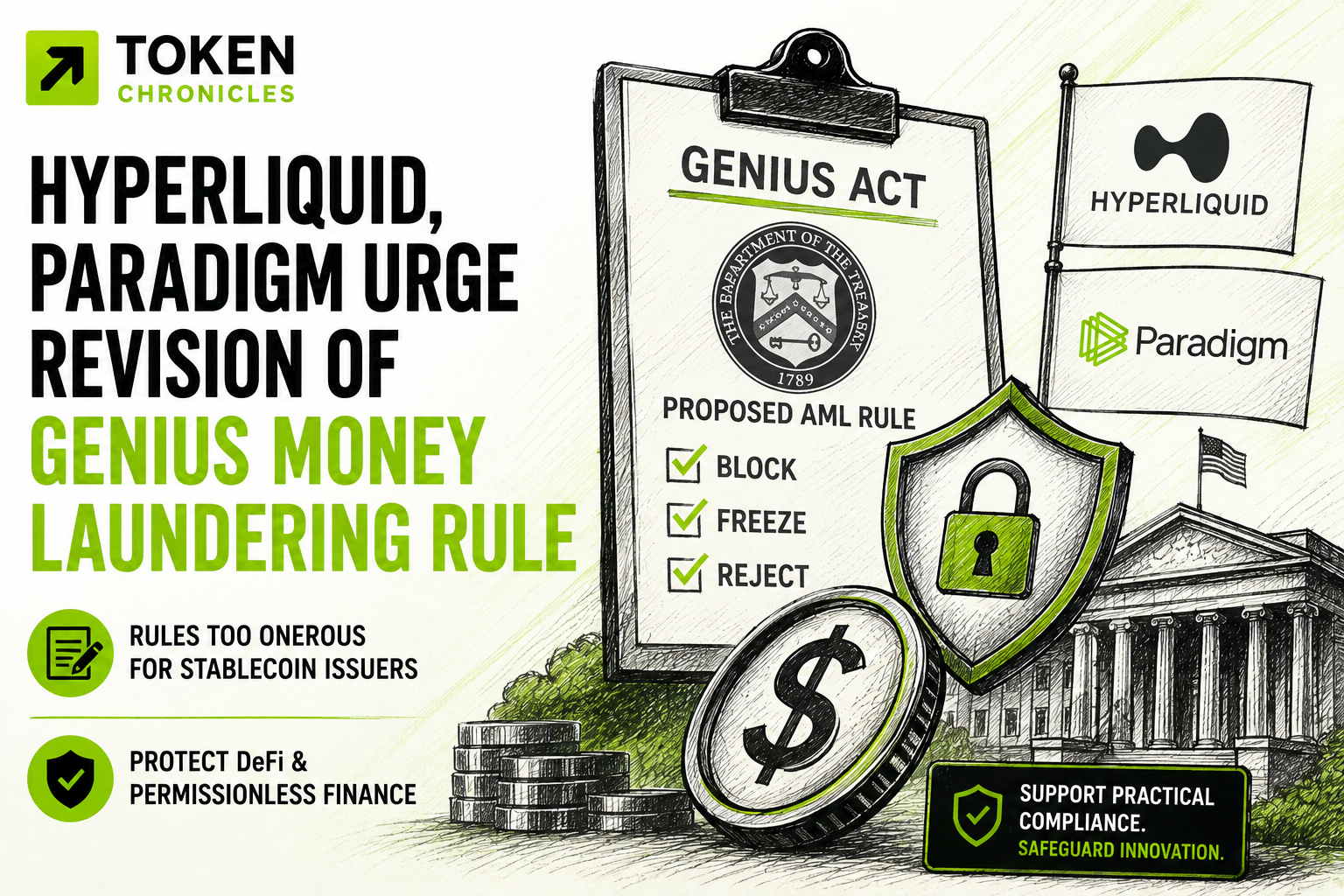
Two influential voices in the digital asset industry—Hyperliquid Policy Center and crypto investment firm Paradigm are urging U.S. regulators to reconsider key anti-money laundering (AML) and sanctions compliance requirements tied to the implementation of the GENIUS Act.
In a joint letter submitted to the U.S. Treasury Department, the organizations argued that portions of the proposed framework place unrealistic compliance burdens on stablecoin issuers and could unintentionally undermine innovation across decentralized finance (DeFi) and permissionless blockchain networks.
The debate highlights a growing tension between regulatory oversight and the decentralized architecture that underpins much of the cryptocurrency ecosystem.
Industry Concerns Focus on Secondary Market Obligations
At the center of the dispute is a Treasury proposal released in April that outlines how stablecoin issuers would comply with AML and sanctions requirements under the GENIUS Act.
The proposed rules would require regulated stablecoin issuers to possess the technical capability to block, freeze, reject, or restrict transactions that violate U.S. laws or sanctions directives not only when stablecoins are initially issued or redeemed, but also when they circulate throughout secondary markets.
Hyperliquid and Paradigm argue that this approach extends regulatory responsibilities far beyond what issuers can realistically monitor or control.
According to the organizations, stablecoin issuers typically have direct relationships with customers only during primary market interactions, such as minting and redemption processes. Once tokens enter the broader blockchain ecosystem, issuers often lose visibility into the identities of participants conducting transactions.
As a result, they believe regulators should limit compliance obligations primarily to areas where issuers have meaningful customer information and direct oversight.
Supporting a Primary-Market Compliance Model
The letter expressed support for the current approach taken by the Financial Crimes Enforcement Network (FinCEN), which generally places AML responsibilities on entities operating within the primary market.
Under this framework:
- Stablecoin issuers conduct Know Your Customer (KYC) checks during issuance and redemption.
- Regulated entities monitor customer activity where identity information is available.
- Compliance obligations focus on participants with direct customer relationships.
Hyperliquid and Paradigm argue that this model is both practical and effective because issuers possess relevant customer data during these interactions.
“The same principle should guide the implementation of AML and sanctions requirements for stablecoins deployed on permissionless blockchain networks,” the organizations wrote.
They contend that forcing issuers to monitor every transaction across decentralized ecosystems would create obligations that are technically difficult—and in many cases impossible to fulfill.
DeFi Ecosystem Could Face Unintended Consequences
One of the industry’s primary concerns is the impact the proposed rules could have on decentralized finance.
The letter warns that stablecoin issuers could become legally responsible for transactions occurring within autonomous smart contracts, even when they have no relationship with the users involved and no practical ability to identify participants.
Because most DeFi applications operate without centralized intermediaries, issuers typically see only wallet addresses and transaction records rather than verified customer identities.
Hyperliquid and Paradigm argue that treating these interactions as direct sanctions or AML compliance obligations creates significant legal uncertainty.
They warn that the result could be a major shift away from permissionless blockchain environments.
Risk of Stablecoins Leaving DeFi
According to the letter, overly broad compliance requirements could encourage regulated issuers to restrict where their stablecoins can be used.
Rather than allowing tokens to circulate freely across public blockchains, issuers may choose to operate exclusively within permissioned networks where participants are fully verified and transaction activity can be monitored more easily.
Industry participants fear such an outcome would weaken the role of U.S.-regulated stablecoins across decentralized markets.
The organizations argue that if regulated dollar-backed stablecoins retreat from DeFi ecosystems, the gap could be filled by less transparent offshore alternatives.
This, they suggest, would undermine the broader policy objective of strengthening the global role of U.S. dollar-denominated digital assets.
The letter states that such a shift could create:
- Reduced adoption of regulated stablecoins.
- Greater reliance on offshore issuers.
- Lower transparency across digital asset markets.
- Reduced U.S. influence over blockchain-based financial infrastructure.
GENIUS Act Moves Toward Implementation
The GENIUS Act, signed into law by President Donald Trump last year, established the first comprehensive federal framework for regulating stablecoins in the United States.
The legislation created clear requirements for:
- Stablecoin issuance.
- Reserve backing standards.
- Consumer protection measures.
- Regulatory supervision.
- Anti-money laundering compliance.
Federal agencies are now working through the implementation phase, with final regulations expected to take effect no later than January 2027.
The current Treasury proposal represents one of several major rulemaking efforts designed to translate the legislation into enforceable regulatory standards.
Broader Crypto Legislation Still Under Debate
The discussion around stablecoin compliance comes as lawmakers continue debating broader digital asset legislation in Washington.
The U.S. Senate is currently considering additional cryptocurrency market structure reforms that could further define the responsibilities of stablecoin issuers, blockchain developers, exchanges, and decentralized protocols.
Among the most closely watched proposals is the CLARITY Act, which seeks to establish clearer regulatory boundaries between digital asset market participants and federal agencies.
Several provisions under discussion could potentially:
- Clarify oversight responsibilities.
- Define liabilities for protocol developers.
- Establish rules for decentralized platforms.
- Limit legal exposure related to AML and sanctions compliance in certain circumstances.
Supporters argue that clear regulatory guidelines are necessary to encourage innovation while protecting consumers and financial markets.
Critics, however, continue to push for stronger safeguards against illicit finance, sanctions evasion, and systemic risks.
A Defining Regulatory Debate for Stablecoins
The objections raised by Hyperliquid and Paradigm underscore one of the most important questions facing regulators today: how to apply traditional financial compliance frameworks to decentralized technologies that operate without centralized intermediaries.
While regulators seek stronger tools to combat money laundering and sanctions violations, industry participants argue that imposing obligations beyond an issuer’s practical control could discourage innovation and reduce the competitiveness of U.S.-regulated digital assets.
As federal agencies finalize implementation of the GENIUS Act over the coming months, the outcome of this debate could play a major role in determining how stablecoins interact with decentralized finance and whether the United States remains a leading jurisdiction for blockchain-based financial innovation.