

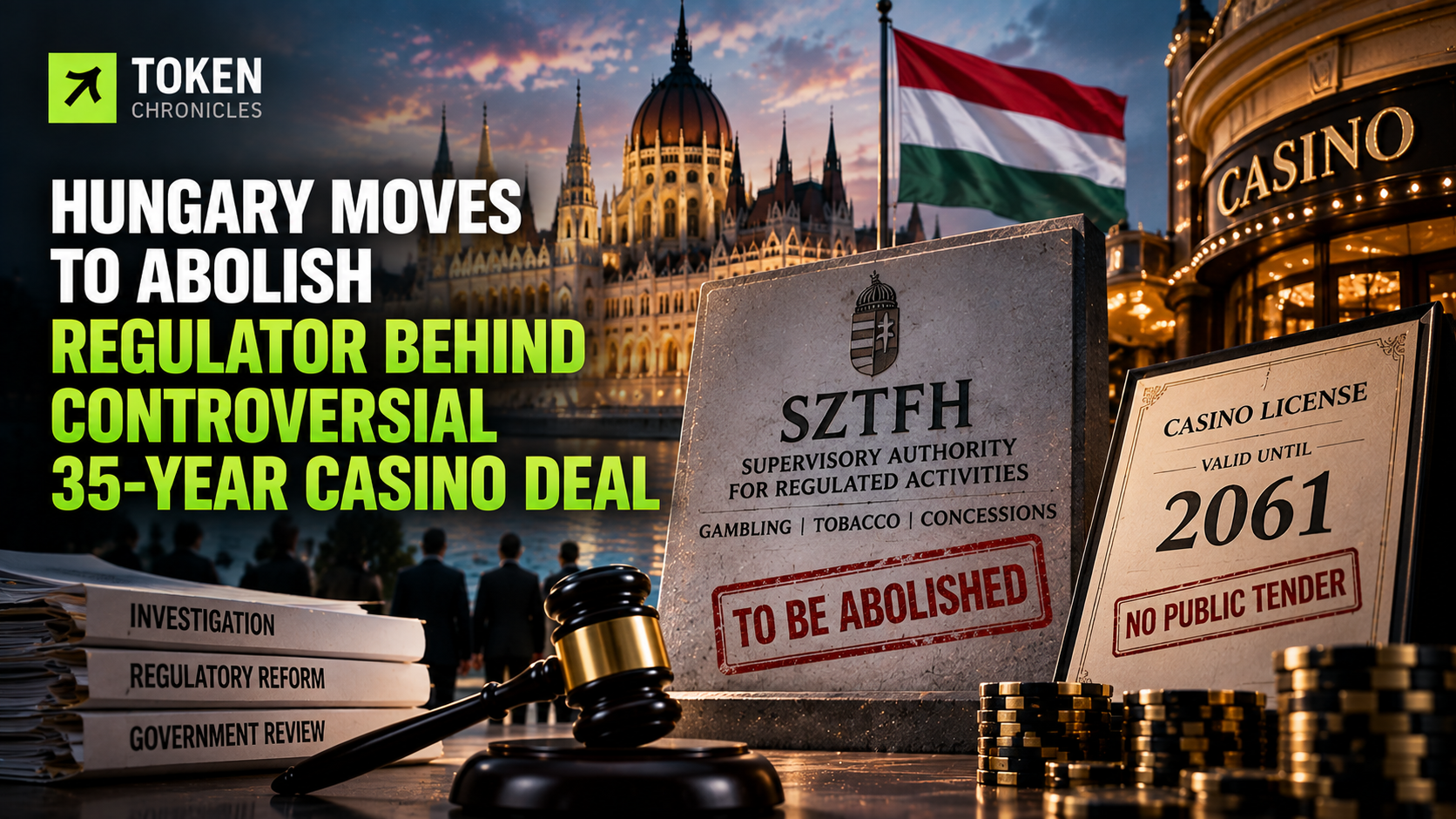
Hungary’s new government is preparing legislation that could dismantle the country’s gambling and concessions regulator following controversy over a casino license that was extended through 2061 without a public tender.
The government has ordered a review of the Supervisory Authority for Regulated Activities (SZTFH) and is considering transferring its responsibilities to other state-controlled institutions.
- The SZTFH extended a Sopron casino concession to 2061 without a public tender.
- The government ordered an assessment of how the regulator could be dissolved by Sept. 30.
- Prime Minister Péter Magyar accused the authority of serving private rather than public interests.
- The government plans to remove the SZTFH’s veto over concession agreements.
- Casino and tobacco concessions are undergoing a broader government review.
Casino Deal Puts SZTFH Under Scrutiny
A government resolution published on Aug. 31 instructed officials to examine the legal framework surrounding the SZTFH and determine how its responsibilities could be transferred to other government-controlled bodies.
Justice Minister Márta Görög has been given until Sept. 30 to submit the findings.
The government argues that the regulator, established in 2021 under the previous administration, was given responsibility for a broad collection of sectors, including gambling, tobacco retail, mining, liquidation services and concession-related activities.
Officials have also questioned the authority’s independence, pointing to its leadership structure and long appointment terms.
At a government press conference, Prime Minister Péter Magyar accused the SZTFH of prioritizing private interests over the public interest. Officials said legislation would be introduced to remove the agency’s authority over concession agreements, including its veto power.
The government is also reviewing existing casino and tobacco concessions, with officials expecting decisions on the broader review within weeks.
Sopron Casino Concession Sparks Controversy
The immediate controversy centers on a casino concession in Sopron, near Hungary’s border with Austria.
According to reporting cited in the source material, the casino’s existing 10-year concession expired on Jan. 15. The SZTFH initially extended it for six months through July 31 before awarding a new concession that runs until 2061.
No public tender was conducted.
Hungarian legislation allows authorities to award certain gambling contracts without a competitive tender when dealing with an organizer considered sufficiently reliable. The use of that provision in the Sopron case has nevertheless attracted political scrutiny.
The issue emerged as the government was already conducting a wider examination of Hungary’s concession system.
A June government resolution instructed ministers to review both tobacco and casino concessions. Transport Minister Dávid Vitézy had previously noted that some concessions granted before the election extend as far as 2061 and suggested that politically connected individuals could benefit from such arrangements.
Government Questions Regulator’s Independence
The government has also raised concerns about how the SZTFH is structured and governed.
The authority was created in 2021 and operates across several sectors that have little direct connection to one another. Government officials argue that its wide-ranging mandate and leadership arrangements have contributed to concerns about political influence.
The SZTFH has rejected the characterization.
In a Sept. 1 response, the authority described itself as an autonomous regulatory body accountable to Parliament. It highlighted the economic importance of the sectors under its supervision, saying they employ more than 50,000 people directly and contribute more than 1 trillion forints, or approximately $3.16 billion, annually through taxes and other contributions.
The regulator also pointed to enforcement against illegal online gambling, measures designed to protect minors from tobacco products, geothermal regulation and cybersecurity oversight.
Despite defending its independence and record, the SZTFH said it would cooperate with the government’s review.
Crypto Was Previously Part of SZTFH’s Responsibilities
The regulator’s responsibilities have also extended into the cryptocurrency sector.
From 2024 until this summer, Hungary required certain crypto-to-fiat and crypto-to-crypto conversions to undergo verification by licensed service providers. The SZTFH was responsible for licensing and supervising those verification providers.
The framework was unusual within the European Union, where comparable requirements were not broadly applied in the same manner.
Hungary’s changing approach comes as European authorities continue strengthening oversight of gambling, prediction markets and digital assets.
The European Union has been considering additional measures affecting the gambling industry, while EU regulators have also taken positions on the application of existing retail-investment restrictions to prediction markets.
Concessions Face Broader Government Review
The proposed restructuring of the SZTFH appears to form part of a wider effort by Hungary’s new government to reassess long-term concession arrangements established under the previous administration.
The Sopron casino agreement has become the most visible example because of its unusually long duration and the absence of a public tender.
Whether the regulator is ultimately abolished, reorganized or replaced will depend on the government’s Sept. 30 review and subsequent parliamentary action.
For now, the controversy has placed both the SZTFH and Hungary’s concession system under renewed scrutiny, while the government weighs how gambling, tobacco, crypto-related activities and other regulated sectors should be supervised going forward.