
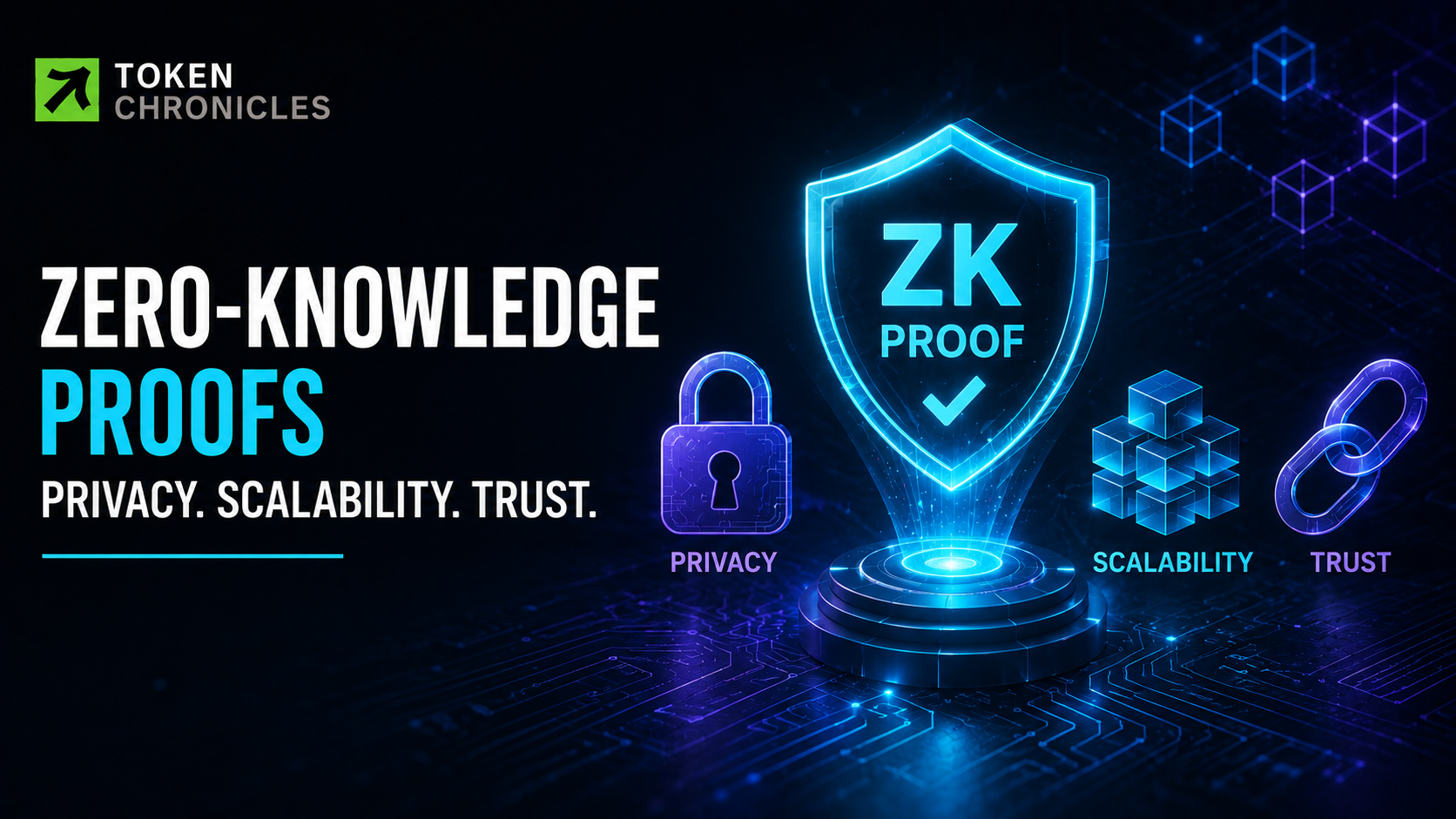
Zero-knowledge proofs, or ZK proofs, are becoming one of the most important cryptographic technologies in blockchain. Their core promise is simple: prove that something is true without revealing the underlying information that makes it true.
A person could prove they are over 18 without disclosing their birth date, demonstrate that they have sufficient funds without revealing their account balance, or prove that a computation was executed correctly without exposing its inputs.
This capability addresses one of blockchain’s biggest contradictions. Public ledgers create transparency and verifiability, but that same transparency can expose users’ financial activity. ZK proofs offer a way to preserve the benefits of verification while reducing unnecessary disclosure.
The three foundations of zero-knowledge proofs
A reliable ZK proof system is generally built around three properties: completeness, soundness and zero-knowledge.
Completeness means that when a statement is true and the protocol is followed correctly, the verifier will accept the proof.
Soundness means that a dishonest prover should not be able to convince the verifier that a false statement is true, except with an extremely small probability.
Zero-knowledge is the defining feature. The verifier learns that the statement is valid without learning the secret information behind it.
This differentiates ZK proofs from conventional cryptographic tools. A digital signature can demonstrate that someone authorized a message, but the message itself remains visible. A hash commitment can prove that someone committed to a particular value, but revealing the value eventually exposes it.
ZK proofs instead establish relationships between hidden information without requiring the information itself to become public.
zk-SNARKs and zk-STARKs
Two major families of ZK proof systems have become particularly important in blockchain: zk-SNARKs and zk-STARKs.
zk-SNARKs, or Zero-Knowledge Succinct Non-Interactive Arguments of Knowledge, are designed to produce extremely compact proofs that can be verified efficiently.
Their small proof sizes make them attractive for blockchain applications where every byte of onchain data has a cost. However, some SNARK implementations historically depended on trusted setup ceremonies, creating concerns around how cryptographic parameters were generated and whether the associated randomness was securely destroyed.
Newer approaches, including PLONK and Halo 2, have reduced or removed trusted-setup requirements for particular implementations.
zk-STARKs take a different approach. They do not require a trusted setup and rely primarily on hash-based cryptography. This gives them a transparent security model and potential advantages against future quantum threats.
The tradeoff is proof size. STARK proofs are generally much larger than SNARK proofs, which can increase blockchain verification and data costs.
Modern systems increasingly combine techniques from both approaches, meaning the practical question is often less about choosing “SNARK versus STARK” and more about proving speed, verification cost, scalability and security.
ZK proofs are becoming a scaling technology
One of the most successful applications of ZK technology is blockchain scaling.
A ZK rollup can execute thousands of transactions outside the Ethereum mainnet, generate a cryptographic proof showing that the transactions were processed correctly, and submit that proof to Ethereum.
Ethereum does not need to independently execute every transaction. Instead, its verification system checks the proof and confirms that the resulting state is valid.
This creates an important asymmetry:
Generating a proof can be computationally expensive, while verifying it can be comparatively cheap.
That allows thousands of transactions to be compressed into a single verification process.
Several major projects have pursued different approaches to ZK rollups.
zkSync Era focuses on Ethereum compatibility while using a proving-oriented execution environment.
StarkNet uses the Cairo programming language and STARK-based proving, giving developers an environment specifically designed for verifiable computation.
Polygon zkEVM has pursued high compatibility with Ethereum’s execution environment, reducing the changes developers need to make when migrating applications.
Scroll has similarly focused on strong Ethereum compatibility while building a ZK-based scaling system.
The underlying tradeoff is straightforward: greater compatibility makes migration easier, while greater specialization can improve proving performance.
ZK technology can fundamentally change blockchain privacy
Scaling is only half of the story.
The privacy applications of zero-knowledge proofs may ultimately be even more significant.
A conventional Ethereum transaction publicly exposes information such as the sender, recipient, amount and smart contract involved. Over time, blockchain analytics companies can combine those records with exchange data and behavioral patterns to associate blockchain addresses with real-world identities.
ZK-based privacy systems attempt to break that visibility.
A private transaction can allow the network to verify that:
- the sender has sufficient funds;
- the transaction is valid;
- no double spending has occurred;
- the resulting state is correct;
without necessarily revealing the parties involved or the transaction amount.
Zcash pioneered shielded transactions
Zcash became one of the earliest major implementations of ZK-based financial privacy when it launched in 2016.
Its shielded transactions use zk-SNARK technology to conceal transaction information, while users can also choose transparent transactions that behave more like conventional public blockchain transfers.
Adoption of shielded transactions has historically remained below the levels privacy advocates hoped for, illustrating that cryptographic capability alone does not guarantee widespread adoption.
Privacy is becoming programmable
Newer projects are attempting to move beyond private payments toward private smart contracts.
Aztec is developing a privacy-focused Ethereum Layer 2 in which transactions can be private by default.
Aleo is pursuing a blockchain architecture designed around native ZK capabilities and private applications.
The broader opportunity extends beyond financial transfers. ZK proofs could enable:
- private voting;
- privacy-preserving identity verification;
- selective KYC disclosure;
- confidential DeFi positions;
- proof of eligibility without revealing identity;
- proof that funds satisfy compliance requirements without exposing complete transaction histories.
The regulatory challenge
The privacy benefits of ZK technology have also created difficult regulatory questions.
The conflict became particularly visible with Tornado Cash, an Ethereum privacy protocol that used cryptographic techniques to obscure connections between deposits and withdrawals.
In 2022, the US Treasury’s Office of Foreign Assets Control sanctioned Tornado Cash, triggering a major debate over privacy technology, sanctions enforcement and the legal treatment of open-source code.
The case demonstrated a fundamental challenge: privacy and regulatory transparency can appear to pull in opposite directions.
ZK proofs, however, could offer a middle ground.
Instead of requiring users to reveal their entire identity or transaction history, a system could allow someone to prove a specific fact.
For example, a user could prove that:
- they completed KYC with a regulated institution;
- they are not included on a sanctions list;
- their funds satisfy a particular compliance condition;
- a transaction meets a regulatory threshold.
The underlying information could remain private.
Selective disclosure could become the bridge between privacy and compliance
This concept of selective disclosure may become one of the most important applications of ZK technology.
Traditional compliance often operates on an all-or-nothing model. Users provide extensive personal and financial information because institutions need to establish eligibility.
ZK systems allow compliance to become more granular.
Instead of revealing a passport, a person could prove citizenship. Instead of exposing their entire balance, they could prove that their balance exceeds a required threshold.
Privacy pools represent another potential approach. Rather than allowing completely unrestricted anonymity, users could prove that their funds belong to a set of deposits that satisfy defined compliance criteria without revealing exactly which deposit is theirs.
Whether regulators ultimately accept these approaches remains uncertain.
The technology can provide the cryptographic capability. Policy will determine how that capability is incorporated into financial systems.
The cost of proving remains a major obstacle
ZK proofs are not computationally free.
Generating a proof can require significant processing power, particularly for complex computations. This creates an important economic distinction between applications.
High-value financial transactions can potentially absorb substantial proving costs because the computational expense represents a small fraction of the transaction value.
Consumer applications are more challenging. If someone is making a transaction worth only a few dollars, spending several dollars or significant computing resources generating a proof is difficult to justify.
That is why specialized hardware has become an important part of the ZK ecosystem.
Companies developing ZK-focused processors, GPUs, ASICs and other acceleration technologies are attempting to reduce proving times and costs.
If proving becomes dramatically cheaper, ZK privacy could move from specialized financial applications into everyday consumer products.
Scaling and privacy are beginning to converge
Perhaps the most important development is that ZK technology can address both scalability and confidentiality.
A conventional ZK rollup can execute transactions offchain and prove that the resulting state is valid.
A privacy-focused ZK system can additionally conceal sensitive transaction information.
Combining those capabilities could produce blockchain networks that are simultaneously:
- faster;
- cheaper;
- verifiable;
- private.
Projects such as Aztec and Polygon Miden are exploring architectures that move toward this combination.
The engineering challenge is considerable, but the long-term potential is substantial. The ultimate objective is not simply to process more transactions. It is to create blockchain systems where users can interact efficiently without making every aspect of their financial activity permanently public.
What ZK proofs do not solve
Zero-knowledge technology is powerful, but it is not a universal privacy solution.
A ZK proof can protect information that the protocol is designed to conceal, but other forms of metadata may still reveal users.
Transaction timing, interaction patterns, gas behavior, network activity and external data can potentially undermine anonymity even when transaction contents remain hidden.
Likewise, a detected cryptographic proof does not automatically establish the complete origin of the information being proved.
ZK systems also do not eliminate implementation risk. A flaw in a proving circuit or smart contract can potentially have catastrophic consequences, including fraudulent state transitions, unauthorized token creation or loss of funds.
ZK machine learning is another emerging frontier
The technology is also expanding beyond blockchain transactions.
Zero-knowledge machine learning, or zkML, seeks to prove that a machine-learning model generated a particular result without exposing the model’s underlying parameters or sensitive input data.
Potential applications include proving that an AI system produced a result according to a particular model, verifying confidential computations and enabling privacy-preserving AI services.
The field remains experimental, but it demonstrates that ZK proofs are evolving from a blockchain-specific technology into a broader framework for verifiable computation.
What users should check before using a ZK protocol
Anyone evaluating a ZK-based application should look beyond the marketing.
Check the proof system and audits. ZK circuits are highly specialized and mistakes can be severe. Look for audits performed by teams with genuine ZK cryptography expertise.
Understand what is actually private. A protocol may conceal transaction amounts while leaving addresses visible, or hide addresses while exposing other metadata. Read the technical documentation rather than assuming that “ZK” means complete anonymity.
Investigate the trusted setup. If a SNARK implementation relies on a trusted ceremony, understand how it was conducted and what assumptions users must accept.
Evaluate proving costs. A system may be cryptographically elegant but impractical if generating proofs takes too long or requires expensive infrastructure.
Consider regulatory exposure. Privacy technologies exist within an evolving legal environment. Selective disclosure and compliance mechanisms may become increasingly important for applications handling regulated assets.
The bigger picture
Zero-knowledge proofs address one of blockchain’s most fundamental problems: how can a decentralized network verify information without requiring everyone to see everything?
The answer has implications far beyond private payments.
ZK technology can help blockchains scale, enable confidential smart contracts, support privacy-preserving identity systems and create new forms of verifiable computation.
The most important shift may be philosophical. Blockchain originally made transparency the default mechanism for trust. Zero-knowledge technology offers another model: trust through verification without unnecessary disclosure.
As proving becomes faster and cheaper, that model could become a foundational layer of both blockchain infrastructure and the broader digital economy.