

A proposed de minimis tax exemption for small Bitcoin and cryptocurrency payments could do more than simplify tax reporting for everyday users. A new analysis from Cornell Brooks School Tech Policy Institute (BTPI) suggests that reducing the tax and paperwork burden on small crypto transactions could actually increase economic activity and generate additional government revenue over time.
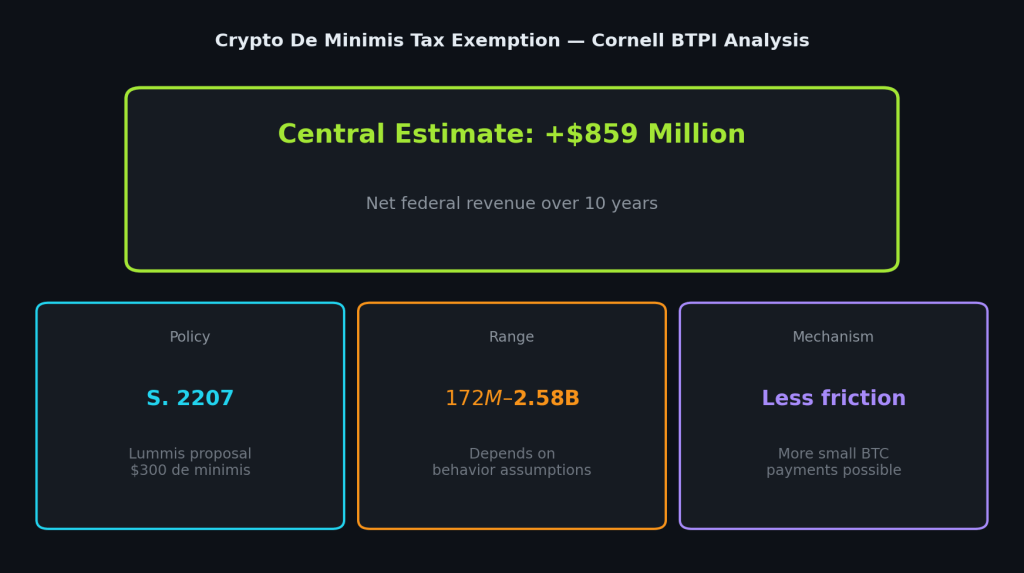
The study estimates that a targeted exemption for small digital-asset payments could produce a net federal revenue gain of roughly $859 million over 10 years under its central scenario. Depending on the assumptions used, the estimated impact ranges from approximately $172 million to $2.58 billion.
The analysis does not claim that such a policy would automatically increase Bitcoin’s price. Instead, it presents a potential chain of effects: lower tax friction → more crypto spending → greater economic activity → potentially higher Bitcoin payment demand → possible long-term benefits for BTC adoption and value.
Key Takeaways
- Cornell BTPI estimates a small-payment crypto tax exemption could generate approximately $859 million in net federal revenue over 10 years in its central scenario.
- The study’s estimates range from $172 million to $2.58 billion, depending on the assumptions.
- A proposed U.S. bill would exempt qualifying Bitcoin and crypto purchases of up to $300, subject to an annual $5,000 limit on excluded gains.
- Current U.S. tax rules can make small crypto purchases cumbersome because each transaction may create a capital-gains reporting obligation.
- A simpler tax framework could encourage more people to use Bitcoin for everyday payments.
- Any impact on Bitcoin’s price would likely be indirect and uncertain, particularly in the near term.
Why Small Bitcoin Payments Are Difficult Under Current Rules
The central problem examined by BTPI is the tax treatment of cryptocurrency used for everyday purchases.
Under the current U.S. framework, spending appreciated Bitcoin can potentially create a taxable capital gain. This means that someone purchasing a relatively inexpensive item with BTC may technically need to determine the asset’s cost basis, calculate the gain and account for the transaction for tax purposes.
That complexity can discourage people from using cryptocurrency as money.
The problem becomes especially apparent when transactions are very small.
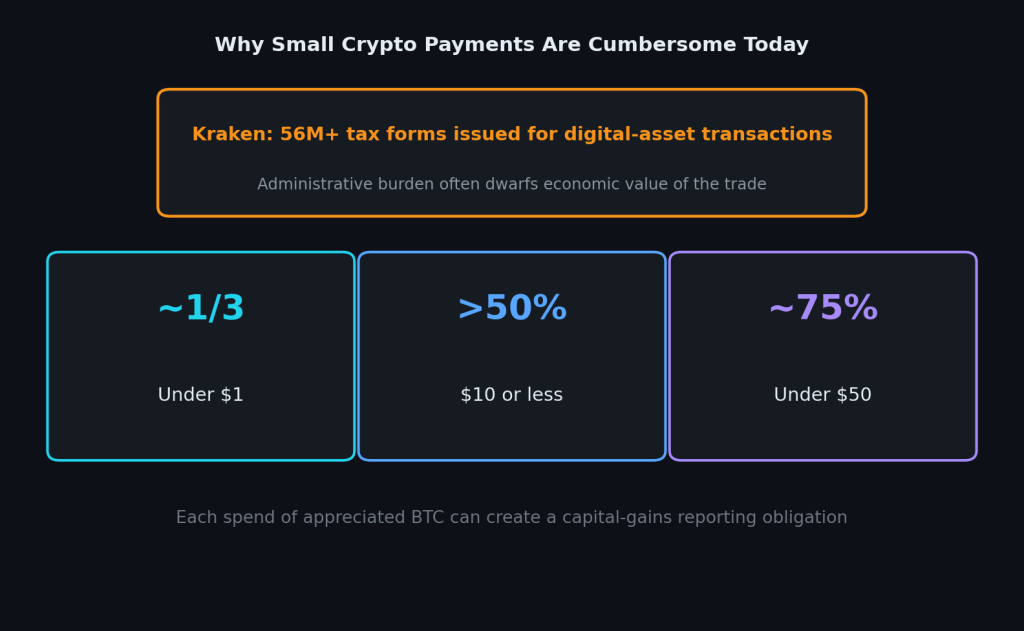
For example, cryptocurrency exchange Kraken previously reported issuing more than 56 million tax forms associated with digital-asset transactions. According to the figures cited in the source, nearly one-third involved transactions worth less than $1, more than half involved transactions of $10 or less, and roughly three-quarters were below $50.
The result is a system in which the administrative burden associated with reporting can become disproportionate to the economic value of the transaction.
BTPI argues that reducing this friction could encourage cryptocurrency holders to actually spend their assets rather than simply hold them as investments.
Proposed $300 De Minimis Threshold
One legislative proposal addressing the issue is S. 2207, introduced by Senator Cynthia Lummis.
Under the proposal described in the source, qualifying Bitcoin and cryptocurrency purchases of $300 or less would be exempt from capital-gains taxation, subject to a maximum of $5,000 in excluded gains per year.
However, the precise scope of any eventual legislation remains uncertain.
Other proposals have sought to limit similar tax relief to regulated stablecoins, while lawmakers continue to debate how digital assets should be treated for tax purposes.
The distinction matters because stablecoins and Bitcoin serve different roles within the crypto economy. Restricting an exemption to stablecoins would provide less direct support for Bitcoin’s use as an everyday payment asset.
Cornell’s Revenue Estimate
At first glance, removing taxes from certain transactions might appear likely to reduce government revenue.
BTPI’s analysis reaches a more complicated conclusion.
The institute argues that the direct revenue lost from exempting small transactions could be relatively modest. If the policy encourages enough new economic activity, the additional taxable activity generated elsewhere could potentially offset that initial reduction.
Under the report’s central scenario, the result is an estimated $859 million net revenue gain over 10 years.
The study also estimates that if qualifying payment volume were to double, only a relatively modest portion of the increase would need to represent genuinely new purchases for the exemption to reach a break-even point.
BTPI estimates that every additional dollar of taxable activity could generate approximately 16 cents in federal revenue.
These projections depend heavily on assumptions about future user behavior, however, meaning they should be viewed as scenarios rather than guaranteed fiscal outcomes.
More People Could Be Willing to Spend Bitcoin
A de minimis exemption could change the economics of using Bitcoin for everyday purchases.
Without the need to calculate a capital gain on every qualifying transaction, users could have fewer reasons to avoid spending appreciated BTC.
That could affect both whether someone makes a purchase and which asset they choose as their payment method.
A Bitcoin holder who currently prefers cash or a stablecoin because of tax-reporting complexity might become more comfortable using BTC for smaller transactions if the additional administrative burden disappears.
This could gradually increase Bitcoin’s role as a medium of exchange rather than leaving it primarily positioned as an investment or store-of-value asset.
Could a Tax Break Actually Support Bitcoin’s Price?

The potential impact on Bitcoin’s price is much less certain.
If a de minimis exemption encourages more people to spend Bitcoin, it could theoretically increase demand for BTC as a payment asset.
More widespread usage could then create a positive feedback loop:
Simpler taxation → more spending → greater utility → increased adoption → potentially stronger demand.
However, the immediate effect would probably be limited.
Bitcoin’s payment economy remains relatively small compared with the enormous amount of BTC traded as an investment asset. A modest increase in everyday spending would therefore be unlikely, by itself, to create a dramatic short-term change in Bitcoin’s market value.
The longer-term implications could be more significant if tax reform became part of a broader shift toward using Bitcoin in everyday commerce.
Bitcoin Faces Competition From Stablecoins
The potential benefits also need to be viewed against the rapid growth of stablecoins.
Stablecoins can offer users a dollar-denominated payment instrument without exposing merchants or consumers to the same level of short-term price volatility associated with Bitcoin.
That makes them attractive for payments, particularly in situations where users want blockchain-based settlement without taking direct BTC price risk.
Bitcoin nevertheless has characteristics that could make it valuable as a global payment network.
Unlike privately issued stablecoins, Bitcoin is not a liability of a particular company or dependent on a specific issuer. Its network operates across jurisdictions and does not require users to rely on a centralized entity to maintain the monetary asset itself.
Whether those characteristics translate into significantly greater payment demand will depend on factors beyond taxation, including transaction costs, volatility, merchant adoption, user behavior and the development of payment infrastructure.
Merchants Could Determine the Real Impact
Even if consumers become more willing to spend Bitcoin, the effect on BTC demand will also depend on what merchants do with the coins they receive.
If merchants immediately convert incoming BTC into fiat or stablecoins, increased payment usage may not necessarily create sustained additional demand for Bitcoin.
If more businesses choose to hold part of their Bitcoin revenue, however, a larger circular Bitcoin economy could gradually develop.
That distinction could become increasingly important as payment infrastructure improves and businesses gain more options for managing cryptocurrency revenues.
The tax exemption, in other words, would only remove one obstacle. It would not guarantee that Bitcoin becomes a dominant payment method.
The Agentic Economy Could Make the Issue More Important
The tax question could become even more complicated as digital payments become increasingly automated.
An emerging agentic economy, in which software agents and AI systems conduct transactions on behalf of users and businesses, could involve enormous numbers of small-value payments.
If every microtransaction creates a separate tax calculation and reporting requirement, the administrative burden could become impractical.
A well-designed de minimis framework could therefore become relevant beyond today’s consumer purchases, potentially providing a simpler foundation for automated digital commerce.
How governments ultimately tax machine-to-machine transactions, stablecoins, Bitcoin and other digital assets remains an open policy question.
Could Other Countries Follow?
The potential benefits are not limited to the United States.
BTPI’s analysis focuses on the U.S., but similar approaches could potentially be considered by other governments looking to encourage digital-asset payments.
In countries where value-added taxes (VAT) play a larger role in government revenue, increased economic activity could theoretically produce additional fiscal benefits through consumption taxes as well.
This could make small-transaction exemptions particularly interesting for governments trying to balance crypto taxation with the desire to encourage digital commerce.
The broader international policy environment is also evolving, with major economies increasingly examining how digital assets could contribute to economic growth.
Tax Reform Is Only One Piece of Bitcoin’s Future
A de minimis exemption could remove one of the obstacles preventing Bitcoin from functioning more naturally as a payment asset.
But taxation is only one factor influencing whether people actually spend BTC.
Price volatility, merchant acceptance, payment infrastructure, transaction costs, consumer preferences and competition from stablecoins will all play major roles.
The proposed tax change therefore should not be viewed as a guaranteed Bitcoin price catalyst.
Instead, its importance lies in potentially changing the incentives surrounding Bitcoin usage.
If smaller transactions become easier to execute and report, more users could experiment with spending BTC. If merchants begin retaining more of the Bitcoin they receive, a stronger circular economy could develop. And if Bitcoin becomes increasingly integrated into automated and global digital commerce, the cumulative effect could become more meaningful.
In the near term, the price impact may be negligible. Over the longer term, however, reducing the friction around everyday Bitcoin payments could help strengthen the cryptocurrency’s utility and greater utility could eventually translate into stronger and more sustainable demand.