
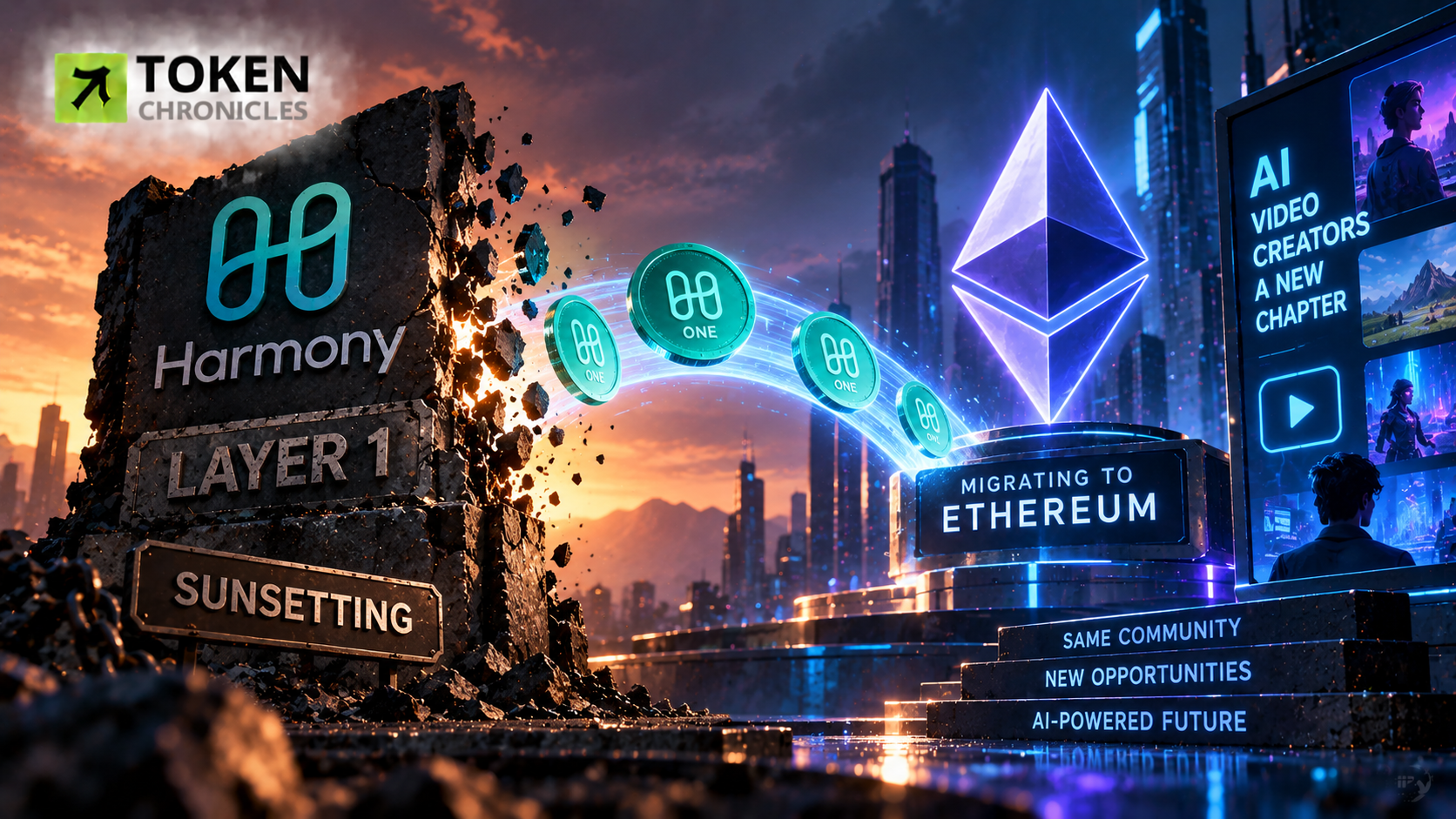
Harmony has announced plans to wind down its Layer 1 blockchain and migrate its native ONE token to Ethereum, citing growing security concerns. The project also wants to redirect its validators and community toward a new AI-driven video initiative built around creator-generated content and remixing.
Key points
- Harmony plans to sunset its Layer 1 network and move ONE to Ethereum.
- Validators can begin shutting down their nodes from Sept. 10, 2026.
- The project has allocated $1.37 million to support eligible validators transitioning into new roles.
- Harmony plans to distribute new ONE tokens on Ethereum without requiring individual holders to initiate the migration.
- Users with assets inside certain smart contracts and liquidity pools must withdraw them before the shutdown deadline.
- The decision follows a major August exploit and Harmony’s earlier 2022 Horizon bridge attack.
Harmony Decides to Wind Down Its Layer 1
Harmony says it will permanently retire its Layer 1 blockchain, ending a chapter that began with the network’s mainnet launch in 2019.
The project cited increasingly serious security challenges, including threats involving state-backed actors and increasingly capable AI systems, as key reasons behind the decision.
Rather than continue operating its own Layer 1, Harmony intends to shift its ecosystem toward Ethereum while redirecting resources toward a new initiative focused on AI-generated video.
The project said validators will be able to stop operating their Harmony nodes beginning Sept. 10.
Harmony has also established a $1.37 million compensation pool for qualifying validators. Participants who shut down their nodes, maintain their existing stakes and sign the required agreement could transition into a new governance role known as “governors.”
The move effectively changes the role of validators from maintaining Harmony’s blockchain infrastructure to participating in the project’s proposed next phase.
New AI Video Economy Could Replace the Old Network Model
Harmony’s proposed replacement initiative is centered on what it describes as a “remix economy” for AI-generated video.
The concept involves a relatively small group of creators producing original videos, prompts and other creative assets. Communities could then modify or “remix” those materials, while AI agents would help transform individual creations into additional videos and variations.
Harmony believes the model could eventually support a large creator ecosystem.
The project said advertising revenue could potentially reach tens of millions of dollars if the platform attracted around one million users.
The strategy represents a significant change from Harmony’s original blockchain-focused mission.
Instead of primarily building and maintaining a standalone Layer 1, the project would use Ethereum as the foundation for its token while attempting to develop a consumer-facing AI content ecosystem around creators, communities and automated agents.
How the ONE Migration to Ethereum Would Work
Harmony has proposed creating new ONE tokens on Ethereum and moving exchange support to the Ethereum-based version.
According to the project, the migration is intended to happen automatically for most users rather than requiring holders, delegators or validators to manually claim their replacement tokens.
Harmony plans to take a snapshot of ONE balances at the final block. The snapshot is expected to account for tokens held in:
- Individual wallets
- Staking delegations
- Validator rewards
- Smart contracts
- Centralized exchanges
The project says corresponding Ethereum-based ONE tokens would then be distributed to the same wallet addresses.
Staked balances and unclaimed rewards would follow a different process, with Harmony proposing that these assets be transferred into individual governor vaults.
However, not every type of onchain position can be migrated automatically.
Harmony specifically warned that multisignature wallets, liquidity pools and onchain applications cannot be migrated through the proposed mechanism.
Users with ONE deposited in these types of contracts have therefore been advised to withdraw their assets before Sept. 10, 2026.
Token Supply Is Expected to Remain Unchanged
Harmony says the migration will not change ONE’s total supply or emission schedule.
Newly issued Ethereum-based tokens would instead be incorporated into the project’s future initiative.
At the time described in the report, ONE was trading around $0.00073, representing a decline of approximately 3.86% over 24 hours.
The proposed migration could nevertheless introduce significant changes to the token’s infrastructure, exchange support and ecosystem utility as the project moves away from its original Layer 1.
August Exploit Accelerated Security Concerns
Harmony’s decision follows a major security incident in August.
The project initially reported that an attacker had created approximately 4 billion unauthorized ONE tokens. A subsequent reconstruction reportedly found that the attacker had generated more than 3 trillion ONE across six transactions.
The vulnerability was connected to Harmony’s cross-shard receipt verification system.
According to the project’s investigation, the flaw allowed valid transaction receipts to be processed more than once. This enabled an attacker to create additional ONE without a corresponding reduction elsewhere in the system.
Harmony also identified a separate issue involving its pre-staking quorum verification mechanism.
Following the incident, the network was rolled back to a state before the unauthorized token creation occurred. At the time, Harmony indicated that moving ONE to another blockchain was among the options being considered.
The latest announcement suggests the project has now moved substantially further toward that strategy.
Harmony Has Faced Major Security Problems Before
The August incident was not Harmony’s first major security crisis.
In June 2022, the project’s Horizon cross-chain bridge was exploited, resulting in the theft of cryptocurrency worth nearly $100 million.
The stolen assets included Ethereum and multiple stablecoins. Security researchers subsequently linked the incident to a compromise involving the bridge’s multisignature wallet.
In 2023, the FBI attributed the attack to North Korean state-backed hacking groups, including the Lazarus Group and APT38.
The history of security incidents has become an important backdrop to Harmony’s latest decision.
From Layer 1 Blockchain to Ethereum and AI
Harmony’s proposed transition marks a major change in direction for the project.
The original vision centered on operating an independent Layer 1 capable of supporting decentralized applications and cross-shard transactions. The new plan instead places Ethereum at the center of the token ecosystem while shifting much of the project’s attention toward AI-generated media and creator-driven applications.
The strategy also reflects a broader trend in the blockchain industry: projects are increasingly weighing whether operating their own Layer 1 provides enough economic and security benefits to justify the risks and costs involved.
For Harmony, repeated security challenges appear to have tipped that calculation.
The coming weeks will be critical as validators prepare to leave the network, users withdraw assets from unsupported contracts and the proposed Ethereum migration takes shape.
If completed as outlined, Harmony will effectively transform from an independent Layer 1 blockchain into an Ethereum-based ecosystem with an AI-focused vision making the Sept. 10 shutdown deadline one of the most consequential moments in the project’s history.