
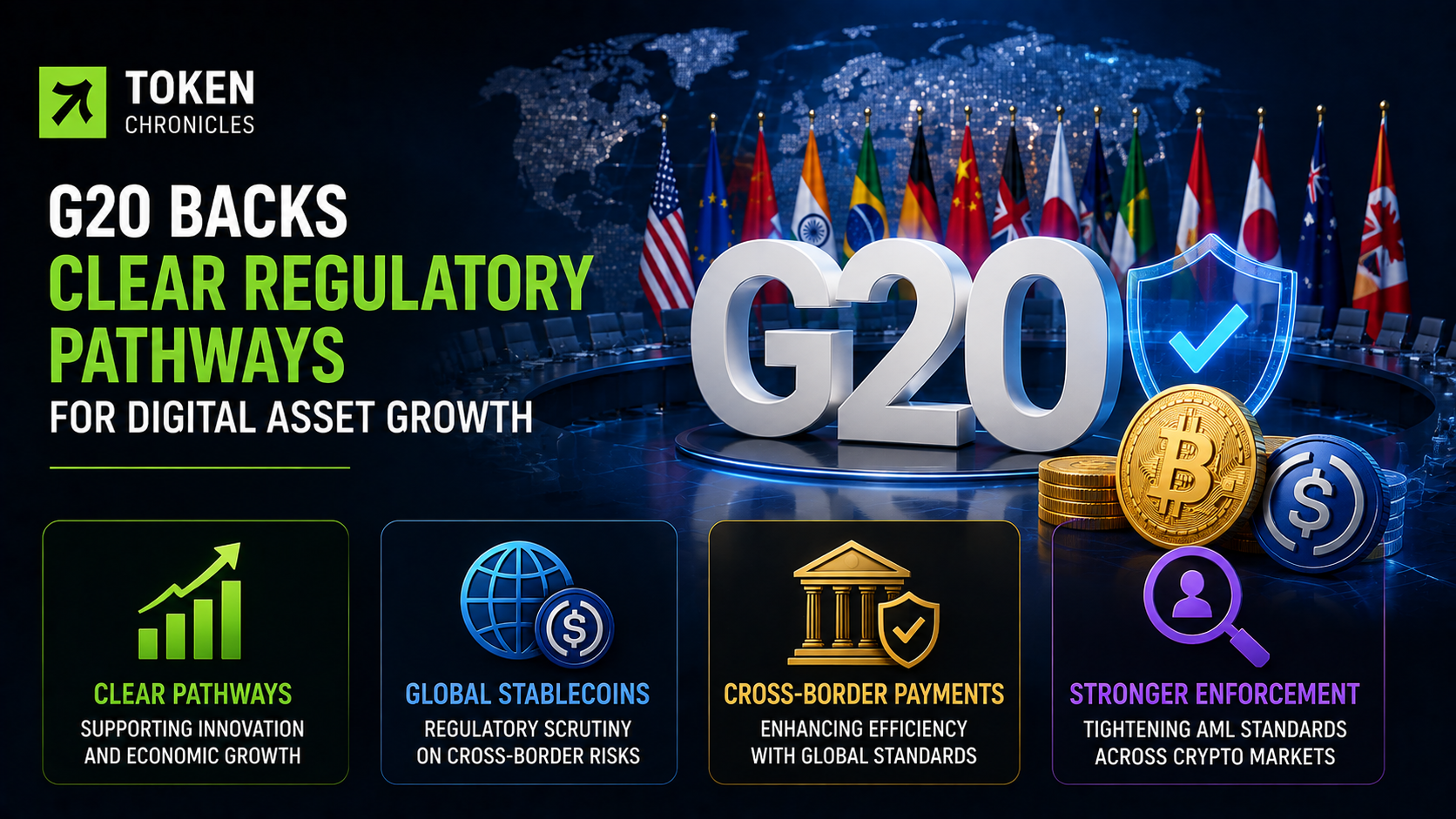
G20 finance ministers and central bank governors are signaling stronger support for clearer rules around digital assets, while emphasizing that innovation must develop alongside financial stability and effective oversight. The group is also turning greater attention toward stablecoins, cross-border payments and enforcement of global crypto compliance standards.
- G20 finance leaders support clear regulatory frameworks for digital asset innovation.
- International regulators are examining the cross-border risks associated with global stablecoins.
- The group is pushing for stronger implementation of anti-money-laundering standards across virtual asset markets.
- Cross-border payment modernization remains a major part of the G20’s financial agenda.
Digital Assets Gain a Larger Role in G20 Financial Policy
Finance ministers and central bank governors from the G20 backed a more structured approach to digital asset regulation during their Aug. 31–Sept. 1 meeting in Asheville, North Carolina.
The G20’s latest statement recognizes that digital financial technologies could contribute to economic expansion and give private-sector businesses new opportunities to develop financial products and services.
Rather than calling for a single global crypto rulebook, the group is encouraging jurisdictions to establish clear and effective regulatory pathways while taking account of risks that extend across national borders.
This represents a broader evolution in the G20’s approach to cryptocurrencies, stablecoins and decentralized finance. Earlier discussions focused heavily on financial stability and illicit finance. The latest position places greater emphasis on the potential economic benefits of responsible digital financial innovation.
Clearer regulation could also reduce differences between jurisdictions, potentially lowering compliance uncertainty for companies operating internationally.
At the same time, international regulators remain concerned that inconsistent rules could encourage businesses to move activities toward jurisdictions with weaker requirements.
Stablecoins Become a Key International Focus
Stablecoins are emerging as one of the most important areas of discussion because their applications increasingly extend beyond cryptocurrency trading.
These digital assets are generally designed to maintain a relatively stable value by referencing another asset, most commonly the U.S. dollar.
Their growing use in payments, trading and settlement has prompted regulators to examine what happens when stablecoins operate across multiple countries.
The G20 expects additional analysis from the Financial Stability Board (FSB) covering the international implications of global stablecoin arrangements. The work is also expected to examine available data and identify areas where regulators may lack sufficient information.
The challenge is becoming more significant as the stablecoin market expands. Different national approaches could potentially create regulatory gaps, complicate supervision and make it harder for authorities to assess risks across borders.
The G20 has therefore stopped short of demanding identical regulations but is encouraging greater international coordination.
Cross-Border Payments Remain a Major Priority
Digital asset regulation is being considered alongside the G20’s broader efforts to improve international payments.
The group reaffirmed its commitment to the G20 Roadmap for Enhancing Cross-border Payments, which seeks to make international transactions faster, cheaper and more efficient.
Officials also encouraged jurisdictions to:
- Extend operating hours for large-value payment systems.
- Promote the use of the ISO 20022 financial messaging standard.
- Improve cross-border movement of financial-services data.
- Maintain appropriate safeguards for privacy, security and domestic legal requirements.
Stablecoins could potentially intersect with these objectives by providing blockchain-based settlement mechanisms for international transactions.
However, greater use of digital currencies in cross-border payments also raises questions about regulation, reserves, monetary policy and financial stability.
FATF Standards Put Pressure on Crypto Businesses
The G20’s pro-innovation stance is being paired with stronger expectations around financial-crime controls.
Officials urged jurisdictions with significant virtual asset activity to improve implementation of standards established by the Financial Action Task Force (FATF).
The FATF’s latest assessment found substantial differences in how countries have implemented its requirements for virtual assets and service providers. Many jurisdictions remain only partially compliant, while others have yet to meet the expected standards.
The G20 wants countries with significant crypto markets to prioritize effective implementation of measures covering areas such as:
- Anti-money laundering
- Terrorist financing
- Virtual asset service-provider supervision
- Licensing and registration
- The FATF Travel Rule
- International regulatory cooperation
The group also highlighted emerging threats involving fraud networks, scam operations and criminals using artificial intelligence to improve financial crime.
Regulators Face a Balancing Act
The G20’s latest position reflects a difficult policy balance.
On one side, governments increasingly recognize that blockchain technology and digital assets could improve financial infrastructure, create new markets and make certain forms of settlement more efficient.
On the other, rapidly evolving financial technologies can create new channels for fraud, money laundering, regulatory arbitrage and financial instability.
The G20 is therefore advocating an approach in which innovation receives clearer regulatory pathways rather than unrestricted freedom.
This could eventually provide businesses with greater certainty while giving regulators stronger tools to manage emerging risks.
What the G20 Position Means for Crypto
The latest statement does not introduce a universal cryptocurrency framework, nor does it require every G20 member to adopt identical rules.
Instead, it establishes a common policy direction: digital assets can support economic growth, but their expansion should occur within credible regulatory and supervisory systems.
Stablecoins are likely to remain at the center of that discussion because they increasingly connect the crypto sector with traditional payments and financial markets.
Meanwhile, stronger FATF implementation means crypto companies operating internationally are likely to face increasing expectations around customer identification, transaction monitoring and financial-crime prevention.
The G20’s message is becoming increasingly clear: digital assets are moving deeper into mainstream financial policy. The next phase will focus on creating rules that encourage legitimate innovation while limiting cross-border risks, strengthening financial stability and preventing digital assets from becoming a weak point in the global financial system.