
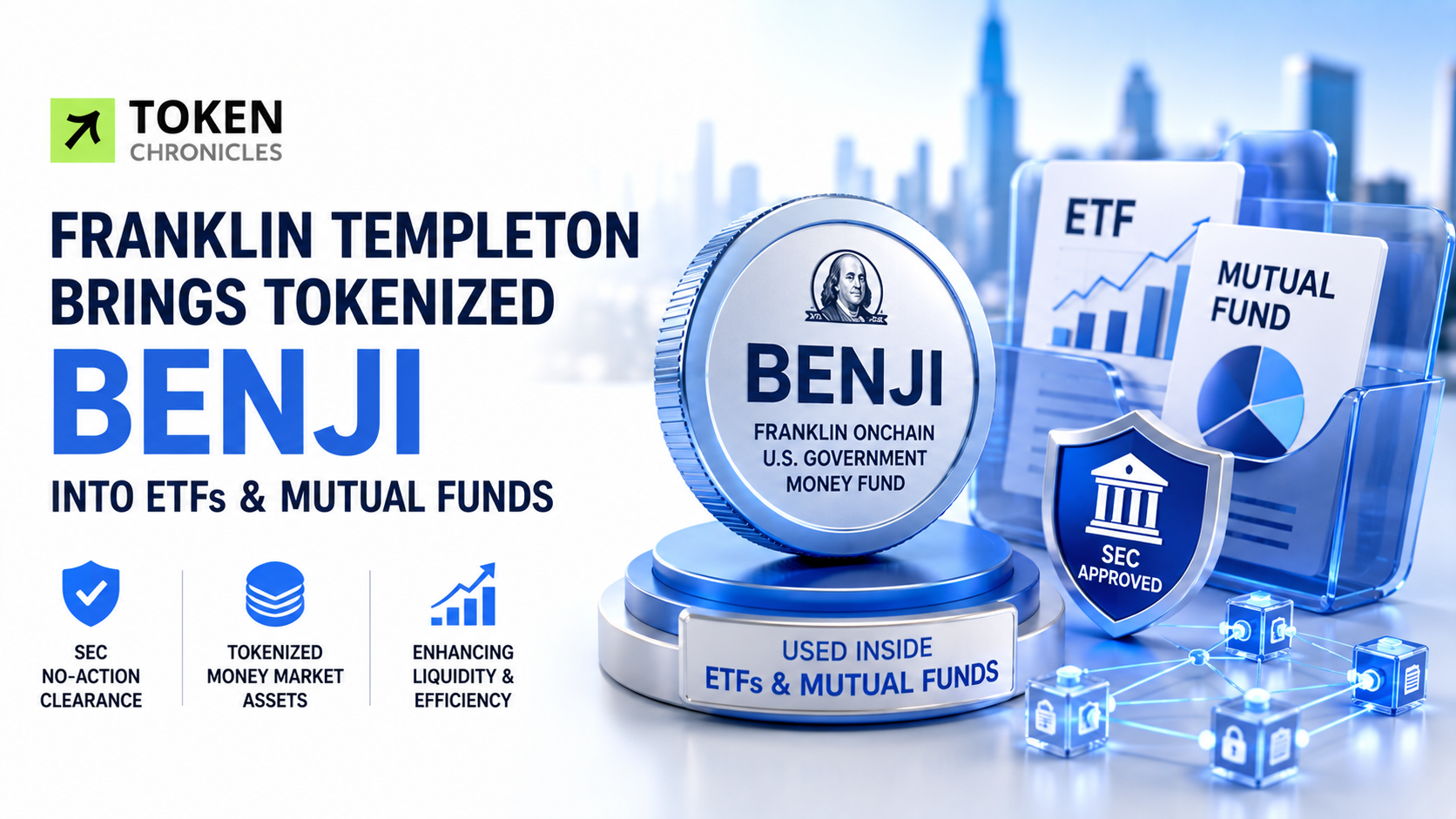
Franklin Templeton is taking another step toward mainstreaming blockchain-based assets by preparing to use its tokenized BENJI money-market fund within conventional ETFs and mutual funds. The initiative follows a new SEC no-action position that could allow tokenized assets to serve as portfolio holdings or collateral in traditional investment products.
SEC Clears Path for Tokenized Assets in Conventional Funds
Franklin Templeton plans to incorporate its Franklin OnChain U.S. Government Money Fund, commonly known as BENJI, into traditional investment vehicles.
According to reports, BENJI tokens could be used as investments or collateral within ETFs and mutual funds, with the first implementations potentially arriving as early as the fourth quarter. Individual fund boards would still need to approve the arrangements.
The SEC issued a no-action position supporting the proposed structure. The regulatory decision gives Franklin greater flexibility to use its blockchain-based money-market product for functions such as cash management and collateral.
The development represents a notable step in the integration of tokenized financial assets with conventional investment infrastructure.
Tokenization Moves Beyond Digital-Only Products
Franklin Templeton has already offered tokenized versions of investment products through blockchain-based wallets. Its latest strategy takes the concept further by placing those digital assets inside traditional portfolios.
Rather than requiring investors to purchase a tokenized fund directly, conventional funds could potentially use BENJI behind the scenes for liquidity management, collateral or other portfolio functions.
This could allow asset managers to gain some of the operational advantages associated with blockchain technology without fundamentally changing how investors access their funds.
Franklin Templeton manages more than 130 ETFs globally, representing approximately $82 billion in assets, while its mutual-fund business oversees roughly $790 billion. Its tokenized money-market products have accumulated approximately $2.6 billion in assets.
Tokenized Real-World Assets Gain Momentum
Franklin’s move comes as the broader tokenization market continues to expand.
Tokenized real-world assets now represent tens of billions of dollars in onchain value, with major financial institutions increasingly exploring blockchain-based funds, securities and settlement infrastructure.
The potential advantages include faster settlement, 24/7 transferability and more efficient collateral management.
But Franklin’s strategy introduces a different use case. Instead of making tokenization the product investors actively seek, blockchain-based assets could become an underlying component of traditional financial products.
Blockchain Could Become Invisible Infrastructure
Franklin Templeton is also exploring additional tokenized products that could eventually function as cash-management or collateral instruments across a wider range of funds.
That could signal a broader evolution in institutional tokenization.
The first phase of the industry largely focused on putting existing financial assets onchain. The next phase could involve using tokenized assets as part of the infrastructure that powers traditional finance.
In that model, investors may never need to interact directly with blockchain technology. Instead, they could benefit from its settlement, liquidity and collateral capabilities through familiar ETFs and mutual funds.
The bigger shift is that tokenization is moving from being a new investment wrapper to becoming part of the underlying machinery of asset management.