
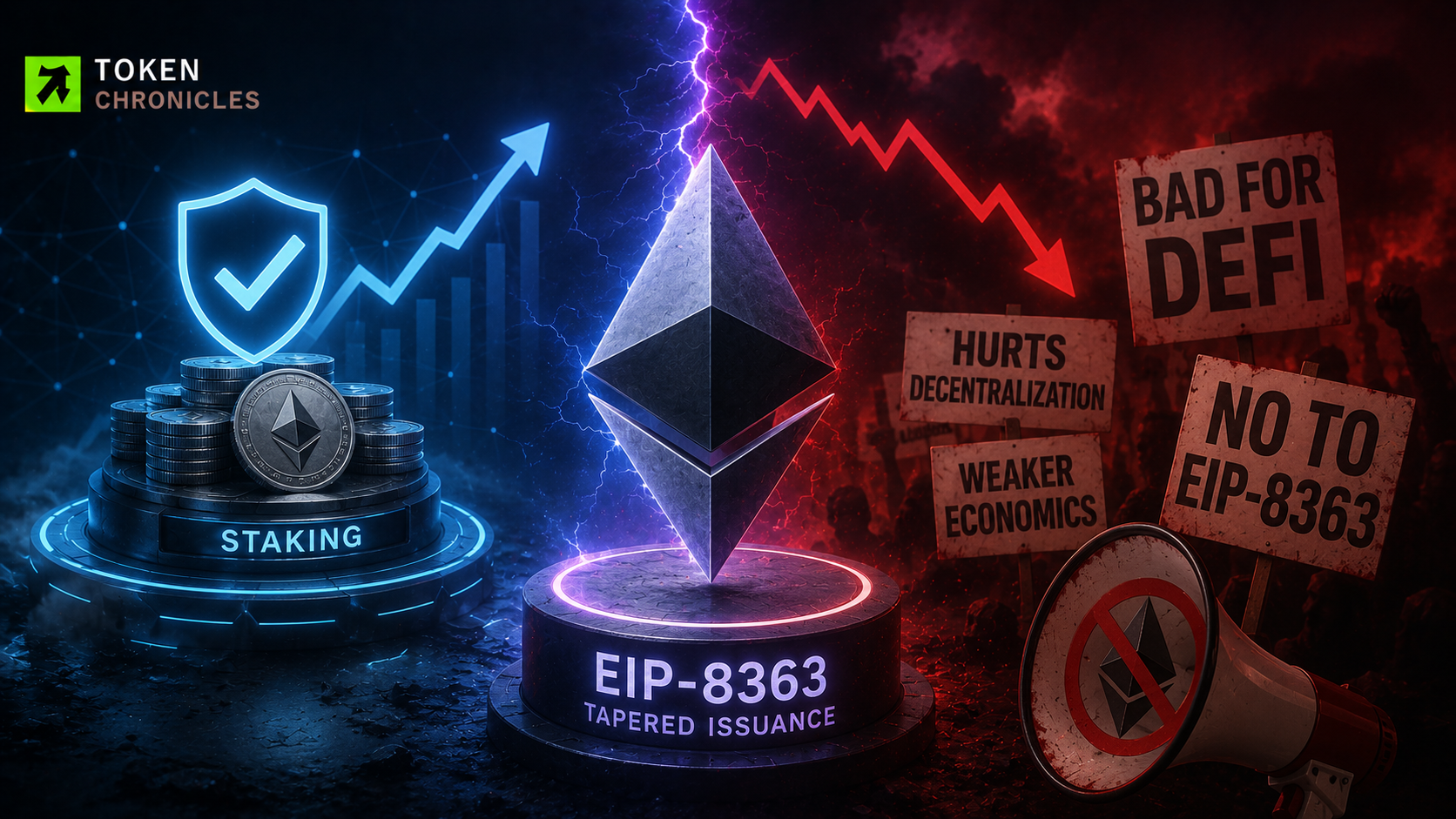
Ethereum’s latest monetary policy proposal, EIP-8363, has triggered one of the most heated debates within the Ethereum ecosystem since the network transitioned to Proof-of-Stake through The Merge. While supporters argue the proposal would strengthen Ethereum’s long-term economics by reducing unnecessary token issuance, critics warn it could weaken decentralization, disrupt decentralized finance (DeFi), and undermine institutional confidence in the network.
The proposal, officially titled “Tapered Issuance Burn,” seeks to gradually reduce staking rewards as more ETH becomes staked, eventually eliminating new staking issuance altogether once approximately 50% of Ethereum’s total supply is locked in staking. What was intended as an optimization of Ethereum’s security model has instead sparked widespread opposition from developers, staking providers, DeFi protocols, and institutional market participants.
What Is EIP-8363?
EIP-8363 proposes a fundamental change to Ethereum’s staking reward mechanism.
Under the current Proof-of-Stake model, validators receive newly issued ETH for securing the network. As more ETH is staked, individual validator yields naturally decline, but the protocol continues issuing rewards.
The authors of EIP-8363 argue that Ethereum has now reached a point where additional staking contributes progressively smaller improvements to network security while continuing to dilute holders who choose not to stake.
Their proposal introduces a tapered issuance curve, gradually reducing validator rewards as staking participation increases. Once roughly half of Ethereum’s circulating supply is staked, new protocol issuance for validators would effectively fall to zero.
Rather than continuously paying for increasing security, the proposal argues Ethereum should only issue enough ETH to maintain the level of security the network actually requires.
Proposal Backed by Prominent Ethereum Researchers
The proposal is supported by several respected members of the Ethereum research community, including Ethereum Foundation researcher Justin Drake and Ethereum Community Conference (ETHCC) co-founder Jérôme de Tychey.
Supporters believe Ethereum currently overpays for security.
Their argument is based on diminishing returns: while early increases in staking dramatically improve network security, each additional percentage of staked ETH provides progressively smaller security benefits.
From this perspective, continuing to issue large amounts of ETH rewards represents unnecessary monetary inflation.
The proposal therefore seeks to improve Ether’s long-term monetary characteristics while maintaining adequate validator participation.
Critics Say Ethereum Is Solving the Wrong Problem
Despite its economic rationale, EIP-8363 has generated fierce criticism throughout the Ethereum ecosystem.
Many developers argue there is little evidence that Ethereum currently suffers from excessive staking participation.
At present, approximately 41.5 million ETH, representing just over 34% of Ethereum’s total supply, is actively staked.
Critics note that validator yields have already declined naturally to around 2.7% annually, reducing the incentive for significantly more ETH to enter staking.
According to several analysts, market forces are already slowing staking growth without requiring changes to Ethereum’s monetary policy.
Rather than introducing a complex new issuance mechanism, opponents argue the existing economic model is functioning as intended.
Concerns Over Institutional Adoption
One of the strongest objections comes from institutional investors and asset managers entering Ethereum staking.
Institutional participants generally value predictability above marginal improvements in token economics.
Changing Ethereum’s issuance model introduces uncertainty around future staking yields, something many institutions carefully consider before allocating capital.
Industry participants argue that frequent adjustments to monetary policy could create the perception that Ethereum’s economic framework remains subject to ongoing governance experimentation.
For institutions managing billions of dollars, predictable long-term returns are often more important than slightly lower inflation.
Critics therefore warn that EIP-8363 may unintentionally discourage future institutional participation.
Impact on DeFi Could Be Significant
Beyond staking itself, many developers warn the proposal could ripple throughout Ethereum’s broader decentralized finance ecosystem.
Today, liquid staking tokens such as stETH and similar assets serve as foundational collateral across lending protocols, decentralized exchanges, derivatives platforms, and yield-generating applications.
Reducing staking rewards would lower the yield generated by these assets.
That could reduce their attractiveness as collateral and potentially decrease liquidity throughout Ethereum’s DeFi ecosystem.
Founders from major DeFi projects have argued that a large portion of Ethereum’s decentralized financial infrastructure has evolved around staking-generated yields.
Significantly lowering those yields could therefore impact lending activity, liquidity provisioning, and capital efficiency across numerous protocols.
Smaller Validators May Face Greater Pressure
Another major criticism focuses on decentralization.
While the proposal seeks to prevent excessive concentration among large staking providers, critics argue it may produce the opposite outcome.
Independent validators and solo stakers generally operate with higher relative costs than institutional operators, centralized exchanges, or large staking providers.
If staking rewards decline substantially, smaller participants may find operating validator infrastructure economically unattractive.
Larger organizations, however, often benefit from economies of scale and can continue operating profitably even under lower reward conditions.
Critics therefore warn that reduced issuance could unintentionally increase validator concentration among large institutions rather than encouraging decentralization.
Ethereum’s Monetary Credibility Under Debate
The controversy extends beyond staking rewards.
Many community members believe the proposal raises broader questions about Ethereum’s monetary policy.
One of Ethereum’s long-term goals has been establishing Ether as a credible digital monetary asset.
Frequent adjustments to issuance mechanisms may create uncertainty regarding future supply dynamics.
Some community members argue that monetary policy should remain as stable and predictable as possible to build long-term market confidence.
Changing issuance curves whenever new economic theories emerge risks undermining that objective.
Supporters disagree, arguing that improving monetary efficiency strengthens Ether’s long-term value proposition.
The disagreement highlights a growing philosophical divide within Ethereum regarding how actively the protocol’s economics should evolve.
Questions Over Governance Process
Beyond the technical debate, several ecosystem participants criticized the timing of the proposal itself.
EIP-8363 was introduced only days before the submission deadline for proposals being considered for Ethereum’s next major network upgrade.
Given the proposal’s potential impact on staking, DeFi, and institutional adoption, critics argue that the community deserves a significantly longer review period before considering such a fundamental economic change.
Many developers believe decisions affecting Ethereum’s monetary policy should undergo extensive public discussion and economic modeling before progressing toward implementation.
A Debate That Extends Beyond Staking
The intense reaction to EIP-8363 illustrates how much Ethereum has evolved since transitioning to Proof-of-Stake.
Changes that once primarily affected validators now influence an interconnected ecosystem worth hundreds of billions of dollars.
Every adjustment to staking rewards impacts not only network security but also DeFi protocols, institutional investment strategies, liquid staking products, lending markets, and Ether’s monetary identity.
As a result, proposals affecting Ethereum’s economic design now generate debate far beyond technical implementation.
The Future of EIP-8363 Remains Uncertain
At present, EIP-8363 remains only a proposal and has not been approved for inclusion in a future Ethereum upgrade.
Given the scale of community opposition, significant revisions—or even complete abandonment of the proposal—remain possible.
Regardless of its ultimate outcome, the debate surrounding EIP-8363 has highlighted one increasingly important reality: as Ethereum continues maturing into global financial infrastructure, even relatively small adjustments to its economic model can have far-reaching consequences across staking, decentralized finance, institutional markets, and the broader digital asset ecosystem.