
Ethereum developers are narrowing down 66 proposals for Hegotá, the network’s next major upgrade, with several of the leading candidates focused on strengthening privacy and censorship resistance at the protocol level.
The upgrade is expected to play an important role in shaping Ethereum’s development roadmap for 2027. Proposals that fail to make the final list could be reconsidered in future upgrades.
Privacy Emerges as a Key Focus
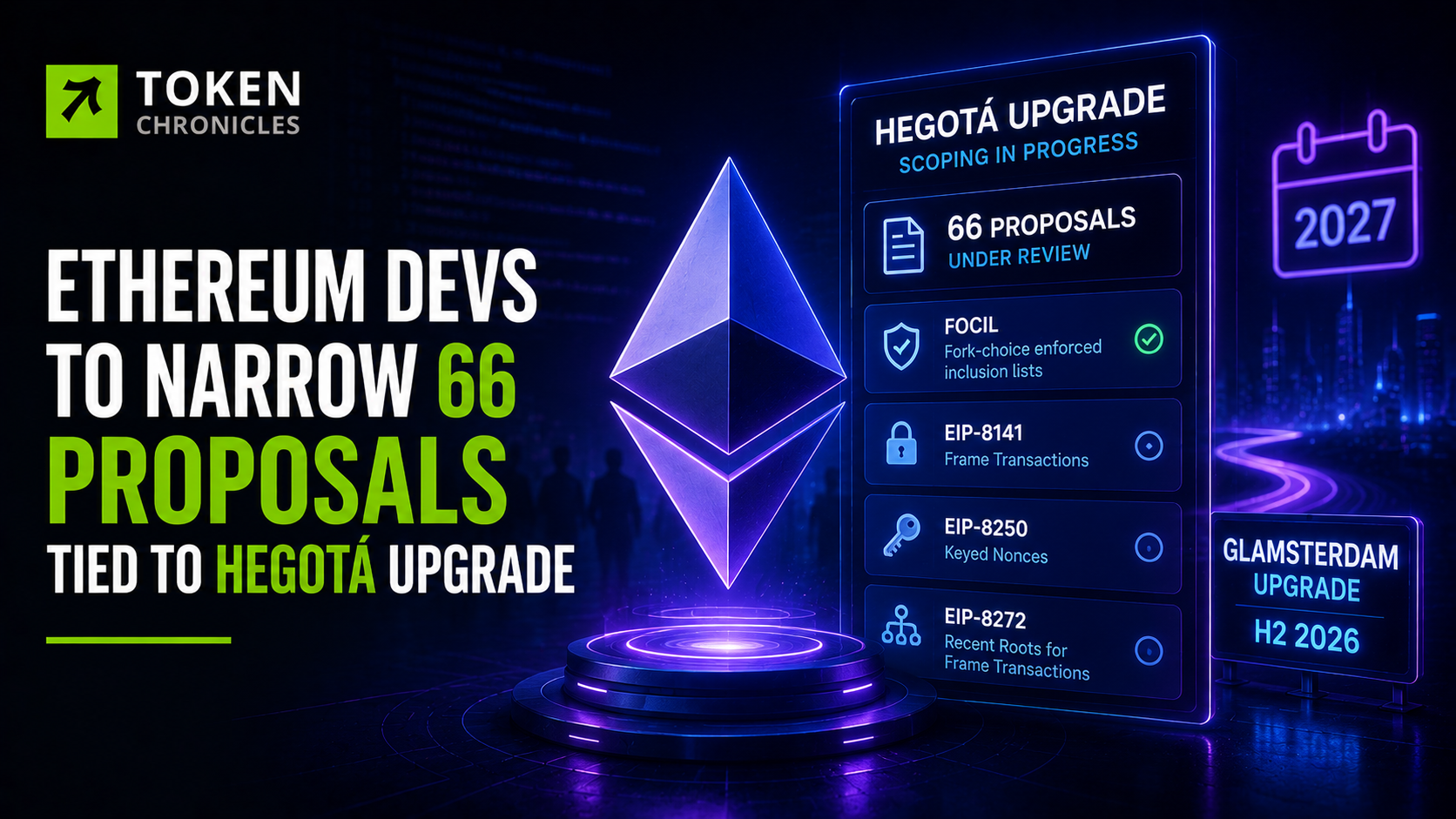
At present, FOCIL (Fork-choice enforced inclusion lists) is the only Ethereum Improvement Proposal formally scheduled for Hegotá.
However, Ethereum Foundation contributor Toni Wahrstätter highlighted three additional proposals that could significantly expand the protocol’s privacy capabilities:
- Frame Transactions (EIP-8141)
- Keyed Nonces (EIP-8250)
- Recent Roots for Frame Transactions (EIP-8272)
According to Wahrstätter, combining these proposals with FOCIL could create the protocol-level foundations needed for native privacy applications without requiring users to depend on intermediaries.
FOCIL itself is designed to strengthen Ethereum’s resistance to transaction censorship. Under the proposal, a committee of validators could require certain pending transactions to be included in blocks, reducing the ability of individual block producers to selectively exclude transactions.
The other proposals focus more directly on introducing primitives that privacy applications could use at the protocol layer.
Developers Face a Crowded Proposal List
With 66 proposals currently under consideration, Ethereum’s core developers must decide which changes provide the greatest strategic value without making the upgrade excessively complicated.
The upcoming developer calls will therefore be important for determining the final scope of Hegotá.
Proposals that are excluded are not necessarily being abandoned. Ethereum’s upgrade process allows developers to move features into later upgrade cycles if they require additional research, testing or development.
The goal is to balance innovation with the reliability required from Ethereum’s base layer.
Hegotá Could Shape Ethereum’s 2027 Roadmap
Ethereum developers are targeting 2027 for the Hegotá upgrade, making the current scoping process an important part of the network’s longer-term development strategy.
Privacy could become an increasingly important component of that strategy as Ethereum seeks to support applications that require greater transaction confidentiality while maintaining the transparency and security characteristics of a public blockchain.
If the proposed privacy-related EIPs advance together, Hegotá could represent a significant shift toward making privacy functionality available directly through Ethereum’s core infrastructure rather than leaving developers to rely primarily on external protocols and intermediaries.
Glamsterdam Comes First
Before Hegotá, Ethereum developers still have another major upgrade to deliver: Glamsterdam.
Glamsterdam is expected to focus heavily on scalability, strengthening Ethereum’s layer-1 infrastructure and improving the network’s usability. According to Ethereum’s public roadmap, the upgrade is targeted for the second half of 2026.
That means developers are effectively working on two overlapping development horizons: finalizing Glamsterdam while simultaneously determining which features should define Ethereum’s next major upgrade.
The next core developer call is scheduled for Monday at 2:00 p.m. UTC, where discussions around Hegotá’s proposal set are expected to continue.
Ultimately, the Hegotá process will determine which of the 66 proposals become part of Ethereum’s next major evolution and which are pushed further down the roadmap.