

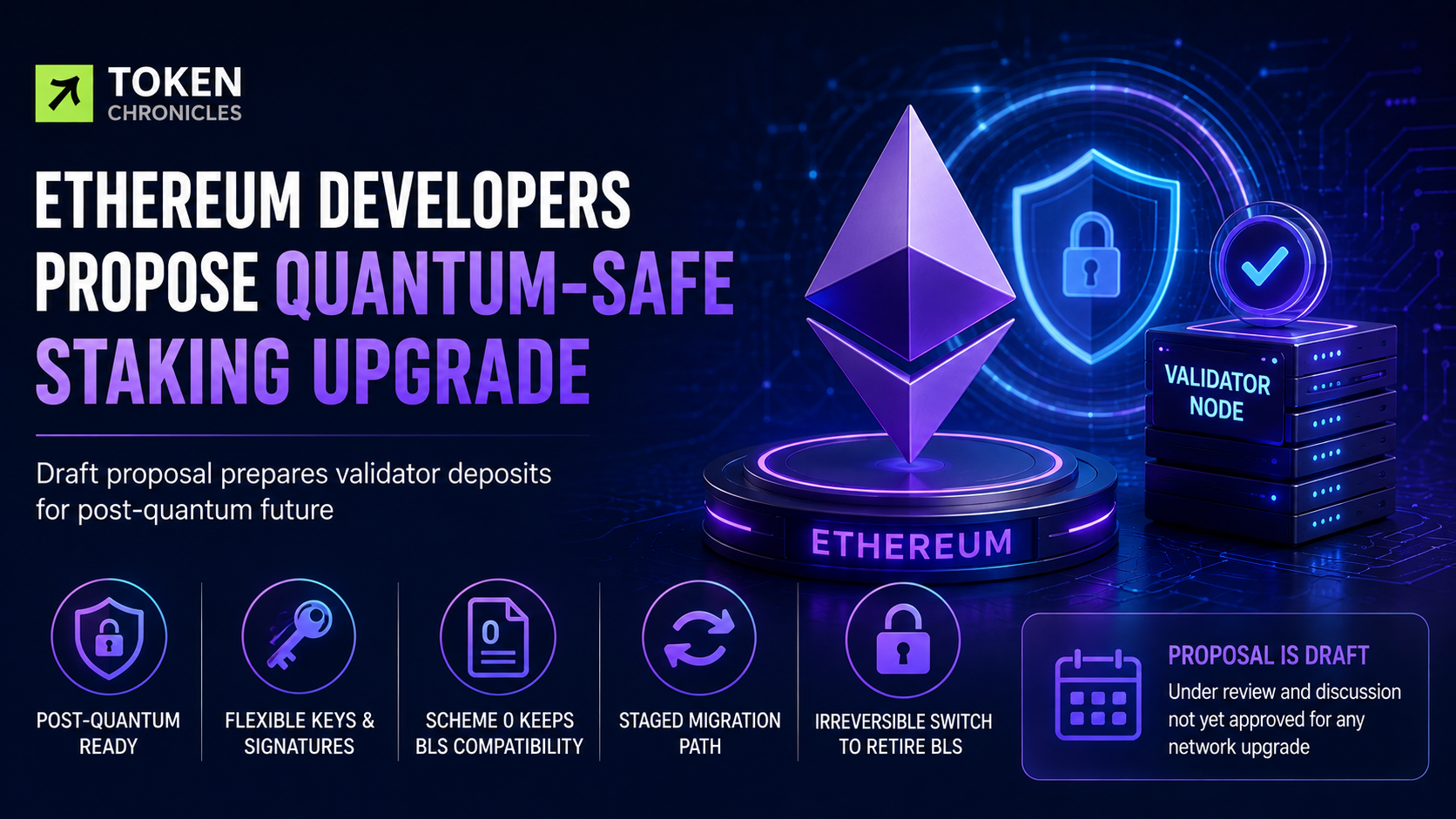
Ethereum developers are exploring a long-term defense against the potential threat posed by quantum computing, with researchers proposing a new validator deposit contract designed to support future cryptographic signature systems.
A draft proposal submitted on Aug. 24 would allow Ethereum to gradually move beyond its existing BLS signature framework without committing to a specific post-quantum algorithm yet.
Key points
- The proposed contract supports variable-length public keys, signatures and validator metadata.
- The existing BLS system would remain available initially under Scheme 0.
- Future scheme identifiers could support post-quantum cryptography or other signature technologies.
- Developers could eventually activate an irreversible mechanism preventing new BLS deposits.
- The proposal remains under discussion and has not been approved for a network upgrade.
New Deposit Design Could Support Multiple Signature Systems
Ethereum validators currently rely on BLS public keys and signatures with standardized formats. The proposed architecture would make the deposit contract more flexible by allowing different key and signature lengths.
Each validator deposit would include a scheme identifier specifying the cryptographic system being used. Scheme 0 would preserve compatibility with Ethereum’s existing BLS infrastructure, while future identifiers could be assigned to alternative cryptographic methods.
Importantly, the proposal does not select a particular post-quantum algorithm. Making the deposit contract flexible is intended to give Ethereum room to adopt a suitable quantum-resistant system later.
The contract itself would therefore not make Ethereum quantum-safe. Additional changes would be required across the consensus layer to verify, aggregate and process signatures generated under new cryptographic schemes.
Deposit Requests Would Connect Ethereum’s Execution and Consensus Layers
The proposal also builds on Ethereum’s newer request-based architecture for transferring validator-related information between the execution and consensus layers.
The design would use EIP-7685, a framework created to standardize these cross-layer requests. Existing Ethereum improvements already use the architecture for validator deposits, withdrawals and consolidations.
Under the proposed system, deposits containing flexible cryptographic information could be transmitted to the consensus layer without forcing every future signature scheme into the same fixed data structure.
That could give Ethereum greater flexibility as cryptographic requirements evolve.
BLS Could Eventually Be Phased Out
The proposal outlines a gradual migration rather than an immediate replacement of BLS.
Initially, validators could continue depositing with the existing Scheme 0 format while developers introduce and test alternative signature systems. At a later stage, Ethereum could activate a permanent switch that prevents new BLS deposits.
The proposed switch would be irreversible once activated.
Existing BLS validators would not automatically disappear, however. Separate protocol mechanisms would still be necessary to manage existing validators, withdrawals, exits, credential changes and eventual migration to a quantum-resistant system.
Developers are also considering how the proposal would interact with other validator-related improvements, including EIP-7002, EIP-7251 and EIP-8282.
Quantum Resistance Is Becoming a Long-Term Ethereum Priority
The deposit proposal is part of a much broader effort to prepare Ethereum for advances in quantum computing.
A sufficiently powerful quantum computer could eventually threaten cryptographic systems widely used across blockchain networks. Ethereum’s long-term preparations therefore extend beyond validator signatures to areas such as account authentication, data commitments and zero-knowledge cryptography.
Replacing BLS would be only one component of that broader transition.
Proposal Still Requires Extensive Review
The proposal remains a draft and has not been merged into Ethereum’s official specification. It still requires technical review, community discussion, security analysis, implementation work and testing.
An editor has suggested a potential EIP number and requested a separate discussion among Ethereum researchers and developers, but the proposal had not yet reached final publication status.
Even if it becomes an official draft EIP, that would not mean Ethereum has approved its implementation.
For the upgrade to reach mainnet, developers would ultimately need to incorporate it into a future hard fork after client development and testing.
No specific hard fork, testnet deployment or mainnet activation date has been announced.
The proposed deposit contract is therefore best viewed as an architectural step toward Ethereum’s eventual post-quantum transition—not an immediate change to the network or confirmation that Ethereum has already become quantum-resistant.